






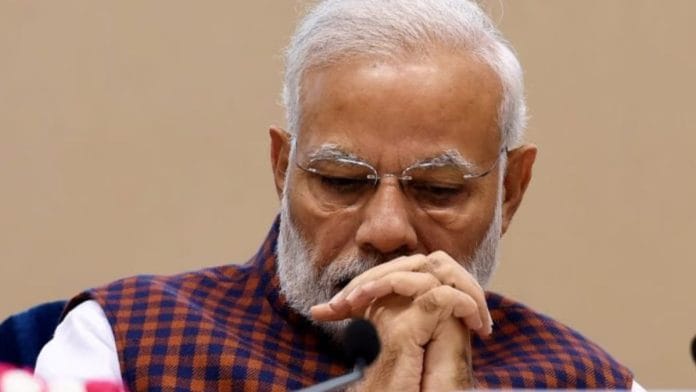


Under fire from the Supreme Court over NEET-UG paper leak, the government told the apex court last week that Prime Minister Narendra Modi was “personally supervising” this issue.
This formulation is problematic on three counts, even as the prime minister maintains a studied silence on this issue.
First, it’s a rather predictable attempt to use PM Modi’s popularity and goodwill to counter what’s widely seen as a gross systemic failure. He may be coated with Titanium, but in politics, even super metals can corrode. There was a time when former Prime Minister Manmohan Singh was called Teflon-coated, given his untainted personal integrity amid a flurry of scams in his government. But that personal image couldn’t make up for his government’s failures in the 2014 general elections. Three years later, his successor was taking a jibe at him in the Rajya Sabha:
“Dr. Sahab is the only person who knows the art of bathing with a raincoat on,” Modi said.
There is no comparison between the two, of course. The point here is that the UPA government’s failures ended up eroding Singh’s Teflon coating. Using PM Modi’s name to counter the public backlash over irregularities and lapses in examinations is, therefore, a desperate and risky strategy. Senior Congress leader and chairman of the parliamentary committee on education, Digvijaya Singh, said on Saturday that the Opposition was demanding education minister Dharmendra Pradhan’s resignation until now.
“If the paper is leaked under the PM’s watch, we will have to ask for the PM’s resignation,” he said.
The second problem with the government’s message on the NEET paper leak is that it would end up lending credence to the Opposition’s contention about Pradhan’s competence. Does PM Modi not trust his education minister to fix the problem? Given that Pradhan has been a part of the Modi Cabinet since May 2014, holding important portfolios, a sudden lack of confidence in his abilities comes as a surprise.
That leads to the third problem. PM Modi is not known to give in to the Opposition and throw any of his Cabinet colleagues under the bus. If he has to personally supervise what his minister is entrusted to do, it makes the latter’s place in the Cabinet untenable. And if the prime minister starts holding his ministers accountable for their supervisory neglect and failures, where will the buck stop? There is a long list of such lapses—from train accidents killing hundreds of people to the economic mess, the Manipur crisis, you name it.
To add just one more, if the JP Nadda-led health ministry hadn’t opposed the computer-based format for NEET-UG, the paper leak would probably not have happened. PM Modi would find it difficult to single out a hardcore loyalist such as Pradhan when many of his colleagues went scot-free for graver lapses.
Lessons from 2011
How PM Modi, who completed 12 years in office on 26 May, goes from here would be keenly watched. Because it could give an inkling of his plans for 2029 and beyond. Unlike many Opposition leaders, the BJP leadership understands the message from the 2024 Lok Sabha elections that brought the party’s tally down to 240. They also know that the subsequent successes in the Assembly elections were not about Brand Modi’s resurgence. They were about home minister Amit Shah’s electoral strategy and management—and rival parties’ failings.
There is no evidence to suggest that the Modi government has gotten more popular since the last parliamentary elections. The instant virality of the Cockroach Janata Party (CJP) on social media is just one pointer. The Gen Z may not be enamoured of any Opposition leader today, but their love for PM Modi seems to be waning as official employment figures fail to match their lived realities. The headwinds confronting the economy don’t seem to be drifting away any time soon. A weak monsoon forecast is another big dampener. As it is, defence or foreign affairs is no longer very exciting politically—not enough to override people’s day-to-day concerns in the foreseeable future, at least.
PM Modi has two options today. He can continue to rely on the Congress and other Opposition parties to keep giving walkovers to the BJP. He remains the most popular leader. He has an election wizard in Shah who has turned the BJP into a juggernaut. The Rashtriya Swayamsevak Sangh’s huge grassroots network and unceasing supply chain of ideologically committed cadre can ensure a head start in any election.
PM Modi can bank on his luck, too. The Indian economy had been decelerating for eight quarters—from March 2018 to March 2020—before the pandemic, but the coronavirus took the blame. Similarly, the Indian economy was staring at a crisis long before the Middle East conflict began. The US, Israel, and Iran must take the blame now.
All these factors combined can be quite heady and make any leader complacent. Can you blame PM Modi if he decides to let it be? At 75, why try new things and disturb the status quo? He can wait and see how things unfold by 2029.
It’s a risky option, though. What may look like a manageable drift in governance can often lead to precipitous falls in politics. Remember what happened in 2011. Barely two years after the Manmohan Singh government got a renewed mandate, there was an economic slowdown with a decelerating growth rate, a decline in private investment, capital flight, stagnant exports, and a falling rupee. Policy paralysis suddenly became a buzzword. Does it ring a bell? Listen to what the economists are saying today.
It was also in 2011 that Anna Hazare’s anti-corruption movement caught the fancy of millions, especially the youth. One wonders if Abhijit Dipke of the CJP is studying that 2011 movement as he plans to return to India later this week.
The point is, the Manmohan Singh government couldn’t recover after 2011.
Also read: The Modi paradox in 2026. Complete political domination alongside worsening economic slide
Cut the deadwood
The references to 2011 are certainly not intended to suggest any parallel today. All I am driving at is that governance drift can be precipitous if not arrested immediately. PM Modi is, of course, not PM Singh. Nor is the BJP the Congress. That’s why one may expect Modi to go for the second option—unleash a new wave of reforms, instead of looking for excuses in foreign factors. And fix accountability in governance, which is certainly not the same thing as personal supervision.
Cut the deadwood. How can PM Modi entrust the crucial micro, small, and medium enterprises (MSME) ministry to 81-year-old Jitan Ram Majhi, whose only claim to fame is the public appeal to his party colleagues to take commissions in constituency development funds? Check how many days HD Kumaraswamy, the minister of heavy industries and steel, spends in Delhi and how many hours in his office. And what does it tell us about priorities when the crucial ministries of power and housing and urban affairs are entrusted to Manohar Lal Khattar, who had to be removed as Haryana chief minister due to non-performance? Not to mention Giriraj Singh, who is helming the crucial textiles ministry. There are many other gems in the Cabinet. Unless PM Modi intends to personally supervise them, too, he needs to let them go—that is, if he is looking beyond 2029.
DK Singh is Political Editor at ThePrint. He tweets @dksingh73. Views are personal.
(Edited by Prasanna Bachchhav)
Dr. Manmohan Singh is known to have bathed in raincoat, but the current PM is( during Kumbh).
Only option for PM is to fire the entire cabinet (most of them proven incompetent) and get new young faces. Remove government controls and regulations and carry out reforms. Remove neet and let MBBS/MD be handled by states on 12th grade marks. Fire FM Jaishankar as well. Get some critics as advisors instead of yes men. Start dismantling IAS/IPS and use state employees at center (have them pass exams and trainings for selection post 5 years in state service).
Jitan Ram Manji. Giriraj Singh. They may be occupying Type VIII bungalows, doubt if they are running the government. The famed core team of mandarins should be delivering better results.