





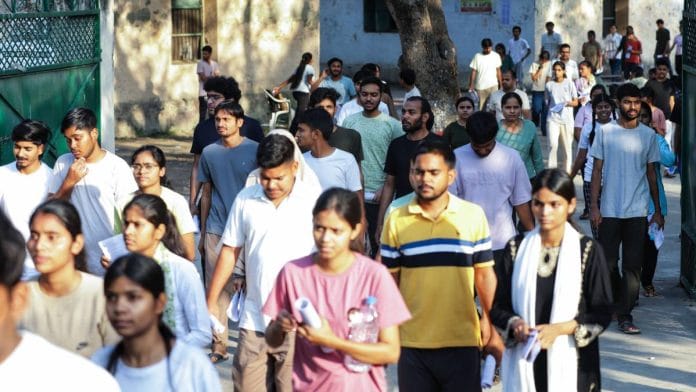


New Delhi: NEET-UG will shift to a computer-based test (CBT) format from the next examination cycle, the National Testing Agency (NTA) told the Supreme Court at a hearing, where the government also said Prime Minister Narendra Modi was “personally supervising” the paper leak issue.
NEET, the annual medical entrance exam, is the only major NTA exam still conducted on paper.
NTA said in an affidavit Friday it will also roll out varied answer keys, background checks of officials involved in the agency’s processes and the use of AI tools to translate the question papers into different languages.
The measures assume significance as the suspects so far arrested in the paper leak investigation include professors and coaching centre tutors who were tasked with setting the questions or translations, or had access to the paper.
NTA’s disclosure came after the top court, hearing a batch of petitions, said on 25 May that the agency had “not learnt its lesson” from the 2024 paper leak. It had directed both the NTA and former Indian Space Research Organisation (ISRO) chief K. Radhakrishnan, who chairs the reform monitoring committee, to explain in writing what had actually been done since then.
NEET-UG 2026 was held on 3 May across 5,432 centres in 552 cities across India and 14 centres abroad in 13 languages. About 22.05 lakh of the 22.79 lakh registered candidates appeared for the exam.
The NTA cancelled the paper on 12 May after enforcement agencies confirmed that the question paper had been circulated on WhatsApp and Telegram groups before the exam day. The candidates are scheduled to sit for the re-test on 21 June.
Appearing before the bench of Justices P.S. Narasimha and Alok Aradhe Friday, Solicitor General Tushar Mehta, representing the Centre, told the court Friday: “The Honourable Prime Minister is personally supervising this.”
In its affidavit, the NTA cited the cancellation and the paper leak investigation being referred to the CBI to illustrate what it called the “seriousness” with which the government viewed exam integrity.
“The cancellation of the NEET (UG) 2026 examination conducted on May 3, 2026, and the reference of the matter to the Central Bureau of Investigation are themselves illustrative of the seriousness with which the NTA and the Government of India view examination integrity. The decision was taken in the interest of students and in recognition of the trust on which the national examination system rests,” it stated.
Accountability & institutional memory
The bench’s core concern Friday was not the mechanics of the breach but the persistence of failure. The court questioned how a fresh leak could occur despite monitoring and implementation of the recommendations of the High-Level Committee of Experts (HLCE).
Following the 2024 leak, the Union education ministry had constituted HLCE, headed by Radhakrishnan, to make recommendations for NTA reforms. HLCE was also tasked with looking into the mechanism of conducting exams, recommending reforms for transparent, smooth and fair exams, and suggesting structural, procedural and technological measures to strengthen NTA.
The bench Friday observed that either the recommendations of the committee themselves were flawed, or that effective monitoring had not taken place.
Radhakrishnan, who appeared in person before the court, said at the hearing that of approximately 60 recommendations made by the committee, most had already been implemented, and few were in process.
NEET-UG 2025, he said, had been conducted satisfactorily except for isolated incidents, including power failures at some centres, and that enhanced coordination with state governments and district administrations had since been introduced.
The bench was not reassured.
The “real problem”, it observed, would persist unless clear accountability was fixed. Without responsibility assigned to individuals, it noted, obligations became “diffused”, making institutional failures difficult to address.
The court also raised the issue of “adhocism” within institutions and stressed the importance of developing institutional memory, continuity of human resources, and permanent expert-driven mechanisms within the NTA.
Strong institutions—not merely individuals—were essential to ensuring credibility and transparency in national examinations, it observed.
On the stakes involved, the bench remarked that examinations like NEET involve emotions, years of hard work, sacrifices and aspirations not only of students but of entire families. It said that such paper leaks were “very traumatic” and that students could not be repeatedly disappointed.
Layers of security & measures ahead
The NTA’s affidavit devoted considerable space to the security architecture deployed for NEET 2026. Paper-setters were held in isolation without internet access or mobile phones, rough work was shredded daily, and encrypted papers were stored on secure systems with regularly updated protocols. Printing was monitored by senior officers, electronic devices were banned at press premises, and CCTV footage was preserved. Papers were transported under Central Armed Police Forces (CAPF) and police escort, and could only be opened 45 minutes before the examination.
For the first time, Aadhaar-based biometric verification was deployed—QR code scans, live photographs, and thumbprint authentication, all linked to UIDAI—with any mismatch triggering alerts and additional verification. Mobile jammers were installed at all 5,432 exam centres and around 1.85 lakh CCTV cameras were used for monitoring the examination, with AI tools scanning footage for malpractice.
For the next cycle of exams, i.e. the next year, NTA said multiple sets of question papers will be prepared, with one retained as a backup. The conventional A, B, C, D series codes will be replaced by special, lengthy codes, and the sequencing of answer options will vary across sets.
Randomisation and rotation policies would be institutionalised for all functionaries in high-stakes examinations, it said, adding: “Background checks/antecedent verification of such functionaries as well as of the officials involved in high stake exams of NTA, shall also be rigorously undertaken.”
On translation, the affidavit added: “AI-based tools shall be used for at least 85% of the translation work in order to minimise human intervention and reduce time involved in the process and consequently lower the probability of any security compromise.”
The shift to CBT, specifically recommended by the HLCE, was delayed due to the Union Ministry of Health and Family Welfare’s preference for the existing format.
“The transition will be implemented from the next examination cycle in consultation with the Ministry of Health and Family Welfare,” the NTA’s affidavit said.
In a separate affidavit, Radhakrishnan said the 101 HLCE recommendations comprised 60 short-term, 35 long-term, and 6 concerning Ministry-level monitoring. “Monitoring and Appraisal at the level of the Ministry of Education is in place,” he wrote.
The former ISRO chief informed the court that the latest High-Powered Steering Committee (HPSC) meeting, held on 17 April, had deliberated on the CBT transition, long-term infrastructure strengthening and achieving a “zero-error, tamper-proof” examination system.
HPSC was another committee formed by the government to ensure that the recommendations given by HLCE are implemented. HPSC is also headed by Radhakrishnan.
Directing the Union government to outline a comprehensive framework for future exams, the bench said: “We direct the Union of India, HRD will be substituted instead of the on Health Ministry to file an affidavit how the conduct of the exam year and after, will be done and, in that process, it will indicate the method in which an institutional memory through continuity of human resource, institutional plurality by composition of experts, etc., is put in place.”
The matter is listed for hearing in the second week of July.
(Edited by Prerna Madan)
Also Read: Re-NEET UG 2026: Modi govt may rope in IAF for logistics, transport of question papers
PM Modi thinks that shifting to a computer based system is the solution! Has he taken feedbacks about EVMs??