






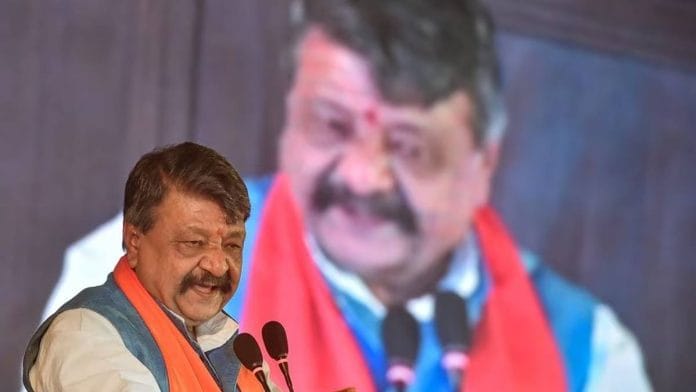


Madhya Pradesh cabinet minister Kailash Vijayvargiya recently triggered a row, virtually mocking government officers for their purported toadyism or servility. Speaking at a memorial event, he shared how officers tell him that they used to go to Rashtriya Swayamsevak Sangh shakhas. Every officer wants to show the “belt tied around his waist” and the “chaddi” or RSS shorts. One of them said that his father was the “adhyaksha” or president of an RSS shakha. “Now what should I tell him? There is no adhyaksha in a shakha.” Vijayvargiya said with a derisive smile and sneer.
The minister’s remarks triggered the Congress, which saw the officers’ purported behaviour as a threat to bureaucratic fairness and neutrality. The very mention of the Sangh had to trigger it, obviously. Vijayvargiya didn’t specify who these officers were—whether from the Indian Administrative Service (IAS) or Indian Police Service (IPS) or some other civil service. He could very well be speaking about government officials in general. It’s, however, a fact that IAS/IPS officers are often the targets of ministers whenever the latter have to send a message—whether to pump up the ego of their supporters or divert the people’s ire with the system against powerful local authorities or simply to convey their anger or anguish to bigger political authorities. Speaking of Madhya Pradesh, IAS and IPS officers being transferred for taking action against the ruling party or ideological affiliates is virtually a norm.
Just a few weeks ago, public works department minister Rakesh Singh called IAS officer and Jabalpur Smart City CEO Arvind Shah over to his residence and reportedly humiliated and threatened him, prompting the IAS association to take the matter to Chief Minister Mohan Yadav.
Himachal Pradesh PWD minister Vikramaditya Singh stoked a controversy, saying that IAS and IPS officers from outside the state disregard Himachali values.
Puducherry Chief Minister N Rangasamy accused IAS officers of coming to the Union Territory “to enjoy themselves”.
Ministers and MLAs in Uttar Pradesh target senior IAS officers almost daily to send a message to Chief Minister Yogi Adityanath.
Listen to these politicians, including Vijayvargiya. You may think that a strong political executive— temporary because it has to get a fresh mandate every five years—has the permanent executive, which is the bureaucracy, at its feet. See how Prime Minister Narendra Modi blasted them in 2021. I mentioned it in a column in January 2023, reminding what the PM said in the Lok Sabha in 2021: “Sab kuchh babu hi karenge. IAS ban gaya toh woh fertiliser ka kaarkhana bhi chalayega. IAS ban gaya toh who chemical ka karkhana bhi chalayega. IAS ho gaya toh hawai jahaaj bhi chalayega. Yeh kaun si badi takat bana kar rakh di humne? Babuon ke haath mein desh de karke hum kya karne waale hain? (Will everything be done by the “babu”? If they became IAS, they will run fertiliser plants, chemical plants, and fly aeroplanes. What sort of a big force have we created? What are we going to do by handing the nation over to the babus?)”
For a Prime Minister who got a renewed mandate with the Bharatiya Janata Party (BJP) winning 303 seats in the Lok Sabha in 2019, his speech seemed to underline how the non-elected executive has gotten the better of the elected political executive during his predecessors’ rule. There was a time when political circles would be abuzz about then-PM Manmohan Singh’s PMO being run by IAS officers loyal to the Gandhi family, including TKA Nair and Pulok Chatterjee. They served as Principal Secretary to the PM then. They were projected as the officers who ran the PMO on behalf of the Gandhi family—something that ran in sync with the public perception about a remote-controlled government.
As the BJP’s prime ministerial candidate, then-Gujarat CM Narendra Modi made the best of this remote-control perception in the run-up to the parliamentary election in 2014. What also added to this perception about PM Manmohan Singh being weak was how ministers like P Chidambaram, AK Antony, Kamal Nath, Jairam Ramesh and Jayanthi Natarajan ran their ministries almost independently, often at odds with the wishes of Manmohan Singh.
What PM Modi said about the over-arching control of the bureaucracy during his predecessor’s tenures went down very well with his supporters. After all, the system had to be changed and these IAS officers had to be called out. Modi supporters loved it. As I mentioned in my #PoliticallyCorrect column in January 2023, many in the IAS circles were not happy with the way PM Modi treated them as ‘babus’.
Also read: Why Yogi may remember Shamshad Begum as BJP ministers, legislators target UP IAS officers
Modi’s criticism and reliance on bureaucrats
They were being impulsive, though. The bureaucracy has never had it as good as it has under the Modi government. The PM was ostensibly upset about IAS officers running anything and everything—from fertiliser and chemical plants to aeroplanes. Well, civil servants continue to do that and much more. See how the chairperson of the Central Board of Direct Taxes (CBDT), Sushil Chandra, went on to become the Chief Election Commissioner (April 2021-May 2022). Ok, between November 2016 and February 2019, the CBDT conducted scores of raids against Opposition politicians, but could that be the qualification for securing the CEC post? Chandra’s successor in the CBDT, PC Modi, went on to become the secretary general of the Rajya Sabha.
So, Indian Revenue Service (IRS) officers could conduct income tax raids against all and sundry and go on to run India’s elections and even the Rajya Sabha Secretariat. So much about bureaucrats (not the IAS officers in these two cases) running fertiliser plants and flying aeroplanes! Rajiv Kumar was the finance secretary of India before he became the chairman of the Public Enterprises Selection Board and then an election commissioner and finally CEC. The current CEC, Gyanesh Kumar, an ex-IAS officer, was parliamentary affairs secretary and then the secretary in Amit Shah’s cooperation ministry before joining the election commission and becoming the Opposition’s eyesore. ‘Cooperation’ in his profile sounds ironic, for sure.
So, when PM Modi resents IAS officers running fertiliser and chemical plants and also aeroplanes, take it with a pinch of salt. Because IAS/IPS/IRS officers are all smiling. They know who controls the levers of this government—it’s them. See how PM Modi can’t find any replacement for them in the decision-making process.
IAS officers have been indispensable to PM Modi, who changes chief ministers at the drop of his hat. PK Mishra, who was principal secretary to CM Modi in Gujarat, retired from the IAS in 2008. He is the principal secretary to PM Modi today. He will be 78 next month. Interestingly, he is said to be overseeing India’s preparedness in the emerging Artificial Intelligence global order. Sixty-nine-year-old Shaktikanta Das is another principal secretary to the PM. K Kailashnathan, the 1979-batch Gujarat cadre IAS officer, retired in 2013 but continued as chief principal secretary in the CMO with seven extensions until hanging up his boots two years ago and shifting to Puducherry Raj Bhawan as Lieutenant Governor. AK Bhalla got four extensions as Union Home Secretary—a tenure that witnessed the 2020 Delhi riots when US President Donald Trump was in India, causing acute international embarrassment. Bhalla was then rewarded with a gubernatorial assignment in trouble-torn Manipur, which could turn out to be another eminently forgettable patch in his career.
Also read: NEET, donation theft, corruption—PM Modi’s silence is getting louder
The permanent power structure
There are examples galore that make you wonder why the Modi government has such blind faith in bureaucrats. From the CMO in Gujarat to the PMO in Delhi, they have been the real decision-makers. Let’s forget about the central ministers, 90 per cent of whom can’t get elected without Modi’s name behind them, but state ministers such as Vijayvargiya sneering at these officers must do it at their own peril. PM Modi trusts the same people—from Delhi to state capitals—to run the governments. You can check out the list of those appointed as chief secretaries and director generals of police in the BJP-ruled states where the CMs are expected to engage in largely performative roles. For one, UP CM Adityanath finally managed to have a chief secretary of his choice, SP Goyal, only in the eighth year of his tenure, in 2025.
The issue here is what makes these bureaucrats so powerful and why that matters to the Modi government. To tackle the first question first, I would like to share what many politicians have told me over the years and what many of these bureaucrats—mostly IAS and IPS officers—largely agree with. That is, there are four kinds of IAS officers (representative of all adhikaris)—corrupt and incompetent, honest but incompetent, corrupt but competent, and honest and competent. There has been near-unanimous agreement among my friends in politics and the bureaucracy that the last category—honest and competent—is becoming a rare breed, even if it is certainly not extinct. A minister once told me that he would any day settle on the third model—corrupt but competent, in the absence of the fourth one.
I am given to understand by my bureaucrat friends that there is now a new addition, the most important one, to the above-mentioned attributes—Loyalty with capital L. That made me think. Because I was struggling to place someone in the Election Commission in one of those four categories without becoming defamatory. Just put loyalty in any of those four categories and there is no confusion anymore. So-called whistleblowing officials such as Ashok Khemka, who retired as a Haryana cadre IAS officer last year, and Sanjiv Chaturvedi, an Indian Forest Service officer, somehow can’t understand it. Khemka, who earned notoriety in Congress circles for targeting Robert Vadra, dreamed of becoming a part of Modi’s PMO but was rejected by the Centre. Chaturvedi, another whistleblower, is running from tribunals to courts to understand why the Centre doesn’t want him. Interestingly, the Centre now maintains that there is no 360-degree appraisal for empanelment. I can only sympathise with officers like Khemka and Chaturvedi. They were heroes for a party as long as it was in the opposition, but the same party in power obviously found them a potential nuisance.
By the way, if it is any solace to them, I used to know the PMO functionaries behind this 360-degree appraisal system. They don’t know me after I wrote a piece about the arbitrariness and opacity of this so-called 360-degree appraisal process that seemed to be designed to promote politically and ideologically committed bureaucracy. These chosen ones call the shots now, no matter what Madhya Pradesh minister Kailash Vijayvargiya thinks about them or their counterparts in the states.
DK Singh is Political Editor at ThePrint. He tweets @dksingh73. Views are personal.
(Edited by Prashant Dixit)