




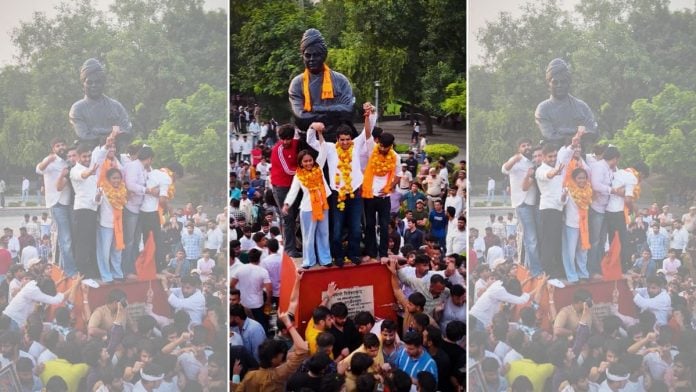

It’s not often that an election-winning machine such as Amit Shah celebrates the results of a university students’ union election. He has fought and won many more, bigger battles. Yet, when the Akhil Bharatiya Vidyarthi Parishad, the RSS student wing, won three of the four central panel posts in the Delhi University Students Union, Shah was more upbeat and aggressive than usual.
“Delhi University is not just a university; students come here to study from every corner of the country. The mandate of this place is a reflection of the sentiments of the youth across all of India. Today’s splendid victory for @ABVPVoice is a clear message to those anti-national forces who want to turn the youth power into a laboratory for their anti-national agenda,” the Union home minister said on X.
The tone suggested a sense of relief and vindication. Tiny cockroaches had punctured the aura of invincibility around the mighty BJP. The ruling party was suddenly looking vulnerable and unsure. Even an Assembly bypoll loss in Bankipur was being seen as a sort of rebellion by the BJP’s core support base comprising the upper castes and the aspirational youth. The ABVP’s poor show in the Hemvati Nandan Bahuguna Garhwal University (Pauri campus) elections drew sneers from Opposition parties that saw it as another sign of doom for the BJP.
दिल्ली विश्वविद्यालय केवल एक यूनिवर्सिटी नहीं, यहाँ देश के हर कोने से विद्यार्थी पढ़ने आते हैं। यहाँ का जनादेश पूरे भारत के युवाओं के मन का प्रतिबिंब होता है।
आज @ABVPVoice को मिली शानदार जीत उन राष्ट्र विरोधी ताकतों के लिए स्पष्ट संदेश है, जो युवा शक्ति को राष्ट्रविरोधी एजेंडे…
— Amit Shah (@AmitShah) September 19, 2026
Congress general secretary (organisation) KC Venugopal thundered on X: “NSUI’s spectacular victory in the Garhwal University elections is a comprehensive defeat of the BJP…. a message from India’s youth and students who were waiting for an opportunity to punish the BJP….The BJP will face a similar fate in the upcoming DUSU elections…”
KC went silent after the DUSU poll outcome on Saturday. It seemed to puncture the hype around Rahul Gandhi’s ‘Chhatron Ki Goonj’ spectacle.
The BJP’s celebrations over DUSU election results were in order, given how the cockroaches had put a big question mark on Prime Minister Narendra Modi’s popularity among students and youth. So much so that even parties such as the Dravida Munnetra Kazhagam and the Nationalist Congress Party (Sharad Pawar) that looked inclined to play ball with the BJP over delimitation suddenly went cold. Shah might now hope that they would give up their diffidence about breaking bread with him. That’s why the monsoon session of Parliament hasn’t been prorogued even five weeks since its adjournment sine die.
A brief history of DUSU election results
The BJP’s chest-thumping aside, the DUSU results are more layered. BJP leaders know quite well that these wins don’t necessarily mean restoration of the status quo ante or the return to the state of affairs as it was before the CJP protests in July. It’s just a university students’ union election. Let’s go back in time to see whether DUSU polls reflect the public mood. They did in the 1970s. For four years prior to the Emergency, the ABVP won the DUSU president’s post: Bhagwan Singh in 1971, Ram Khanna in 1972, Alok Kumar in 1973, and Arun Jaitley in 1974. In the first election post-Emergency, too, ABVP made a clean sweep with Vijay Goel as president, Sunil Mittal as vice-president, Rajat Sharma as secretary, and T Joggulamba as joint secretary. The public mood changed in 1980, when Indira Gandhi returned to power, but it didn’t get reflected in DUSU polls, with the ABVP winning the president’s post in 1980 (Vijay Jolly), 1981 (Sudhanshu Mittal), and 1982 (Yogesh Sharma).
In September 2008, Nupur Sharma of the ABVP became the DUSU president; the BJP lost the Lok Sabha elections a few months later. In 2012, the NSUI swept the DUSU elections, winning three central panel posts, while the fourth one was a tie. We know what happened to its parent party, the Congress, in the 2014 Lok Sabha polls. In 2013 though, the ABVP did win three posts and the NSUI one. In 2017, at the height of PM Modi’s popularity, the NSUI won the president’s and the vice-president’s posts.
What this brief history tells us is that the DUSU elections may or may not reflect students’ mood across the nation. If the BJP leaders think these elections reflect popular sentiment, they need to worry. The victory margins of the ABVP candidates have gone down significantly from last year, which may be interpreted as a gradual erosion of its support base in its bastion.
The ABVP had won the president’s post last year by a margin of 16,196 votes; it came down to 2,053 votes this year. In 2025, the ABVP lost in the vice-presidential race by a margin of less than 9,000 votes; in 2026, it lost out to the rebel NSUI candidate by 13,705 votes. Add the 4,300-odd votes that the official NSUI candidate got and the margin of the ABVP’s loss for the VP’s post becomes much bigger. In 2025, the ABVP had won the secretary’s post with a victory margin of over 7,600 votes; it fell slightly to 6,781 votes this year. The RSS student wing had won the joint secretary’s post by over 4,400 votes last year; the margin came down to 837 votes this year. The reduction in the ABVP’s victory margins and the increase in its margin of defeat should worry BJP leaders who see these results as a barometer of national mood.
In terms of absolute numbers too, there was a dip in the ABVP’s voter shares compared to the 2025 polls across the board. Its presidential candidate got 24,576 votes in 2026, against 28,821 in 2025—a dip of 4,245 votes. The V-P candidate got 3,632 votes less than last year, while the joint secretary candidate got 5,210 votes less.
Having said that, a win is a win.
Also read: Frontier Nagaland Bill should have made national headlines. A new model of autonomy
Kanhaiya Kumar’s one-upmanship
The BJP has two other reasons to celebrate. First, the opposition remains divided. If there were opposition unity in the DUSU polls, the ABVP would have been routed. But that’s a theoretical argument. The inherent conflict of interests and ambitions in the opposition camp precludes any long-term unity. Second, and more important, the Congress as an organisation remains too weak and divided to capitalise on the growing anti-establishment mood.
See what happened in the DUSU polls. Emboldened by Gandhi’s unflinching love for him, ex-comrade and NSUI in-charge Kanhaiya Kumar made it his mission in the DUSU elections to undermine and snub Congress MP from Haryana, Deepender Hooda, who was promoting Deepanshu Shokeen and Vishesh Yadav. According to Congress insiders, Hooda had recommended these two as NSUI nominees in the 2025 DUSU elections but was told that they would be fielded in 2026.
It remains true that Shokeen, son of a DTC bus conductor, was initially reluctant to contest as the NSUI’s presidential candidate this year, as the ABVP candidate was much more resourceful. However, he relented after Hooda intervened. Insiders say that Kanhaiya Kumar was supposed to come back with a final decision on Shokeen’s presidential nomination, but he never did. The NSUI in-charge later conveyed to them that Shokeen should contest as the V-P candidate and Yadav as the joint secretary candidate. A final twist in the plot was yet to come.
Shortly before they were to file nomination papers as NSUI candidates, Shokeen and Vishesh were asked to withdraw, prompting them to rebel. Shokeen ended up winning, while Yadav lost by a narrow margin. The results show that but for Kanhaiya Kumar’s one-upmanship, the Congress would have won two out of the four DUSU posts, and the narrative would have been different. And who did Kanhaiya choose as the NSUI V-P candidate? It was Virr Chatrath, son of Congress leader Manish Chatrath. The former comrade has learned the rules of the game in the dynasty-ruled party fairly quickly.
Also read: No Boney M, no Queen—what Modi-Shah’s BJP doesn’t get about Gen Z
Lesson for Rahul Gandhi
DUSU results have a big message for Gandhi, who seems to be on cloud nine nowadays. He has every reason to, given the traction his ‘Chhatron Ki Goonj’ is getting. Just as PM Modi believed that in 2014, people wanted a “trusted name, not a party name”, Gandhi also seems to believe that it’s his name—not the Congress’ organisational capability—that will bring students and youth in droves to the polling booths.
During an interaction with journalists in the UPA era, one of the invitees asked Gandhi how the Congress would take its message across the country, when it didn’t have regional satraps or an organisational presence at the grassroots.
“Did Nehruji need it? Even one person is enough to carry the message… just because I didn’t go to jail like Nehruji during the Freedom movement!” Gandhi shot back.
All these years later, his conviction hasn’t changed, evidently. Congress leaders are still expending all their energy on building ‘Brand Rahul’, while the organisation remains in shambles. What the principal Opposition party is missing is the fact that the RSS and BJP cadres did a lot to feed into and capitalise on the growing disgruntlement against the Manmohan Singh government before Modi appeared on the centre stage and became a brand. Gandhi can’t become the ‘trusted name’ in 2029, as Modi was in 2014, without a well-oiled party machinery working for it. DUSU election results hint at precisely this.
DK Singh is Political Editor at ThePrint. He tweets @dksingh73. Views are personal.
(Edited by Prasanna Bachchhav)
I am a regular reader of the print. Dk you were full of prejudice from start but recently you think as my time has come let be more biased.
If Dusu results would have been different the story would have been the same but different headline but same crap. By the way expecting honesty from politician and journalist is to much to ask . Be honest otherwise the time will change bad then election by election either you will cry or will write explaining where congress missed or bjp gained again it would be all false information from your side . I will love to read your small understanding in 2027 feb and 29 may and 32 feb . But you won’t change because for that one needs honest introspection rather than bitching and writing own crafted crap without data and argument to support.
Statecraft. Realpolitik. Shri Rahul Gandhi is still on a shallow learning curve.