




On 3 September, the concluding day of the ninth session of the 14th Nagaland Legislative Assembly, the House in Kohima did two things that ought to have been front-page news in Delhi. It passed the Frontier Nagaland Territorial Authority (FNTA) Bill, 2026, creating a new autonomous body for the state’s eastern districts — Tuensang, Mon, Longleng, Kiphire, Noklak and Shamator.
Six months earlier, Union Home Secretary Govind Mohan, Nagaland Chief Secretary Sentiyanger Imchen, and the leadership of the Eastern Nagaland Peoples’ Organisation (ENPO), A Chingmak Chang and General Secretary M. Honang, had signed a Memorandum of Agreement (MoA) on the issue. The Assembly also passed a unanimous resolution asking the Union government to withdraw the Protected Area Permit regime from the state. This restriction, they held, was detrimental to tourism, cultural exchanges and investment decisions in the state.
Both developments were reported by PTI and IANS. The copy went everywhere it usually goes, but only a few carried excerpts of the agreement, including ThePrint, Deccan Chronicle, Hindustan Times, The Hans India, The Federal, Sentinel Assam, EastMojo and the Northeast papers. Not one national paper appears to have specifically sent a reporter to Kohima or Tuensang. None offered an editorial comment. Neither did they commission or publish an analytical piece by their opinion columnists.
Although both the Bill and the resolution call for detailed analysis, the focus of this and the next column is on the implications of this political settlement under Article 371A and its fallout elsewhere.
Also Read: Has 6th Schedule outlived its use? Political deals do the work now, Darjeeling to Nagaland
FNTA Bill is more important than coverage suggests
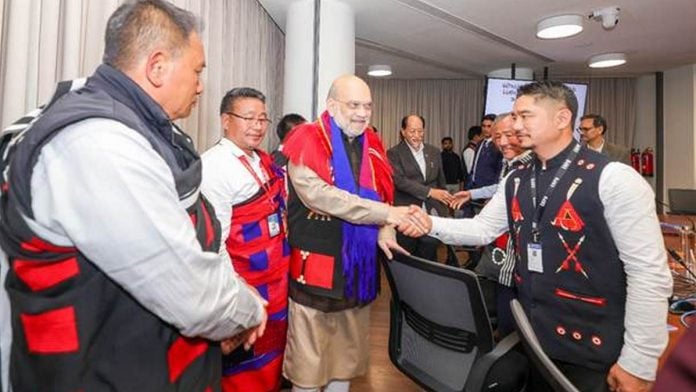
The contrast with the signing ceremony for the ENPO accord held in New Delhi earlier this year was stark. Amit Shah in the frame with Neiphiu Rio beside him was covered everywhere. So was the Prime Minister’s endorsement of it the following day. Ironically, the legislation that gave effect to this agreement after six months of intense negotiations was not.
The Bill is more ambitious than the standard administrative terminology of an ‘autonomous council’. It is effectively a second tier of governance, with a 62-member authority exercising legislative, executive, administrative and financial powers over 46 subjects across the districts of Tuensang, Mon, Longleng, Kiphire, Noklak and Shamator, while remaining within Nagaland’s constitutional and legal framework.
Forty of the 62 members will be directly elected from single-member territorial constituencies through adult suffrage, with one-third of those seats reserved for women. Two more will be nominated by the Governor, in consultation with the Authority, from recognised tribes of the territory that are unrepresented or under-represented. Unlike the 20 ex-officio MLAs, these nominated members will have voting rights.
Executive power will rest with a Council of up to nine members, headed by a Chief Executive Member with the protocol status of a Cabinet Minister. The secretariat supporting the rollout of the 46 subjects will be headed by a senior IAS officer of Additional Chief Secretary or Principal Secretary rank. The subjects include agriculture, horticulture, fisheries, non-reserve forests, irrigation, jhum cultivation, primary healthcare, school education up to higher secondary, skill development, labour and employment, rural development, social welfare, tourism, handloom and handicrafts, district roads, public transport and housing.
Eastern Nagaland’s special status
The background to the grievances of the eastern districts predates 1963, when the Naga Hills Tuensang Area was constituted as the sixteenth state of India — Nagaland.
It bears recall that when the first Census of India was held in 1951, Tuensang was not included because it was too remote and there was no administrative machinery to carry out the enumeration.
It was only in 1957 that the Tuensang Frontier Tract, from which all six districts have been created, was added to the Naga Hills District of Assam, with its headquarters at Kohima and a subdivision at Mokokchung. This happened at the behest of Major Bob Ralengnao Khathing of the Indian Frontier Administrative Service (IFAS), who was the Political Officer of Tuensang from 1953 to 1957, when the Naga insurgency was at its peak in this region. He argued that a common administrative set-up would lead to better co-ordination between the security agencies — Assam Police, Assam Rifles and the Indian Army — the magistracy and the development administration.
Compared to Kohima, Tuensang was quite backward in terms of road connectivity, health, education and communication infrastructure. In fact, the first bank and regular post office were established only after Khathing — who was awarded the Padma Shri in 1957 — took charge of Tuensang.
When the third Naga Peoples’ Convention (NPC), held at Mokokchung from 22 to 26 October 1959, paved the way for a settlement with the Centre, a 16-Point Agreement was signed. Khathing was then the Deputy Commissioner of Mokokchung. Given the economic, social, educational and political backwardness of this area, Tuensang was accorded a special ten-year dispensation under Article 371A. A Regional Council was established under the aegis of the Governor, with independent fund allocations.
However, after the statehood settlement of 1963, the first few decades were marked by insurgency, and development discourse took a back seat. No one noticed when the institutional safeguard for Tuensang was dissolved in 1974 and eastern Nagaland became part of the standard administrative matrix of the state.
Also Read: Centre’s ‘permanent’ solution to Gorkhaland is not so simple. Accords & discords for 38 yrs
The demand for a Frontier Nagaland
From then to now, the gap between eastern Nagaland and the rest of the state has widened.
A briefing paper by the Manohar Parrikar Institute for Defence Studies and Analyses (MP-IDSA) shows that while the six eastern districts account for 28.88 per cent of Nagaland’s population and occupy roughly 36 per cent of its geographical area, they held only 20 of the 60 seats in the Legislative Assembly.
Although eastern Nagas represent approximately 20 per cent of the workforce qualified for state employment and enjoyed a statutory 25 per cent reservation for non-gazetted and non-technical posts, the ENPO has highlighted that actual representation across permanent state government jobs was nowhere close to this figure. The second Nagaland State Human Development Report, published by the state government with UNDP and released by then chief minister TR Zeliang on Independence Day 2017, was candid that headline progress concealed considerable intra-state disparity. Critical road density stood at 71.07 km per 100 sq km, compared to 95.70 km per 100 sq km in western Nagaland.
Such disparities had already contributed to the formation of the ENPO. It traces its institutional origins to 1994, when it was originally established as the Tuensang-Mon Peoples’ Organisation (TMPO). As more districts were carved out, it morphed into the ENPO in 2005 to reflect the broader regional identity of the seven eastern Naga tribes — Chang, Khiamniungan, Konyak, Phom, Sangtam, Tikhir and Yimkhiung.
In late 2010, the ENPO formally crystallised its mandate from a civil welfare platform into an active political movement by submitting a memorandum to the Government of India demanding a separate state of ‘Frontier Nagaland’. After a series of memorandums, cease-work protests, demonstrations and discussions, it finally adopted the Chenmoho Resolution on 23 February 2024 to boycott all elections — from local bodies and the state Assembly to Parliament.
However, by this time, the 2023 Nagaland Assembly elections had already been held, and 20 legislators from eastern Nagaland were represented in the House. Of them, P Paiwang Konyak of the BJP holds the Health & Family Welfare portfolio, CL John of the Nationalist Democratic Progressive Party (NDPP) is Minister for Forest, Environment & Climate Change and Village Guards, and P Bashangmongba Chang of the BJP is responsible for Housing & Mechanical Engineering.
Meanwhile, as Nagaland has only one parliamentary seat, the ENPO’s enforcement of a total boycott across all 738 polling stations in the eastern districts did not affect the remaining 1,601 polling stations in the other 40 Assembly segments in central and western Nagaland. S Supongmeren Jamir of the Indian National Congress won the Lok Sabha seat by defeating Dr Chumben Murry of the BJP-supported NDPP.
In 2026, with the FNTA Bill finally passed, ENPO’s response was notably unsentimental. It called the passage “just a second step towards many obstacles in future” and asked both the MHA and the state government to continue supporting implementation.
The state government certainly seems invested. When Chief Minister Neiphiu Rio and Deputy Chief Minister Yanthungo Patton called on Union Home Minister Amit Shah in New Delhi on 11 September 2026, they reiterated Nagaland’s formal request to the Centre to enhance the Special Development Grant package — proposed under the MoA at Rs 5,000 crore — to at least Rs 10,000 crore, citing the acute historical infrastructure deficit across the six eastern districts.
Well begun is half done, even though there may be challenges to surmount along the way.
(To be continued)
This is the third part of a four-column series on political settlements in the Himalayan region of Darjeeling-Kalimpong and the eight northeastern states, now referred to as Ashtalakshmi — the eight sisters of wealth and prosperity.
Sanjeev Chopra is a Senior Fellow at the Centre for Contemporary Studies, Prime Ministers Museum and Library (PMML), New Delhi, where his Fellowship topic is Borders, Boundaries and Bluewaters of Bharat. He is also working on a biography of Padma Shri Major Bob Khathing, former Chief Secretary of Nagaland and India’s ambassador to Burma. Views are personal.
(Edited by Asavari Singh)