





On 22 October 1947, ‘armed tribal raiders’ backed by Pakistan crossed into the princely state of Jammu and Kashmir. It was the first act of aggression in the Kashmir dispute and the event that eventually led Maharaja Hari Singh to accede to India. Nearly eight decades later, the history of that invasion presents a profound irony. Pakistan justified its intervention in the name of the people of Kashmir, yet the territories it occupied remain among the least politically empowered and economically developed regions in the subcontinent.
The story of Pakistan-occupied Jammu and Kashmir (PoJK) is therefore not merely the story of a disputed territory. It is the story of promises made in the name of Kashmiris but rarely fulfilled.
The original Aggressor and the forgotten question
Much of the international discussion on Kashmir begins after accession, but from the Indian perspective the crucial question is simpler: who initiated the conflict?
The princely state of Jammu and Kashmir had not acceded to either dominion when Pakistan-backed tribal forces entered its territory in October 1947. Faced with invasion, the Maharaja sought military assistance from India and executed the Instrument of Accession. Indian troops arrived thereafter. Thus, according to India’s position, Pakistan was not responding to an injustice in Kashmir; it was the party that created the crisis in the first place.
If Pakistan claimed to intervene for the welfare of Kashmiris, what has it done for the people living in the territory?
The answer is uncomfortable for Islamabad.
Development deferred for decades
The territories occupied by Pakistan possess extraordinary natural advantages. Gilgit-Baltistan contains immense hydropower potential, strategic trade routes and breathtaking tourism assets. Pakistan-occupied Jammu and Kashmir enjoys fertile valleys, water resources and a population with strong social indicators.
Yet despite decades of control, Pakistan has failed to transform these advantages into broad-based prosperity. Economic activity remains heavily dependent on remittances, government transfers and public employment. Industrial development is limited. Opportunities for higher education, modern healthcare, advanced infrastructure and large-scale private investment remain significantly behind those available on the Indian side of the Line of Control.
India’s Jammu and Kashmir today possesses a far larger and more diversified economy, integrated with one of the world’s largest national markets. Roads, rail links, telecommunications, universities, healthcare institutions, banking networks and tourism infrastructure have expanded steadily despite decades of insurgency and terrorism.
This contrast becomes particularly striking when one considers that India achieved these gains while simultaneously fighting terrorism, infiltration and violence orchestrated by Pakistan-backed forces. Thousands of security personnel and civilians lost their lives.
Yet despite this difficult environment, democratic politics survived. Elections continued, representatives sat in Parliament, governments changed through ballots, courts remained accessible and political parties openly criticised New Delhi.
Pakistan faced no comparable challenge in POJK yet delivered substantially less economic progress. Their political space remained narrower and their constitutional position weaker.
This raises a difficult question for Pakistan’s defenders. If security measures in Jammu and Kashmir are often criticised, what explains heavy-handed responses in territories where no comparable situation exists? It is the betrayal of Kashmiri aspirations.
The contradiction of “free” Kashmir
Perhaps the greatest paradox is the name given by Pakistan itself: “Free” Kashmir.
The population of Pakistan-administered Kashmir did not wage any significant violence against Islamabad, except till recently. There was no sustained campaign of terrorism or secession directed against the Pakistani state. One might therefore expect such a region to enjoy wide political freedoms and extensive self-government.
The reality has been very different.
The political system has historically operated within strict boundaries established by Islamabad. A fundamental political position, questioning accession to Pakistan, remains constitutionally constrained. The territory possesses institutions that appear autonomous, but decisive control over strategic, constitutional, and security matters remains concentrated outside the region.
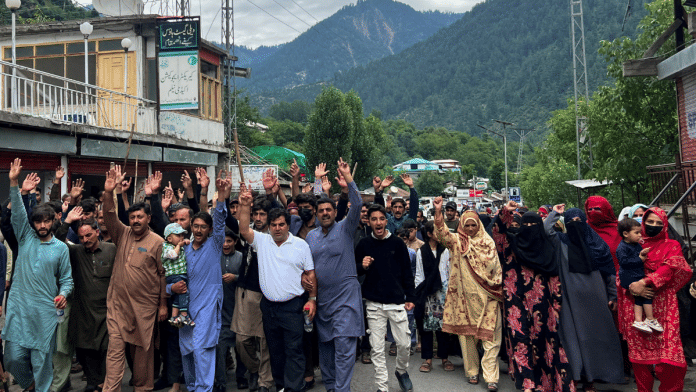
An especially revealing development has emerged during the recent unrest in POJK. Unlike insurgencies elsewhere in the world, the protests witnessed in these regions were largely expressions of economic distress, demands for accountability, concerns about governance, electricity costs, subsidies, representation and local rights.
In other words, many citizens were not demanding anything extraordinary. They were asking for better governance. The response was deeply revealing.
The authorities resorted to arrests, internet shutdowns, and restrictions on assembly, sedition cases and the deployment of security forces. There are reports of fatalities, injuries and extensive coercive measures against protest movements. Even Pakistan’s own human-rights voices reportedly expressed concern about disproportionate force and excessive state responses. Amnesty International also documented concerns relating to arrests and suppression of dissent.
The significance of these events cannot be overstated.
For decades, Pakistan justified its control of these territories by portraying itself as the defender of Kashmiri aspirations. Yet when ordinary residents demanded better governance and greater accountability, the response was not dialogue but coercion. The state appeared willing to deploy the full weight of its administrative and security machinery against citizens whose principal demands concerned rights and governance rather than separatism.
The tragedy of PoJK is therefore not merely territorial. It is fundamentally political and developmental.
Generations of people were told that Pakistan’s intervention in 1947 was undertaken to protect Kashmiri interests. Yet seventy-nine years later, those same territories continue to experience constitutional uncertainty, limited political empowerment, inadequate economic transformation and recurring allegations of administrative repression.
The issue is no longer simply who controls the territory. The issue is how that territory has been governed.
By that measure, the record raises serious questions. A region that witnessed neither the scale of orchestrated violence from across the Line of Control should have emerged as a model of prosperity, democracy and self-government. Instead, it remains dependent, politically constrained and periodically subjected to force when its citizens demand reform.
Also read: PoK’s revolt is the clearest sign of the unravelling of Pakistan’s political and military rule
The real legacy of 22 October
The anniversary of 22 October should therefore not be viewed merely as a remembrance of a military invasion by Pakistan. It should also be seen as an occasion to examine the consequences of that invasion.
Pakistan entered Jammu and Kashmir claiming to speak for Kashmiris. The people were promised liberation but received dependency. They were promised self-determination but received supervision. They were promised representation but continue to face constitutional ambiguity.
The most telling verdict on Pakistan’s Kashmir policy is not delivered by India, international observers, or historians. It is delivered by the repeated emergence of protest movements from within PoJK itself.
Nearly eight decades after the invasion of 22 October 1947, the people of PoJK continue to ask a simple question: if Pakistan came in the name of Kashmiris, why have Kashmiris gained so little from its rule?
SN Srivastava is a former police commissioner. Views are personal.
(Edited by Ratan Priya)