






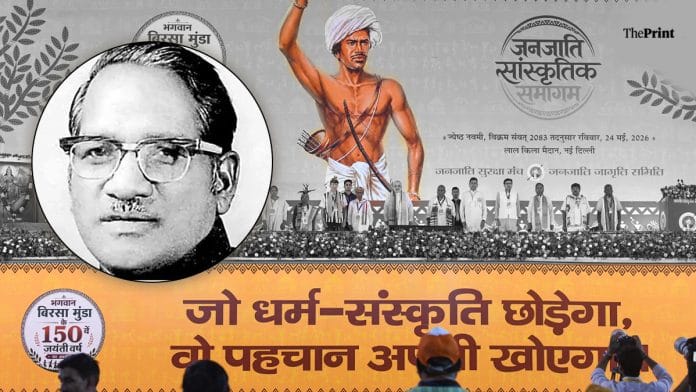


Nearly two lakh tribals from more than 500 communities gathered at Delhi’s Red Fort on 24 May for the Janjati Sanskritik Samagam. Their demand was direct: those who abandon tribal faith, culture, customs, and community life after conversion should not continue to claim the constitutional benefits meant for Scheduled Tribes.
This demand, led by the Janjati Suraksha Manch, is not new. It is not a sudden reaction to present-day politics. It draws from a question raised more than five decades ago by Kartik Oraon, the eminent tribal leader, three-time Lok Sabha MP, and Union minister in Indira Gandhi’s Cabinet: can a person who has severed himself from tribal customs, rituals, beliefs, and community recognition still claim the constitutional status of a Scheduled Tribe?
Bharat has avoided this question for far too long.
Also Read: End ST quota benefits for ‘converted’ tribals—RSS affiliate-backed outfit urges Murmu, Modi
What have courts said about conversion & ST status?
The Constitution does not define “Scheduled Tribe”. Unlike the Scheduled Caste framework, where the law expressly provides religion-based restrictions, the Constitution (Scheduled Tribes) Order, 1950 contains no comparable exclusion. This silence has often been treated as if Scheduled Tribe status is entirely religion-neutral.
But the law is not so simplistic. In State of Kerala v. Chandramohanan (AIR 2004 SC 1672), the Supreme Court rejected the argument that ST status automatically survives conversion merely because the ST Order does not contain the same express religious exclusion found in the SC framework. The court held that a person must not only belong to a tribe, but must continue to be a member of that tribe. If, after conversion, he or his ancestors stopped following tribal customs, rituals, and customary laws of succession, inheritance, and marriage, he may not be accepted as a member of the tribe.
The same principle was reaffirmed this year by the Supreme Court in Chinthada Anand v. State of Andhra Pradesh. The court clarified that where conversion or later conduct results in complete severance from the tribal way of life and loss of community recognition, the foundation of Scheduled Tribe status stands eroded. In other words, ST benefits must remain tied to living tribal identity.
That is the constitutional heart of the delisting demand.
No tribal life, no ST quota
Conversion becomes legally relevant not because the State must police personal faith, but because Scheduled Tribe benefits are not ordinary welfare entitlements. They are constitutional protections for historically vulnerable communities with distinct cultures, traditions, customary institutions, and ways of life. These benefits exist because of tribal identity. They cannot be detached from the continued existence of that identity.
The Janjati Suraksha Manch’s case is therefore clear: ST benefits must go to those who remain part of Scheduled Tribe life. If a person voluntarily exits the tribal cultural and social framework, stops observing tribal customs and rituals, ceases to follow customary law, and is no longer recognised by the community as part of its living tradition, continuing to claim ST benefits becomes an injustice to those who remain rooted in the community.
Conversion to an alien faith results in a complete departure from tribal customs, ancestral practices, and community life; the same person cannot simultaneously claim constitutional protection on the basis of the very identity that has been abandoned.
Kartik Oraon understood this contradiction decades ago. His concern was that a small section of converted tribals, aided by better access to education and institutional networks, was cornering a disproportionate share of reservation benefits while the poorest and most disadvantaged tribal families remained behind. JSM has revived that concern, arguing that the imbalance has only grown.
The problem is exacerbated by the issue of double benefits.
A converted tribal may continue to claim ST reservation while also accessing minority welfare schemes. This is not an argument against welfare for poor converts. The State may create separate schemes for any disadvantaged group. But such welfare cannot be carved out of the limited constitutional share reserved for Scheduled Tribes.
JSM’s point is simple: do not abandon poor converts, but do not take from the quota meant for tribals who continue to preserve tribal faith, culture, customs, and community life.
A long-standing demand
The demand also has legislative history. The Joint Parliamentary Committee on the Scheduled Castes and Scheduled Tribes Orders (Amendment) Bill, 1967 considered whether persons who gave up tribal faith and embraced Christianity or Islam should continue to be treated as Scheduled Tribes. In 1969, the committee supported exclusion. But the issue was not finally resolved, and the Bill lapsed after the Lok Sabha was dissolved.
That unresolved question has returned with urgency.
For years, JSM has built public support around it. In 2009-10, it conducted a large signature campaign, reportedly collecting 27.67 lakh signatures from adult tribal members across 26,253 villages, 293 districts, 1,268 development blocks, and 26 states. These signatures were sent to the President through district collectors and governors.
In January 2010, a delegation of senior tribal leaders, including Dilip Singh Bhuria and Jagdevram Oraon, met President Pratibha Patil and submitted a memorandum urging early resolution of the issue. Since then, JSM has continued village contact drives, rallies, and district conferences across tribal regions.
In 2020-21, its outreach covered 221 districts, with large tribal participation in district-level programmes. In 2022-23, it says programmes were held in 21 states, drawing participation from more than 400 tribal communities. In 2023-24, 5.70 lakh postcards were sent to the Prime Minister in support of the demand. In March 2023, JSM conducted a two-week outreach in Delhi, during which it contacted 450 Members of Parliament across party lines and briefed them on the issue.
The Red Fort gathering on 24 May was the latest and largest public expression of this campaign. It was an assertion and cry for the long-awaited demand that tribal identity cannot be reduced to ancestry while its customs, faith, rituals, and community recognition are discarded.
After the gathering, JSM conveyed its demands to the highest constitutional offices, including the President and the Prime Minister. Its central demand is that persons who abandon tribal faith, customs, and culture after conversion should be barred from claiming benefits attached to Scheduled Tribe status. It has also sought reference of the matter to the National Commission for Scheduled Tribes and a clear legal framework so that ordinary tribals are not forced into endless litigation.
That last point is crucial. The Supreme Court has laid down the principle, but its present application remains difficult. Courts say each case must be decided on facts: whether the claimant continues to observe tribal customs, follow customary law, participate in community life, and enjoy community recognition. But who will bring these cases? Who will pay for them? How many years will they take? Can a poor tribal family realistically fight prolonged identity litigation?
Also Read: SC must formulate a code for former judges. The robe cannot be rented after retirement
Justice for Bharat’s tribal communities
A right that can be protected only through expensive case-by-case litigation is not an effective right. Constitutional protection must be made administratively workable.
Four steps are necessary.
First, the Constitution (Scheduled Tribes) Order, 1950 should be amended, clarified, or supplemented to state that a person who converts and abandons tribal faith, culture, customs, and practices, and is no longer recognised by the tribal community as its own, ceases to be treated as a member of a Scheduled Tribe for the purpose of constitutional benefits.
Second, the matter should be referred to the National Commission for Scheduled Tribes. The NCST is the constitutional body specifically tasked with safeguarding tribal interests. It should study the issue, consult tribal communities, and recommend workable criteria.
Third, the term “tribal” needs greater clarity. The Lokur Committee criteria — primitive traits, distinctive culture, geographical isolation, shyness of contact, and backwardness — were framed decades ago. Some of them no longer fit modern Bharat. But distinctive culture, customary life, and community recognition remain central to tribal identity and must be reaffirmed.
Fourth, the government must create a simple administrative mechanism so that tribal communities are not forced to fight each case in court. The law must be clear enough for authorities to apply it fairly, without harassment, political misuse, or endless delay.
Bharat’s tribal communities are not merely administrative categories. They are living cultural communities with their own languages, sacred geographies, festivals, customary laws, ecological knowledge, and social institutions. The Constitution recognised their vulnerability and gave them special protection. That protection must not be reduced to a technical benefit available even after tribal identity has been left behind.
For more than 75 years, Bharat has postponed this question. Kartik Oraon raised it in the 1960s and 1970s. The Joint Parliamentary Committee considered it in 1969. JSM has carried it through signature campaigns, memoranda, meetings with constitutional authorities, MP outreach, and mass tribal mobilisation. The Red Fort Samagam shows that the question can no longer be ignored.
Scheduled Tribe status cannot rest on ancestry alone. It must remain tied to living tribal identity.
Loss of faith is loss of culture, and loss of culture is loss of identity. That is the case for delisting. It is not against any religion. It is for justice to Bharat’s tribal communities.
The author is a Delhi-based advocate. He tweets @adityak_law. Views are personal.
(Edited by Asavari Singh)
Absolutely, anyone who abandons tribal customs can’t claim to be tribal. The constitution penalizes those who don’t convert from their native beliefs. Native religions don’t have protections, but foreign religions get “minority” benefits. And then narrative is created to abuse native beliefs as bad, when in fact the foreign ones committed Inquisitions and massacres.
The bjp government in assam has extended st reservation to muslim paharis in Jammu and Christian tea tribes in assam
The writers seems to be unaware that christian and muslim tribal are unique in terms of their customary law, culture and worldview in comparison to cultures around the world. One does not stop speaking native languages or wearing native clothes( identity markets of tribal cultures) , celebrate tribal icons or festivals as many christians do.
The writers has upheld the same criteria that many christian and muslim tribal uphold, namely distinctive culture, customs and way of life relative to the society around them. The organization quoted here wants to make religion the sole criteria for granting ST reservation which is against all standards of anthropology and even standards established previously.
If one thinks I am lying then one should read some ethnography of the different communities.
Furthermore, recognition by wider society is a slippery slope when bad faith actors exist who define tribal identity narrowly.