



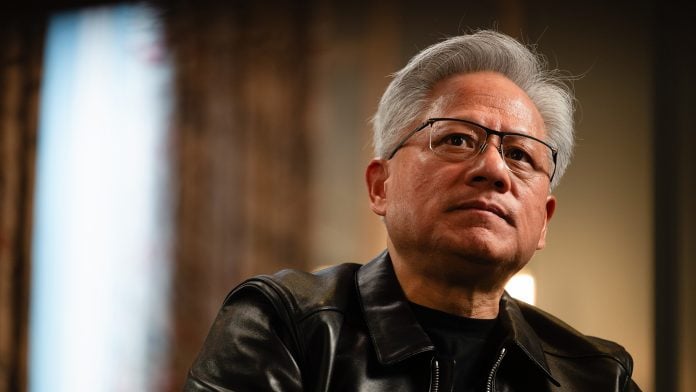
Jensen Huang’s resignation as Nvidia CEO triggered an immediate intraday drop of roughly 14 to 16 per cent before shares closed that session down 4.3 per cent, contributing to a weekly wipeout of roughly $500 billion to $575 billion in market value and shaving an estimated $10 billion off his personal fortune over the week. His exit, after a scandal involving alleged extramarital affairs—including one with a businesswoman suspected by US intelligence of having links to China—has plunged the world’s most valuable AI chipmaker into a leadership, national security, and governance crisis.
Nvidia has appointed long-serving chief financial officer Colette Kress as the interim CEO and said that it will consider both internal and external candidates for the permanent position. It has also named Harvey C Jones as its first-ever chairman.
But this is no ordinary leadership transition.
For more than three decades, Huang was synonymous with Nvidia. The black leather jacket, the carefully curated rock-star persona and his seemingly effortless command of the technology world made him one of Silicon Valley’s most recognisable figures. He was not simply the chief executive of the world’s biggest chipmaker but became the public face of the artificial intelligence renaissance.
The controversy has now moved way beyond Huang’ personal life. Nvidia’s chips are central to the US-China technology rivalry, and the crisis has become a test of the extraordinary influence the company exercises over the global technology industry, making it ThePrint Newsmaker of the Week.
The most serious dimension of the scandal concerns Alice Huang, also known as Huang Le, a former executive at Singapore-based Megaspeed International. US intelligence agencies reportedly suspect her of honey-trapping Huang and collecting and passing information to Beijing, as reported by The New York Times on 29 October.
Nvidia’s advanced processors are critical to the development of AI. Their sale to China is subject to US export restrictions, making the company an important part of Washington’s effort to maintain its technological advantage.
Meanwhile, China has rejected allegations of espionage, calling them unsubstantiated.
Nvidia has said it has no reason to believe that national security or its secrets had been compromised, but announced an internal investigation into whether Huang had been the target of a foreign intelligence effort.
On 8 November, Huang acknowledged that he had been unfaithful to his wife. In a message to Nvidia employees, he apologised to his family and colleagues, writing: “There is no excuse for what I did. I am deeply sorry.”
He also acknowledged that he had fallen short of the responsibility that came with leading Nvidia. “You deserve better from me,” he told employees, the board, partners, and shareholders.
This admission led to Nvidia announcing its independent investigation into the CEO. The reports of relationships within the company made it increasingly difficult for the board to treat the controversy as a purely private matter. Nvidia initially indicated that Huang would remain in his position while it investigated the allegations, but scrutiny intensified after the news broke of his second affair.
On 11 November, The New York Times reported that Huang had a separate relationship with Kimberly Powell, Nvidia’s vice president of healthcare, who reported directly to him, adding a layer of conflict of interest and workplace power. A day later, Nvidia announced Huang’s departure from the company.
But the resignation didn’t end the revelations, because a third affair with an unnamed Nvidia employee was also subsequently reported by Reuters.
Also read: India and EU have new reasons to engage. Real test comes after FTA is signed
Shares plummet
The market impact was immediate. Nvidia’s shares fell as much as 14.3 per cent during trading on 12 November before recovering some ground to close at 4.3 per cent. The decline came after the stock had already fallen 9.6 per cent over Monday and Tuesday following the initial allegations of Huang’s affair with Alice Huang.
By 13 November, Nvidia had lost $573 billion in market value over the week, its biggest weekly decline on record. The historic sell-off dropped Nvidia’s market cap below $4 trillion (to approximately $3.92 trillion) and capped a turbulent stretch triggered by major leadership and personal disclosures.
The impact extended to Huang’s personal wealth as well, since most of his fortune is tied to Nvidia stake. Fortune estimated that his net worth had fallen by nearly $10 billion from before the first revelations to 12 November. Bloomberg‘s Billionaires Index subsequently placed his fortune at around $138 billion.
The consequences were not limited to Nvidia. The company is deeply embedded in the AI market. Any uncertainty over its leadership, export permissions, or business leadership can affect the wider industry.
A cross-border network
Another aspect of the controversy is the Megaspeed connection. The Singapore-based company has emerged as an important Nvidia customer. According to reports, the company and its Malaysian affiliate, Speedmatrix, purchased around $4.8 billion worth of Nvidia’s advanced AI equipment and processors over three years.
The company’s growth also raised questions. Megaspeed was originally incorporated in Singapore in 2015 as 7Road International, an offshoot of a Chinese gaming company. It was renamed Megaspeed International in 2023, with Alice Huang as its managing director.
Its assets reportedly grew to $3 billion in 2024 from $33 million in 2023. Yet questions have been raised about the company’s physical presence and corporate structure. Reports have described its Singapore headquarters as largely empty, while its Australian subsidiary reportedly listed a newspaper vendor as a director. One of its Malaysian offices was described as a dilapidated storefront outside Kuala Lumpur.
US investigators reportedly suspect that Alice Huang used industry contacts and a network of shell companies to gain access to around 240,000 advanced chips whose export to China was restricted.
The allegations are not restricted to the US. Singaporean authorities questioned Alice Huang and confiscated her passport as part of an investigation into Megaspeed. They later said there was insufficient evidence that she had committed a crime, although they suspected that she had provided inaccurate information about her role at the company.
The story has acquired an international dimension as Malaysian authorities are also investigating whether chips brought into the country by Megaspeed or its Malaysian affiliate, Speedmatrix, were re-exported elsewhere. Megaspeed has denied any wrongdoing, saying that no investigation until now has found substantial proof of illegal chip transfers.
Also read: Chandrababu Naidu wants demonetisation 2.0. There’s still questions about the first round
Nvidia after Huang
Beyond the immediate investigations, Nvidia also needs to survive a major leadership challenge. Huang, who had led Nvidia since its founding, never clearly established a successor in place.
He co-founded Nvidia with Chris Malachowsky and Curtis Priem in 1993 and led the company through the transformation from a graphics chip maker to the most influential company in the AI economy. His departure exposes the risks of a firm making an individual such a close identifier.
Announcing the CEO transition, Nvidia’s board thanked Huang for his “profound” and “immeasurable” contributions to the company and industry without explicitly addressing the spying allegations or personal conduct revelations in their official resignation announcement.
Huang’s departure also has implications because of his close relationship with US President Donald Trump. Trump has repeatedly praised Huang, calling him smart and amazing. The relationship is under a different kind of scrutiny, as The Associated Press reported that Trump was briefed about the intelligence findings well before the allegations became public.
When asked about the allegations on 9 November, Trump said he had spoken to Huang, who told him he had no idea that Alice Huang was allegedly a spy. The president described the Nvidia chief as an “honorable guy” who was “definitely suffering”. In another interview on Thursday Trump said that he had called Huang on Wednesday, saying the situation was “sad”.
“I spoke to him yesterday. He’s going through hell,” Trump said. “What he feels most badly about is his wife and family… That’s what he told me.”
In a post on Truth Social, Trump suggested that former Apple CEO Tim Cook should take over Nvidia. “There is only one man to take his place – TIM COOK of Apple,” he wrote. “A Legend replaces a Legend!”
Views are personal.
(Edited by Prasanna Bachchhav)