






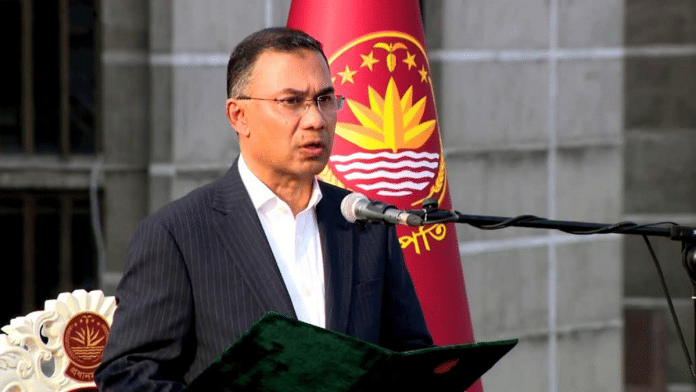


Just 120 days into the formation of a new Tarique Rahman-led government in Bangladesh, its actions and policies have received a mix of praise and criticism. What has been more prominent is the Jamat-e-Islami-led opposition threatening to take to the streets if the ‘July Charter’ is not implemented, especially after 70 per cent of citizens voted in favour of the reform plan in the February referendum.
“If the government fails to fulfil the aspirations of the people, they will give a befitting reply,” warned Shafiqur Rahman, the leader of the opposition and chief of the Jamat-e-Islami, on 14 June. He was speaking at a rally organised by the 11-party alliance led by Jamaat, which contested against arch-rival Bangladesh Nationalist Party (BNP) in the national elections held on 12 February 2026.
During the election campaign, many saw new entries such as the National Citizens Party (NCP)—formed by the students who led the anti-Sheikh Hasina movement in July 2024—emerging as the forerunners. But the Jamaat and its key ally NCP ended up performing poorly.
Bangladeshi voters showed faith in the experienced BNP and avoided a populist anti-Awami League, anti-Hasina ideology. Besides public faith in the experienced party, Tarique’s electoral promise of protecting women’s rights and ensuring their representation in society, the workforce, and politics worked in his favour—something that the Jamaat allegedly opposed.
Now, the question is whether Tarique will be able to stabilise the country’s political landscape and tackle political polarisation.
CRA doesn’t pose a constitutional challenge
The July 2024 uprising was undoubtedly the result of underlying factors such as unemployment, corruption, and, most prominently, 17 years of Hasina’s alleged ‘dictatorial rule’, where the opposition was completely sidelined and silenced. The movement that followed resulted in the installation of the Muhammad Yunus-led interim order at the popular demand of the protesting students. Unfortunately, Yunus’s 1.5 years in power were ruled by an ideology of vendetta, with a strong support for extremist political forces such as the Jamaat. With election fervour taking the lead in late 2025 and early 2026, Yunus was clearly aligned with the Jamaat and its allies.
For Bangladesh watchers, the ban on the Awami League was indeed a vendetta carried out by the interim government against the country’s oldest party, and Yunus colluded in this act. The changes Yunus sought to press were driven by ideology rather than the popular will of the people. Asking citizens to vote in a referendum alongside the ballot for electing representatives to the Jatiya Sangsad was a strategic move.
And if the BNP has sidelined itself from that, it is purely Tarique’s long-term thinking about entrusting elected representatives with such reforms under his leadership.
As a result, newly elected BNP lawmakers only took the oath of office but refused to take the oath as members of the Constitutional Reform Assembly (CRA). It was a political call for the Tarique-led government, and his actions were constitutionally valid—the Bangladesh constitution does not mention the CRA oath. Therefore, a CRA oath meant nothing in the legal eye, and Tarique treated it merely as a political decision by the Yunus government, drenched in populist values.
Had the CRA been held constitutional, Tarique would have faced a different set of challenges, but that is not the case.
Also read: Nepal is reimagining its relationship with China. What this means for India
What lies ahead for Tarique Rahman
Tarique is a new-age leader who spent 17 years in exile in London to escape what he called ‘politically motivated persecution’. His return in December 2025 not only infused soul into the BNP, which remained underground during much of Hasina’s regime, but also filled the leadership vacuum that had been occupied by the two ‘Begums’—Hasina and Khaleda Zia. Now, Tarique faces flak from the opposition for a delay in implementing the reforms suggested in the July Charter that the majority favoured during the February referendum.
While Tarique is legally protected from CRA and its recommendations, that may not be enough. Following its defeat, the Jamaat and its 10 allies would now take a populist approach to pressure the government to implement the July Charter. Even if Tarique were to come up with a modest solution through the parliamentary process, it would not be sufficient for the opposition. The challenge before the BNP government remains the street uproar in favour of the Jamaat-led opposition’s demands.
The second challenge is the question of stability in the government. On the completion of the BNP government’s 100 days in power, several opinions in the media found Taqid playing it safe, including on issues concerning foreign policy and Hasina’s extradition from India. Others called Tarique’s government ‘responsible, disciplined, and inspirational’, appreciating its outreach and openness, including with the media. The Bangladesh prime minister has also not shied away from endorsing the country’s past. He was quick to pay tribute to the martyrs of the Liberation War of 1971 at the National Memorial on 18 February—two days after taking oath. The Jamaat, of course, didn’t like this.
The Awami League banked on Bangladesh’s independence movement, and the political gains from it were evident in Hasina’s long reign. Therefore, Tarique can’t afford to do away with established norms that have been upheld irrespective of who was in power, including a decade-long military regime from 1975 to 1986. Though military rulers tried to reframe, dilute, and selectively rewrite the national history around the 1971 Mukti Juddho, they could not completely write off Bengali nationalism, secularism, syncretism of cultures, and national heroes.
Also read: 3 things the US-Iran peace deal will likely yield
Way forward
As the head of the government elected by the people of Bangladesh, Tarique must come up with an alternative reform plan. He must take into account the spirit of the reforms outlined in the July Charter, with a timeline for their implementation. This would not be without opposition, which makes it crucial to have a follow-up plan for reaching out to people. The good news is, unlike the Jamaat and the NCP, the BNP has political grounding and national acceptance. Its workers will merely have to launch a national campaign advocating for reforms that align with the BNP government’s long-term thinking on national development.
As the opposition prepares to take to the streets, Tarique must present the spirit of the referendum by discounting the agenda and ideology that the interim leaders tried to advocate. While the prime minister may have a majority in parliament, the streets have often redefined and unsettled established regimes. The lesson from Hasina’s ouster must not be taken lightly by the BNP government, especially when the Jamaat-led opposition is capable of creating an alternate national consciousness ingrained in its long history.
Rishi Gupta is a commentator on global strategic affairs. Views are personal.
(Edited by Prasanna Bachchhav)