






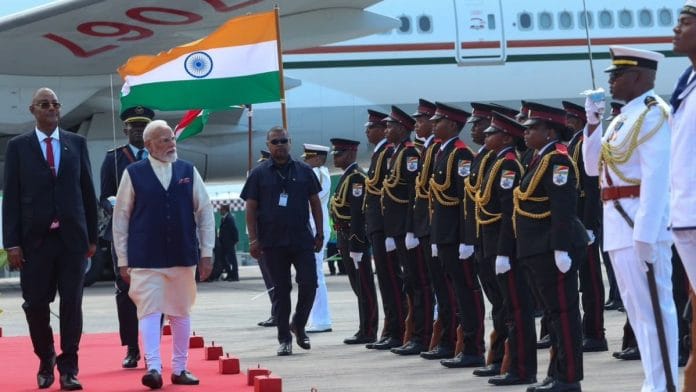


As Prime Minister Narendra Modi embarks on a three-day visit to Seychelles, there is considerable buzz about reviving India’s strategic partnership with the island nation after a slowdown in ties in recent years. The resurgence has come about since Patrick Herminie assumed the presidency in Seychelles last October. His visit to India in February was highly substantive and clearly demonstrated his intent to take the bilateral ties to the next level. Prime Minister Modi’s visit is expected to provide that much-needed momentum to further strengthen the partnership across a broad spectrum.
There is a sense of urgency now with the West Asia conflict serving as a wake-up call to both India and Seychelles. Although oil has since started flowing through the Strait of Hormuz and maritime trade has resumed, there is a growing realisation that such global shocks can impact nations irrespective of their size and level of development. The prolonged disruption of shipping has heightened maritime security concerns in the Indian Ocean Region. The war’s effect was particularly severe for an import-dependent economy like Seychelles with supplies of food, energy and consumables coming to a grinding halt. India rushing an initial tranche of 250 MT of food grains, construction material including cement and other necessities to Seychelles shortly after President Herminie’s visit was much appreciated as it helped tide over the immediate crisis.
Modi returns to Seychelles after his landmark visit in March 2015, which was the first to the island nation by an Indian prime minister in 34 years. It was immediately following his visit to Seychelles that PM Modi articulated his SAGAR (Security and Growth for All in the Region) vision in Mauritius, signifying the extension of India’s “Neighbourhood First” policy to its maritime neighbours as well.
The present visit is strategically timed coinciding with Seychelles’ 50th Independence Day and 50 years of India-Seychelles diplomatic relations. The invitation extended to PM Modi to grace the National Day celebrations as the Guest of Honour and to address an extraordinary sitting of the Seychelles National Assembly reaffirms India’s role as a trusted Indian Ocean partner and recognition as a torchbearer of the emerging economies.
Why Seychelles matters
This tiny archipelago of 115 islands (of which only four are inhabited) located in the Western Indian Ocean with a population of 1.3 lakh, figures prominently in New Delhi’s strategic calculus. From an Indian perspective, Seychelles’ location at the centre of a highly volatile maritime region near vital sea lines of communication makes it an important pillar of its MAHASAGAR (Mutual and Holistic Advancement for Security and Growth Across Regions) vision. It envisages deepening cooperation across the maritime domain beyond collective security and economic engagement, integrating non-traditional security challenges such as climate change, sustainable development, coastal resilience and the blue economy. With limited surveillance capabilities, Seychelles relies on India as its partner of choice against piracy, drug trafficking, illegal fishing, and other transnational threats in the Western Indian Ocean.
In the geopolitical context, recent developments in the region, particularly the possibility of prolonged tension around the Persian Gulf and the Strait of Hormuz may see a proliferation of extra-regional naval presence and enhanced surveillance to safeguard maritime traffic and commercial shipping. In this context, strengthening the partnership with Seychelles in furthering maritime domain awareness assumes particular significance.
The growing Chinese footprint in the Indian Ocean Region with enhanced engagement with small island states and East African countries in terms of infrastructure development, port construction projects, extending project-related soft loans, and concluding defence cooperation agreements, has been a concern. For India, forging a partnership with Seychelles is key to maintaining regional balance in the sensitive Indian Ocean Region by augmenting Indian presence in this strategic maritime space. Reinforcing India’s partnership with Seychelles is of particular significance in the context of countering growing geopolitical competition and maritime expansion in the region.
Seychelles has the potential to serve as a economic and maritime gateway to Eastern Africa for Indian commercial entities. The island nation could also be a logistics hub for Indian defence installations along the African littoral coastline.
Another important consideration for India is the diaspora factor. About 12 per cent of the total population of Seychelles are either Indian nationals or of Indian origin. Reaching out to them and through them to the larger segment of Seychelles’ population, supporting people-centric development cooperation projects and capacity building programmes help generate positive sentiments and goodwill for India.
Also read: A middle power defence synergy is on the rise. Don’t let it become another ‘Global South’
Key focus areas and expected outcome of the visit
Coming close on the heels of the highly successful visit by President Herminie to India, Prime Minister Modi’s visit will seek to take forward the recent bilateral momentum by moving from a roadmap to an active implementation phase.
During President Herminie’s visit, India announced a Special Economic Package of $175 million—a $125 million Line of Credit and a $50 million grant—the largest single financial commitment India has made to Seychelles. This is now the primary vehicle for bilateral development and security partnership. One of the important LoC projects envisaged is social housing (1,000 units) and e-mobility (250 electric buses along with charging infrastructure). Among the grant projects, setting up a vocational training centre and introducing digital public infrastructure are notable. Adoption of UPI and the Jan Aushadhi scheme (making generic medicines available at affordable price) is envisaged during Prime Minister’s visit. These high-visibility people-centric projects are not only in sync with the current Seychelles Government’s welfarist agenda but are also expected to go down well with the masses.
The recent Presidential visit also saw both sides adopting a Joint Vision SESEL (Sustainability, Economic Growth and Security through Enhanced Linkages), a roadmap spanning renewable energy, blue economy, digital governance, healthcare, and maritime surveillance. The e-inauguration of projects on 28 June in Prime Minister Modi’s presence will translate SESEL into concrete deliverables.
Defence and maritime security cooperation constitute a major plank of the India-Seychelles partnership. As part of the implementation of the SESEL framework, India is committed to bolstering the Seychelles Defence Forces through customised training, joint hydrography mapping and coordinated surveillance. This is also backed by deployment of physical defence and security assets.
A centrepiece of PM Modi’s visit will be the handing-over of a Fast Patrol Vessel to the Seychelles Coast Guard, the latest in a series of capability transfers that include two Dornier aircraft, patrol boats, and embedded Indian defence personnel. The 11th edition of Exercise LAMITYE (March 2026) was elevated to a tri-service level for the first time.
With Seychelles now drafted in as a full member of the Colombo Security Conclave, it marks the institutionalisation of a regional security architecture that would augur well for the future in terms of maintaining a unified rule-based maritime order in the region. As a full member, Seychelles is also now eligible to participate in multilateral exercises, MILAN and PRAGATI. Prime Minister Modi’s visit will demonstrate India’s commitment to strengthening maritime security in the region by enhancing cooperation with small island nations that are strategically located along major sea lines of communication.
Seychelles is currently passing through a difficult phase in terms of its relations with the West. The European Union is particularly upset with President Herminie for his visit to Moscow in April this year. Meanwhile, relations with India, Russia and China continue to strengthen. After India and Russia, President Herminie is expected to visit China next year. While Moscow and Beijing continue to court Seychelles, the nature and extent of Indian outreach, continuing exchange of high level visits and Prime Minister Modi’s current visit with a structured agenda and expected substantive outcome will set the tone for eventually elevating the bilateral ties to that of a strategic partnership.
Sanjay Panda is the Former High Commissioner of India to Seychelles. He tweets @AmbSanjayPanda. Views are personal.
(Edited by Prashant)