





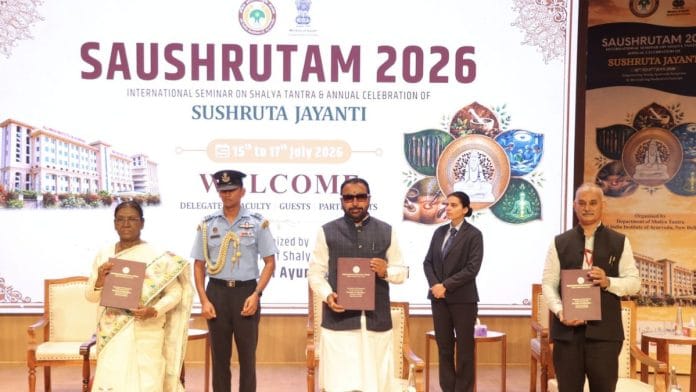


New Delhi: Surgical principles described by ancient Indian physician and surgeon Sushruta, Kshara Sutra therapy for fistulas and leech therapy are being discussed alongside robotic surgery and laser treatments at a Union government conference this week as the Centre steps up efforts to build scientific evidence for Ayurveda and integrate it with modern medicine.
“People usually go to modern medicine first. Ayurveda becomes the second choice. We want people to have confidence that Ayurveda can also provide treatment,” Union Ayush Minister Prataprao Jadhav told reporters Wednesday. He said the government is ramping up research, training practitioners and generating scientific evidence to strengthen awareness and acceptance of Ayurvedic surgical practices.
Jadhav was speaking at Saushrutam 2026, a three-day international conference organised by the AYUSH ministry at the All India Institute of Ayurveda (AIIA) in New Delhi on the occasion of Sushruta Jayanti—the birth anniversary of Acharya Sushruta, popularly recognised as the father of surgery.
The conference is part of the Centre’s broader push to position Ayurveda as an evidence-based system of medicine alongside conventional healthcare. Since the creation of a separate Ministry of AYUSH in 2014, the government has expanded investment in research, education and infrastructure. It has established institutions such as AIIA, supported the WHO Global Centre for Traditional Medicine in Jamnagar, promoted integrative medicine in hospitals and medical colleges, and backed research to generate clinical evidence for Ayurvedic therapies.
Saushrutam 2026 extends that effort by focusing on Ayurvedic surgery and its interface with modern surgical practice.
The conference has brought together surgeons, researchers and policymakers from India, Thailand, Israel, Austria, the United Kingdom, Sri Lanka, Indonesia, Nepal and Greece. Through live surgeries, workshops and scientific sessions, it aims to encourage collaboration between Ayurvedic and modern surgical disciplines.
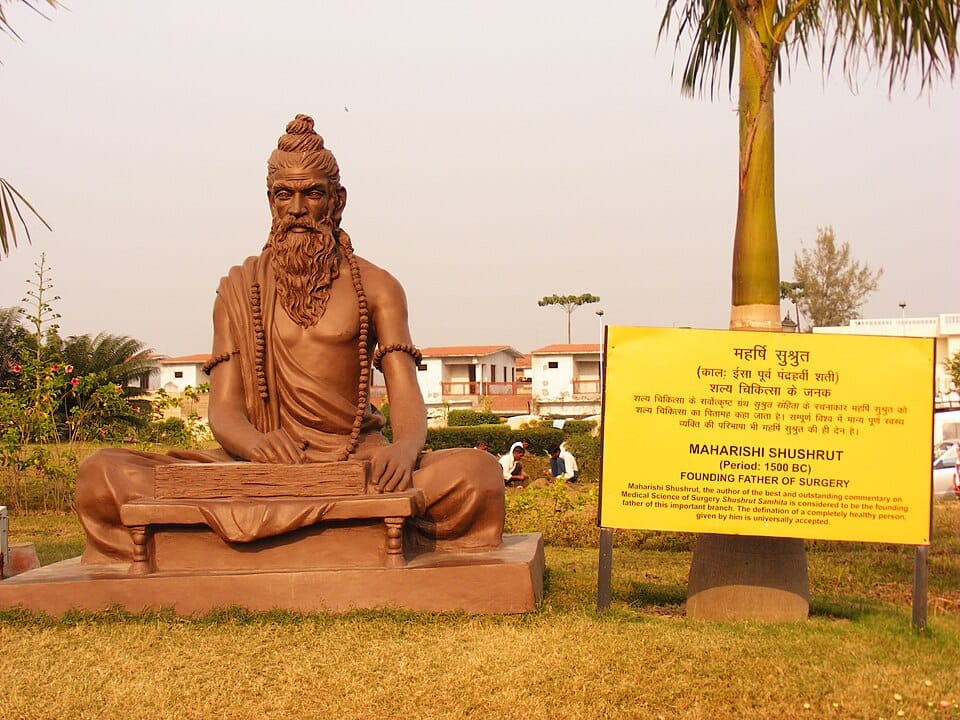
“There is a misconception that there is no surgery in Ayurveda. That is not true,” Jadhav said.
Ministry of AYUSH Secretary Vaidya Rajesh Kotecha said qualified Ayurvedic surgeons are already permitted to perform specified surgical procedures under regulations of the National Commission for Indian System of Medicine (NCISM), but many people remain unaware of this.
In 2020, the commission notified postgraduate training standards allowing MS (Shalya Tantra) and MS (Shalakya Tantra) graduates to perform a defined list of surgical procedures as part of their clinical practice.
Alongside sessions on Sushruta’s surgical principles, Ayurvedic wound healing, Kshara Sutra, Agnikarma, Marma therapy and leech breeding, delegates are attending demonstrations of keyhole surgery for appendicitis and hernia, robotic gallbladder surgery, laser treatment for varicose veins, skin grafting for difficult wounds, bladder examination procedures and hernia surgery in children.
Other sessions cover breast cancer surgery, chronic wound management, blood vessel disorders, integrative cancer care and the use of robotic technology in surgery.
‘Deficiency of evidence one of Ayurveda’s biggest challenges’
Jadhav acknowledged that generating scientific evidence has been one of Ayurveda’s biggest challenges. “There was a deficiency of evidence. Research has increased over the past decade and we are working to build that evidence.”
Responding to questions on why more Ayurvedic research is not widely known, ministry officials said the Ayush Research Portal now hosts more than 43,000 peer-reviewed and indexed publications. They said users can search evidence by disease, including more than 1,600 studies on diabetes, and access full-text research papers.
Officials also referred to the WHO-supported Global Traditional Medicine Library, launched last year, which they said now indexes more than 2 million traditional medicine publications from around the world.
Asked about comparisons with China’s Traditional Chinese Medicine ecosystem, Jadhav said the Ayush sector has grown more than nine-fold since 2014 and now contributes about 1.3 percent of India’s GDP.
“We are already competing,” he said, adding that the government’s focus is on expanding research, strengthening training and increasing international collaboration.
Earlier in the day, President Droupadi Murmu inaugurated the conference and called for integrating traditional knowledge with modern science to strengthen evidence-based Ayurveda. She also inaugurated an AI-enabled 3 Tesla MRI facility at AIIA and released a National Commission for Indian System of Medicine study on the careers of women Ayurveda graduates.
(Edited by Gitanjali Das)