



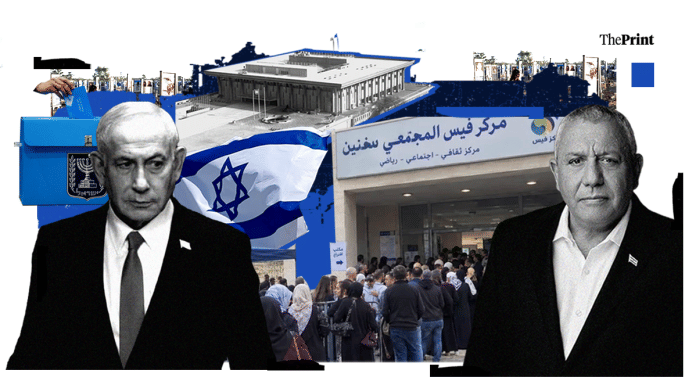
Israel has voted, but it has not decided who should govern or how. Benjamin Netanyahu’s right-wing Likud has emerged as the largest party, projected to win 53 seats, yet his alliance of nationalists and religious conservatives remains short of a parliamentary majority—61 seats. Gadi Eisenkot, the former military chief, who challenged Netanyahu’s political narrative as Israel’s indispensable guardian, is not projected to get the governing majority of 48 seats either. The votes of Palestinian Arab citizens, projected to win 19 seats, could prove decisive in either making or breaking coalition negotiations. As a last resort, a caretaker government under Bibi might continue until the next elections.
There is more to this story than the familiar math of a fragmented Knesset. Netanyahu’s electoral resilience, Eisenkot’s challenge from within the security establishment, and the increased influence of Arab parties reveal three different and crosscutting anxieties about Israel’s future. First, how far the pursuit of security should define national life; second, who gets to define the Jewish character of the state; and finally, whether its Arab citizens can become equal participants in political power.
Over the decades, Israel has become extraordinarily adept at defending itself, innovating and keeping its economy resilient. Yet these achievements have not settled the deeper arguments over identity, democracy and belonging for the country or its citizens.
That is a remarkable predicament for a competitive parliamentary democracy in a region where authoritarian rule and compromised democracies are the order of the day. Yet Israel cannot be reduced to Netanyahu, his coalition or the military establishment. Its courts, civil society, journalists, hostage families, protest movements and advocates of coexistence have repeatedly contested the direction of the state, reminding us that democratic resilience lies not in an absence of conflict but in the capacity to conduct it openly.
Cunning of the zeitgeist
The post-Cold War world was supposed to be moving in a different direction. Despite a few over-generalisations, Francis Fukuyama’s “end of history” argument expressed the optimism that liberal democracy and market capitalism might gradually displace older ideological contests. Globalisation had promised to rearrange politics around markets and money rather than inherited antagonisms in the hope that governments would increasingly weigh the costs of conflict against the dividends of cooperation.
Yet ethnic wars in the Balkans, nationalist movements across the former Soviet space and renewed religious mobilisation suggested that economic calculation could not dissolve historical memory. In 1995, philosopher Nancy Fraser observed that the “struggle for recognition” was becoming a defining feature of political conflict. She did not claim that material inequality had disappeared. Quite the opposite, Fraser’s concern was that demands for cultural standing were rising while economic injustices persisted. Redistribution and recognition, she argued, must be considered together.
Three decades later, that distinction offers a revealing insight into Israel. For instance, prosperity cannot decide whose traditions define the nation. Further, formal citizenship does not, by itself, resolve who may legitimately speak for it, and finally, military strength cannot answer what kind of political community it protects.
Also Read: National security is centrepiece of Israel elections, but GenZ is voting for freedom of choice
Shaped by memory, nurtured by trauma
The political imagination of early Israel was, in important respects, socialist. Early Zionism imagined not merely a Jewish refuge but a society organised around collective labour, agricultural settlements and social solidarity. The kibbutz, or a communal settlement, became its symbol. Labour dominated the state’s early decades, shaping institutions often associated with the European-origin Ashkenazi Jewish establishment.
But Jewish statehood was never simply a project in economic reconstruction. Zionism had a bloody birth. It emerged amid antisemitism and exclusion. The Holocaust gave the aspiration for sovereignty a terrible urgency. In 1948, Israel’s establishment was understood by its Jewish founders as the promise that a persecuted people would possess the means to defend themselves. Whereas for the Palestinians, the year also marked the Nakba, the catastrophe of displacement and dispossession. These memories of the same historical rupture continue to shape incompatible understandings of justice and homeland.
Successive wars ever since have made battle-readiness a central institution of Israeli life. Security became more than a government’s responsibility: it was woven into the meaning of national survival.
Scholars of international relations call one aspect of this “ontological security”—the desire of states and societies for continuity in their understanding of themselves, which goes beyond the protection of territory and lives. In Israel, the promise that Jews should never again be defenceless has acquired both strategic and existential force.
But the problem with internalised trauma is that it does not yield uniformly inevitable politics. The atrocities of 7 October 2023 struck all of Israel. Even Israelis with sharply different political views came together under that common vulnerability.
The pursuit of security, however, has also had a devastating price beyond Israel’s borders. The scale of mass killing, displacement and destruction inflicted on Gaza during Israel’s military campaign after 2023 has been disproportionate to the trauma of 7 October. Entire neighbourhoods have been reduced to rubble; families have lost children, homes and livelihoods; and the humanitarian emergency has continued despite on-and-off ceasefire arrangements.
A United Nations commission of inquiry has accused Israeli authorities and forces of grave international crimes, including genocide, findings that Bibi’s government disputes. Whatever the legal contest over those conclusions, the suffering of Palestinian civilians cannot be disputed.
Netanyahu’s political narrative has rested on this insecurity being converted into a case for his indispensability. His rejection of Palestinian statehood and emphasis on deterrence are central to his appeal. From that vantage point, permanent conflicts and forever wars risk becoming not a condition to overcome but the organising principle of political life.
Eisenkot challenges Bibi’s political project. A former IDF chief, he draws authority from the security establishment, not from opposition to it. He remains sceptical of Palestinian statehood under present conditions and champions Zionism and universal conscription. He claims that commitment to Israeli security need not entail commitment to Netanyahu’s political survival.
In other words, a change of government need not be a change of security doctrine.
This is not a simple election between hawks and doves. It is a contest over who may claim the mantle of security, how institutions should be governed and whether Israel’s survival must be narrated through the authority of a single leader.
The many meanings of Jewishness
Even the phrase “Jewish state” conceals extraordinary social diversity. Israel’s Jewish citizens trace their lineages across Europe, North Africa, the Middle East, Ethiopia and elsewhere. They range from secular to ultra-Orthodox, with many traditions in between. Their shared political home has never implied identical cultural memories or obligations.
The traditional class divide between Ashkenazi Jews of European origin and Mizrahi Jews with roots in the Middle East and North Africa is especially instructive. Early Israeli institutions were disproportionately dominated by Ashkenazi elites. Many Mizrahi arrivals experienced unfair treatment and cultural condescension. Their grievances concerned housing, education and employment, but also whether their traditions were recognised as fully Israeli.
The political upheaval of 1977—when Menachem Begin’s Likud displaced the long-dominant Labour establishment—drew significantly upon Mizrahi disaffection. Yet Begin was Ashkenazi, as is Netanyahu. But it is important to note that Mizrahi voters became central to the political right without immediately transforming the highest leadership.
Eisenkot, the son of Moroccan Jewish immigrants, represents a further transformation. He rose to command the armed forces and now contests the premiership through the language of service, responsibility and institutional authority rather than an explicitly ethnic platform. His son’s loss in the Gaza war has given his public life an intimate connection to the sacrifices demanded of Israeli society.
Mizrahi origins, per se, however, do not determine political outlook. Aryeh Deri’s Shas draws upon Sephardi and Mizrahi religious traditions while defending ultra-Orthodox interests. Itamar Ben-Gvir, whose family has Iraqi and Kurdish Jewish roots, represents a markedly different religious-nationalist politics. Disagreements over military conscription similarly expose competing definitions of citizenship: for many Jewish Israelis, service embodies collective responsibility; for sections of ultra-Orthodox society, compulsory enlistment challenges the autonomy of religious study.
Thus, the internal argument over Israel’s character cannot be reduced to a contest between Jews and Arabs, or between secularists and believers. There are multiple, often conflicting visions of Jewish nationhood itself.
Also Read: Who are Israel’s Arab parties, what they want, why they matter
Democracy and the boundaries of belonging
The position of Palestinian Arab citizens introduces a harder question. Roughly one-fifth of Israel’s population, or 20 per cent, is Arab. Their exceptional mobilisation in the 2026 election was very much related to the catastrophe in Gaza.
Preliminary reports suggested turnout approaching 80 per cent among Palestinian citizens, compared with approximately 56 per cent in 2022; finally the turnout reached 77.7 per cent. Palestinian voters and researchers linked this surge to seething anger over Bibi’s campaign in Gaza, hostility toward his far-right coalition, and discrimination at home. For many, voting was a means of reclaiming political agency, not an endorsement of either of the two major Jewish-led blocs.
That said, Arab-led parties themselves differ in outlook and do not necessarily share either Netanyahu’s Zionism or Eisenkot’s security premises; some also reject Hamas’s methods while disputing Israel’s conduct of the war. Those substantive differences are telling. The question of Arab citizens inside Israel must also be distinguished from that of Palestinians in the occupied West Bank and Gaza, who inhabit fundamentally different legal and political circumstances.
Democracy does not oblige incompatible parties to govern together. But exclusion grounded in national identity rather than policy disagreement raises a different problem. In 2021, the religious-Zionist Naftali Bennett led a coalition including Mansour Abbas’s Arab Islamist Ra’am—an unlikely arrangement that showed the boundary was negotiable but short-lived.
Fraser later argued that justice also requires political representation, alongside recognition and economic equality. In Israel, having the right to vote is not the same as being accepted as an equal participant in political power. Israel’s Arab electorate has made that tension harder to evade.
But the consequences travel beyond Israel. The 2020 Abraham Accords demonstrated that Arab–Israeli cooperation could advance without resolving the Palestinian question. They did not establish that Palestinian claims had ceased to exist. For now, Gaza’s future, the West Bank and the prospects of Saudi normalisation remain entangled with Israel’s internal decisions about security, territory and political rights.
For India, whose partnerships with Israel and the Gulf intersect with ambitions for regional connectivity, the takeaway is insightful: corridors cannot alone reconcile competing claims of history and homeland and even less so the questions of identity, even when they promise economic dividends.
Swasti Rao is a Consulting Editor (International and Strategic Affairs) at ThePrint. She tweets @swasrao. Views are personal.
(Edited by Insha Jalil Waziri)