




Tukaram Mundhe has brought Maharashtra’s Food and Drug Administration the sense of urgency it badly needed. Every restaurant now takes inspection seriously. The Bombay High Court, meanwhile, has spent much of the summer appearing to clip the Maharashtra FDA chief’s wings.
Since Mundhe took charge, we have identified at least sixteen disputes over FDA action that have produced reasoned orders in the High Court. All sixteen have gone against the department. It is tempting to see this as the court poking its nose into administration. We think the court has no other option.
The Food Safety and Standards Act (FSSA), 2006, bakes a serious weakness into the FDA’s institutional legitimacy: a business challenging a licence suspension is forced to appeal before the Commissioner who heads the department (here, Mundhe) that imposed it. In effect, the law rolls judge, jury and executioner all into one role. That cuts against the spirit of the Constitution’s separation-of-powers principle: final review of the exercise of public power should not lie with the same authority that wields the stick. As things stand, the High Court’s interference is the only independent check against unjust exercise of power.
Also Read: Stalking judges’ assets helps nobody. We must rethink how we audit our judges
The diagnosis
At a press conference in August, Tukaram Mundhe said that 103 of the 165 establishments whose licences had been suspended since he took charge had appealed. “Every Tuesday I conduct hearings,” he said. He does this under Section 32 of the FSSA, which deals with the suspension or cancellation of licences. Under subsection 4, appeals go to the Commissioner of Food Safety, whose decision the law says shall be “final”.
Think of a parallel in tax collection. Imagine the tax department raises a demand on Rs 25 lakh of “unexplained” income. You appeal. The same department reconsiders its own finding and, after scrupulous review, agrees with itself. Imagine further that the law says this is the end of the statutory road. A writ petition at the High Court, a constitutional route, becomes the last resort when the statute leaves you no further remedy.
Something similar played out at the Bombay High Court.
Santosh Sagam’s hotel in Ahilyanagar was inspected on 3 July and suspended on 4 July, before he had been given a copy of the inspection report. He appealed, and the Commissioner ordered a fresh inspection. On 17 July, the department’s own inspectors scored the hotel 99 per cent. He went to the High Court anyway on 22 July, and Justice SG Chapalgaonkar declined to intervene at that stage, recording that “it is expected that appellate authority would immediately pass an order in pending appeal”. On 11 August, the state’s lawyer told Justice Manjusha Deshpande the order would come “within a period of two to three days”, and she agreed to wait. On 13 August, the Commissioner dismissed the appeal, confirmed the suspension and refused a stay.
The natural question is why the FDA’s orders are not appealable to a tribunal, the way income tax law provides for the Income Tax Appellate Tribunal (ITAT). The strange fact is that the FSSA does set up an appellate tribunal. It just does not have jurisdiction to review orders suspending food establishments’ licences.
An elusive tribunal
The FSSA builds two different routes for challenging a regulatory action.
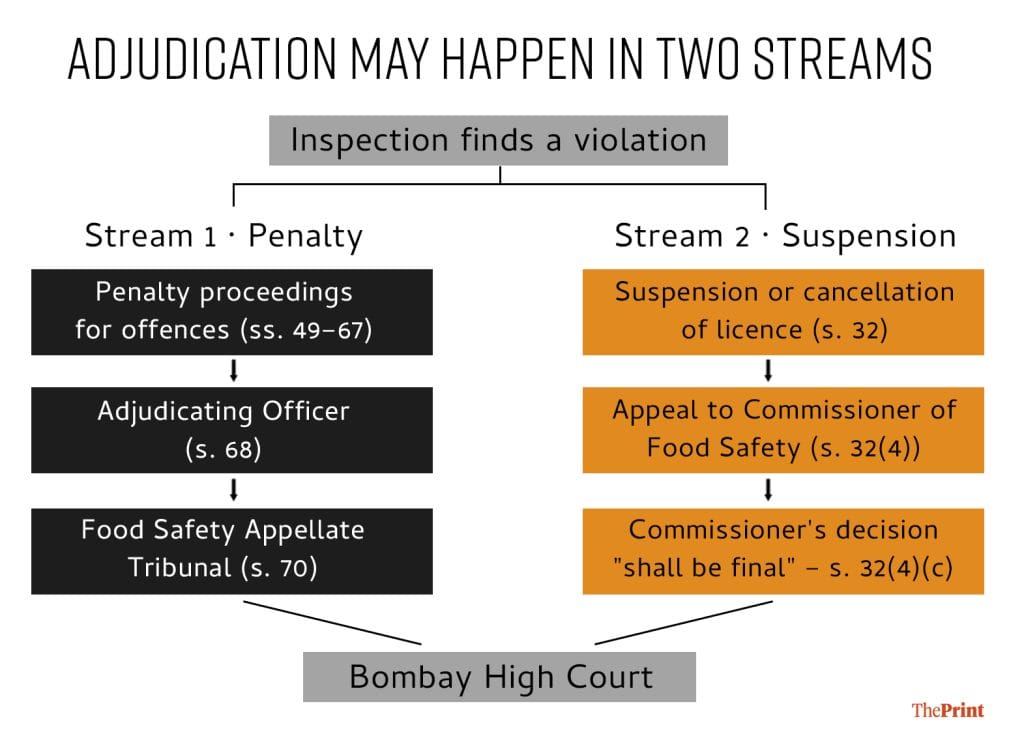
Stream 2 is what we dealt with in the previous section. For penalties under the Act, as opposed to licence suspension or cancellation, a different stream applies. If you are penalised for selling misbranded or sub-standard food, an adjudicating officer conducts an inquiry and passes a reasoned order deciding the penalty. If you remain aggrieved, the Act offers thirty days to appeal to a Food Safety Appellate Tribunal (FSAT) under section 70, headed by a sitting or retired district judge. Lose there, and there is another statutory appeal to the High Court under section 71(6). In short, the Act builds a full appellate chain outside the FDA for orders imposing a monetary penalty.
This creates an odd mismatch: the heavier the sanction, the lighter the appeal structure. The Act provides an independent appellate forum for monetary penalties, but not for a decision that can shut a business altogether.
Off paper, that system works even worse. First, this tribunal is nearly impossible to locate. Maharashtra’s FSAT has no dedicated public website or clear helpline (unlike, say, the Jaipur FSAT). We called at least six different numbers in the FDA’s offices, and none could assist with the query. On physically visiting the headquarters, we were made aware that the FSAT’s functions have been merged with the district consumer courts in Maharashtra, though we could locate no official notification or public document online confirming this.
Second, a body this quiet is either not being used or not being useful. Since the tribunal itself offered so little to work with, we looked to the next forum, the Bombay High Court, where its decisions might surface. In TheProfesseer’s CourtsDataLab, of the 751 matters since 2015 whose orders engage with the Food Safety and Standards Act, we read every one that names the tribunal or invokes the appellate provision. We found just five matters across eleven and a half years. One of those five shows how long the full route can take. Tata Chemicals was penalised in 2013, lost before the tribunal in 2016, and was finally exonerated by the Bombay High Court in 2024.
Three urgent changes are needed
As Tukaram Mundhe settles into his 22nd pair of bureaucratic shoes, there are changes he can make himself, and others the legislature must make for him. This is key to the legitimacy of his orders.
First, Mundhe should publish the details of his own appellate hearings. This must include statistics on appeals allowed and dismissed, as well as the time taken to decide these matters. Wielding quasi-judicial power, his orders must be reasoned and available for public scrutiny.
Second, the legislature should delete the finality clause from s.32(4), and allow suspension appeals to go on to the Tribunal. A business should have an accessible and effective forum they can take their appeals to before having to approach the High Court.
Third, that only works if the tribunal itself works. A body vested with the powers of a civil court should not be this difficult to find. Its benches, procedures, orders and basic caseload figures should be publicly accessible.
Laws are not written for the commissioner you like. A power this broad can feel reasonable in the hands of a popular commissioner working towards the promise of “Safe Food, Safe Drug, Safe Maharashtra”. The real test is what it lets the next commissioner do when a food business criticises the government, refuses to play along, or finds that the officer woke up on the wrong side of the bed.
Srikanth Rajkumar is a Developer and Data Scientist at TheProfesseer. He tweets @SonOfRajkumar. Gokul Sunoj is a Legal Associate at TheProfesseer. He tweets @GokulSunoj. Views are personal.
(Edited by Asavari Singh)
Your comparison with income tax is wide off the mark. Unlike income tax which is a matter between the individual and the department, here there is a huge public health and safety issue involved. If (let’s say) many rats and cockroaches were found in a kitchen and its license was suspecnded, can they ask for a reversal simply by a one-time killing of those pests? How do they convince the FDA and the public that the poor hygiene issues will not recur?