






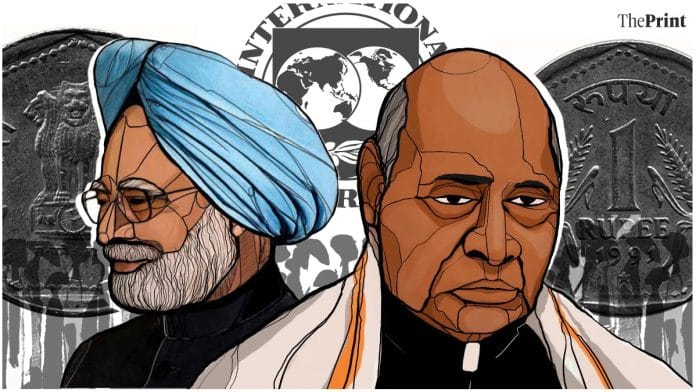


The reforms of 1991 are seen by many as having been India’s economic launch pad. In his Budget speech of 24 July 1991—35 years ago today—Manmohan Singh quoted Victor Hugo to say “No power on earth can stop an idea whose time has come”, and added: “I suggest to this august House that the emergence of India as a major economic power in the world happens to be one such idea.”
Thirty-five years later, what is clear is that the dismantling of industrial and trade controls on that day served to accelerate India’s rate of economic growth, as well as the rate of its poverty reduction. But one would have to add that the promise of 1991 has been redeemed only partially. Indeed, the country once again finds itself at a cusp, confronted by new challenges of economic security, technological adequacy and an inclusive pattern of growth that have no easy answers in a less than hospitable global climate.
In the 40 years to 1990-91, the economy had grown five-fold. Since the population grew two-and-a-half times in that period, income per head barely doubled, as a result. In comparison, in the 35 years since 1990-91, the economy has multiplied eight-fold. And since the population has grown by 70 per cent in the interim, per capita income has multiplied more than four-and-a-half times.
It goes without saying that the achievements of the second period have been built on the foundations laid in the first. Yet India basically under-performed in relation to other countries in the first period, but has a growth record in the second period that not many countries can match.
China and Vietnam show that much more could have been done. Starting from a comparable point, the first is on the threshold of achieving high-income status. Vietnam started out with less than half India’s per capita income in 1991, and now has an 80 per cent higher income level. That puts it in the upper-middle income group, whereas India, ranked in 1991 among the low-income countries, is still only in the lower-middle income group.
Three-quarters of all countries rank above India on per capita income. India’s figure is less than a quarter of the world average. However much we may pat ourselves on the back for the achievements of the past 35 years, it has not been anywhere near enough, and much remains to be done.
Still, absolute poverty has dropped sharply. Destitution blighted 37 per cent of the population in 1991; that is down to 5 per cent. But that only takes bare survival as the yardstick. On broader indicators, the record is more qualified. On the composite multi-dimensional index (which includes health, education and other indicators), one sixth of the people are still poor. On the UN’s human development index, India is two-thirds of the way down the list of 192 countries.
Yet there is now much-improved (though not universal) access to many basic goods and services, like clean cooking fuel, treated tap water, toilets, low-cost financial services and household electricity. Also, the country’s physical infrastructure has improved noticeably in recent years.
Though some of the accomplishments are modest in an international context, India enjoys traction in a way that it did not before. That is primarily because of the size of its population, the world’s largest. As the sixth-largest economy, India has among the world’s biggest markets for a whole range of products and services. These reflect the birth of a large middle-class with money to spend.
There is no one way to define that class, but a commonly used income criterion cuts off at a minimum per capita income of $10 per day, using purchasing power parity for rupee comparison. At a rough guess, that would include 30 per cent to 40 per cent of India’s population of 1.45 billion, yielding a vast middle class (more correctly, the upper echelon) that is more numerous than the entire population of all countries other than China.
The existence of anywhere between 80 million and 100 million households in this category explains annual sales of 20 million for two-wheelers, 25 million for refrigerators and 150 million for smart phone handsets (plus another 250 million for feature phones). Every day more than half a million people take off or land at what are among the busiest airports in the world. As many cars are now sold in a fortnight as were sold in all of 1991. Products are more affordable relative to incomes, are of better quality, and offer greater choice.
It is not just the size of its markets. Over these 35 years India has become recognised for its expanded capabilities—in software services, for instance, and the manufacture of low-cost pharmaceuticals that became globally useful during the pandemic. Also recognised are its ultra-low-cost digital infrastructure stack and technological sophistication in oil refining, the manufacture of speciality chemicals and some engineering goods, as well as in medical care. Dozens of countries higher up the income ladder cannot claim any of this, or the massive roll-out of solar and wind energy capacity. Based on how these capabilities are reflected in the country’s export mix, India ranks in the top third of 145 countries on the Harvard Growth Lab’s Economic Complexity Index.
Much more would have been achieved if the country had followed through with the core logic of the 1991 reforms: to leave to the private sector and markets what they can deliver, open up to the world, and focus government efforts on what governments alone can deliver: law and order, justice, public health, quality state schools, environmental protection and the proper regulation of markets.
On each of these, India is found wanting. The country has 2.2 million policemen, and four times as many private security guards. Court delays are endemic. Half of all school children now go to private schools, and 40 per cent of hospital beds are privately provided—both involve paying not modest charges when incomes are still modest (though there is now a government-funded insurance programme for hospital bills). Poor nutrition levels find reflection in widespread stunting and wasting.
Tax revenues are not enough to change this picture, and public debt has been uncomfortably high since the pandemic. Shrinking shares (relative to the larger whole) are being spent on both education and defence, and practically nothing on purely civilian research and development. On top of which, the informal sector of the economy still overshadows the smaller organised sector. A Reserve Bank tracker therefore shows poor improvements in productivity.
Agriculture remains largely unreformed, with significant productivity shortfalls when compared with world averages. Manufacturing remains stunted despite many policy initiatives. Over the past decade-and-a-half, these have found reflection in the sharply declining ratio of merchandise exports to GDP, even as protectionist tariffs and other barriers have been raised.
The reforms left undone find reflection in worrying trends. The middle class is no longer growing as it once was, as quality jobs have become more difficult to find. The top cohort of the population is leaving the country in greater numbers, while net inflows of capital have reduced and domestic private investment has fallen short in recent years, though companies and banks are flush with cash.
The hardest hit is the bulk of the population which lies between the middle class of some 400-450 million and the multi-dimensionally poor population of 250 million. Some have termed this an aspirational category. In truth, as Thoreau said in a different context, most of them lead lives of quiet desperation because of low and uncertain incomes in the informal sector.
Some in this group have shown up at New Delhi’s Jantar Mantar protest zone over the past month, youngsters in age cohorts that have between 25 per cent and 40 per cent unemployment. Post-school enrolment in higher education institutions has nearly quadrupled since 1991, to now include half of all school-leavers, but many of their degrees and diplomas have little value and so they stare at a grim future.
The political class has kept economic distress in the bottom rungs under control through an expanding array of cash hand-outs, plus free foodgrain, free electricity in many places for low-end consumers, and massive subsidies that are not fully accounted for in government budgets. But these are unlikely to quell the discontents of the “cockroaches”, many of whom must have a sense of being among the excluded in a country with glaring and growing inequalities. The system finds it easier to offer identity-based politics as an opiate, than what is most important for millions of hard-pressed people: the hope of a better future.
TN Ninan is a former editor of Business Standard. Views are personal.
(Edited by : Insha Waziri)
1978 created a better China. 1991 created a better India. At one stage, the two countries were roughly on par ( which Indian diplomats feel was carved in stone ). The 5 : 1 asymmetry that has emerged is due largely to the consistency and force with which economic reforms have been pursued in the two neighbouring countries. Still not too late to open the faucet. Start by joining RCEP and CPTPP, reviving SAARC, even if South Asia is less prosperous that South east Asia.
India remains a third-rate socialist, undeveloped, dirty, and corrupt country. If this is the situation in 2026, imagine the horror before 1991.