






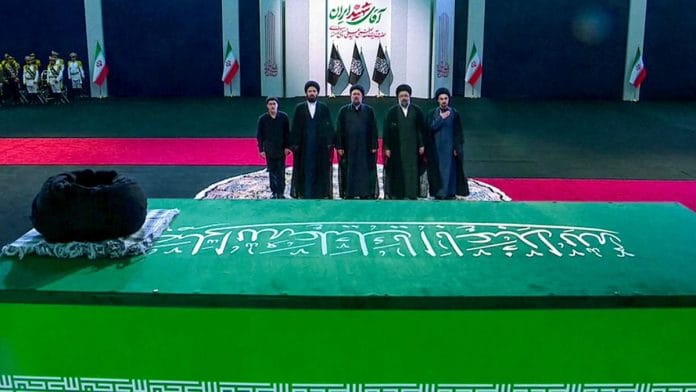


On 3 July, Iran began public commemorations in Tehran at the Imam Khomeini Mosalla Grand Mosque for its assassinated Supreme Leader Ayatollah Ali Khamenei. The 86-year-old was targeted in the first airstrike of the US-Israeli war against the Islamic Republic. The commemoration began with a powerful message of continuity for the Islamic Republic and Ummah, religious solidarity.
Official state delegations and representatives from around the world attended the funeral ceremony. It was the beginning of a six-day journey through Qom, Najaf, and Karbala ahead of his burial at the Imam Reza shrine in Mashhad on 9 July. But was it just a burial or something more?
Saudi Arabia stood out
Saudi Arabia’s Deputy Foreign Minister Waleed Al-Khuraiji led a delegation to Tehran and attended the official memorial ceremony. The Saudi representation was cautious yet symbolically significant, marking a notable act of Saudi-Iranian diplomatic engagement amid continued regional tensions over authority and Western influence.
Iran and Saudi Arabia restored diplomatic relations in 2023, an agreement that affirmed sovereignty and non-interference. But more often than not, the two have been at odds.
The presence of Saudi Arabia indicates that religious solidarity can still be a strong pull factor in regional unity.
Saudi Arabia’s ‘unexpected’ presence at the funeral shows how the martyrdom of Ali Khamenei united the Ummah despite contemporary regional rivalries.
It marked the de-escalation of the Iran-Saudi confrontation, along with public recognition of Iran’s political continuity, without endorsing Iran’s ideology.
The presence of the Deputy Foreign Minister, rather than the Crown Prince, Mohammed bin Salman, was a balanced move to keep the diplomatic channel open, the Western alliance intact, and to maintain an autonomous regional authority capable of balancing among Iran, the Gulf, and the United States.
At the funeral, Iran diplomatically shifted the attention of the Muslim community from being defensive to stability and expansion through the context of the Battle of Badr.
The Quranic recitation of Surah Aal-e-Imran (3:13) during the tribute by the Saudi delegation, referring to the Battle of Badr, was interpreted as a reminder that military strength, strategic alliances, and numbers do not determine victory, but rather fighting in the cause of God.
The choice of verse reads both as a definitive diplomatic message for fellow Muslims to distinguish themselves from external powers, particularly the US and Israel, and a reconciliatory assertion that security rests in faith and divine power.
Symbolically, the recitation underlines Iran’s survival through faith, resistance, and divine support, and signals Islamic responsibility beyond sectarian rivalry and toward preserving diplomatic channels.
Also read: We are living in the new Hormuz World Order
Symbolic unity of Islamic identity
During the funeral ceremony, despite sectarian and ideological differences within the Islamic world, Iran projected a strong, unified Islamic identity through the choice of Muharram for the funeral.
Muharram, the first month of the Islamic lunar calendar, is historically rooted in the Battle of Karbala in 680 CE. It symbolises mourning, martyrdom, resistance, and collective Islamic memory, shaping religious identity, political ideas, and social movements within Islamic communities.
Even the funeral procession passing through Karbala, Iraq, shows how the region is connected to that history.
Iran framed Khamenei as a martyr of resistance, with religious, political, and regional significance to the funeral—a projection of smart power.
Muharram for Shia Muslims is a collective language for standing against tyranny, while for Sunni Muslims it is associated with fasting and remembrance. Muharram is symbolically linked to the Karbala paradigm, which is not merely a historical memory but a political language.
It’s a language in which every Muslim, regardless of opposition, symbolically perceives death as a sacrifice against injustice and oppression, and responds through public mourning. It evolves into a collective language of justice, loyalty, suffering, martyrdom, and moral conflict.
The presence of Saudi Arabia highlights the strength of religious values in Islamic societies, reinforcing the regime’s ideology.
Iran’s actions go beyond legitimising continuity after Ayatollah Ali Khamenei as a sacred duty. It links loyalty to the Islamic Republic to loyalty to the memory of martyrdom, as they are rooted in the religious-political history of Karbala.
In simple terms, Karbala helps convert grief into political legitimacy—a key need for its external support and internal stability as it fights a war.
Also read: Khamenei funeral shows Iran’s diplomatic relevance for India and its neighbours
Isolating Iran?
Despite US efforts to isolate Iran, Tehran just showed how it can still leverage its historical and religious ties. Saudi Arabia, a key US partner, sent a high-ranking official to commemorate Ayatollah Khamenei, signalling reluctance to fully follow the US-Israel isolation policies at the expense of Islamic values and solidarity.
While their diplomatic ties are strained, religious identities and shared values legitimise Khamenei’s political and religious continuity.
These ties allow Iran to project moral authority through its geopolitical relevance and non-Western authority ties with China, India, Russia, Pakistan, and other Muslim-majority countries.
When the US is attempting to invoke the notion of democracy through Western values, Iran’s procession through Iran and the city of Karbala in Iraq projected nationalist sentiments and the ideological depth of the current regime.
It is too early to conclude who won the war in West Asia, but Iran has just dropped a powerful message of regional unity and its capacity to position itself as an influential leader.
Azeemah Saleem is an independent researcher on West Asia and North Africa. She holds a PhD in West Asian Studies from the School of International Studies, Jawaharlal Nehru University. She tweets at @AzeemahSaleem. Views are personal.
(Edited by Theres Sudeep)