






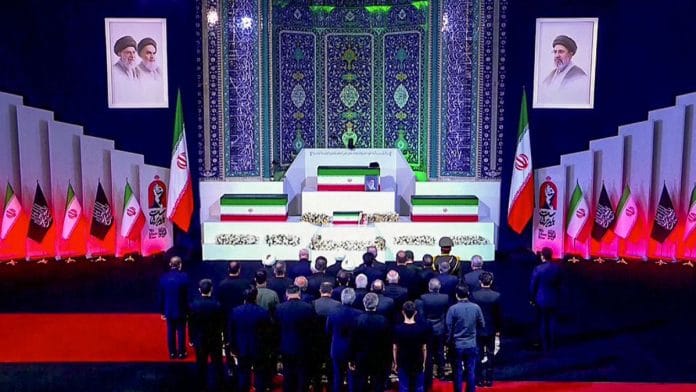


Tehran witnessed high-level movement from almost 100 countries across the world, including heads of state, government officials, ruling and opposition party leaders, military officials, influential figures from civil society, and religious leaders. They were all in Iran for the state funeral of Supreme Leader Ayatollah Khamenei, who was killed by US-Israeli airstrikes on 28 February 2026.
The global attendance in mourning exhibited Tehran’s political, religious and strategic outreach, with the global community, and most importantly with countries that preferred a ‘measured distance’ in the backdrop of the US-Israel strikes.
While leaders from the West were largely a miss, Russia, China, and India were among the key countries in attendance. Iran also used this opportunity for “regional engagement” as the Parliament Speaker Mohammad Baqer Qalibaf held talks with global leaders on the sidelines.
Countries in India’s neighbourhood were present in good numbers, especially those importing Iranian oil and have been affected by the US-Iran war and the choking of the Strait of Hormuz. This reflects how crucial Tehran remains as a cultural and strategic partner.
While future studies would be required to examine the impact of the crisis on smaller countries, the Indian subcontinent would be an important focus. The region is among the largest consumers of Iranian oil, with India having the highest volume.
Here is a glimpse of key attendance from the region.
India’s official delegation included Syed Ata Hasnain, Governor of Bihar, and Pabitra Margherita, State Minister in the Ministry of External Affairs. Besides the official representation, leaders of the Opposition parties, including Congress, and key civil society members were invited.
The media also zoomed in on the presence of Mehbooba Mufti, former Chief Minister of Jammu and Kashmir, and Salman Khurshid, Congress leader and former Foreign Minister in the UPA-2.
While Iran’s outreach with the Opposition leaders reflects its strategic coverage of India’s political establishment, the presence of Opposition leaders from Kashmir showcased deep-rooted religious ties with the local Shia community. It anchors an ideological and religious outreach Tehran has historically enjoyed with the valley for centuries.
If there is one country that has been on good terms with all parties—United States, Israel and Iran—it is India. Even if India’s direct role in peace facilitation is not always visible, New Delhi has time and again advocated diplomatic means to resolve the conflict.
Just before the Indian delegation departed for Tehran on 3 July, Prime Minister Modi was briefed by the Iranian President Masoud Pezeshkian in a telephonic conversation on regional developments on 30 June.
Also read: Iran-US MoU is an opportunity for India. Or forget the $5-trillion economy
Iran’s eastern neighbours
From Pakistan, the so-called ‘popular duo’ of Prime Minister Shehbaz Sharif and Army Chief Asim Munir, reportedly led one of the biggest delegations to Tehran. The two sides have been at loggerheads in the past, notably the 2024 Iranian airstrikes on Pakistan targeting the terrorist armed group, Jaish al-Adl. The group was accused of launching deadly attacks against Iranian border guards since at least 2013 and has previously claimed bombings and kidnappings of border police.
However, since the war broke out in West Asia, the Pakistani duo has sought prominence for facilitating dialogue between Iran and the United States on its soil.
Pakistan seems to be seeking an opportunity during the crisis to find a regional role. It’s an ambition that has failed to materialise due to its existing terror nexus and failure to counter it.
What’s even more interesting is that despite frequent visits to the White House and meetings with American leaders, the latest US Congress report, “Terrorist and Other Militant Groups in Pakistan”, still notes the presence and activities of the terror outfits in Pakistan.
While Iran sees Islamabad’s connection with White House as key, Tehran has always been wary of its next-door neighbour’s intentions and activities.
Iran’s other eastern neighbour, Afghanistan, was represented by the Taliban regime’s Deputy Prime Minister Abdul Ghani Baradar and Foreign Minister Amir Khan Muttaqi. Iran has been a major trade and energy partner of Afghanistan, yet issues like migration, refugees, and Helmand River water sharing continue to cause friction in the relationship. Despite their differences, Pakistan remains their common challenge in the region.
Bangladesh also sent an official delegation to Tehran, headed by the Speaker of the Bangladesh Jatiya Sangsad, Hafiz Uddin Ahmad.
Bangladesh’s Ministry of Foreign Affairs noted that “Speaker Hafiz Uddin expressed his profound condolences on the tragic demise of His Eminence and condemned his brutal killing.” And “He conveyed the solidarity of the Government and the people of Bangladesh with the Government and the brotherly people of Iran during this period of national mourning.”
Bangladesh’s official delegation was among the few countries that held a sideline conversation with Iran’s Parliament Speaker Qalibaf. Besides the Jatiya Sangsad Speaker’s presence, a delegation of the 11 opposition parties led by Jamaat-e-Islami leader Mujibur Rahman was also present.
While Bangladesh shares socio-cultural and religious ties with Iran, its presence was also important from an energy point of view. Hormuz remains a key gateway for Dhaka’s energy imports from the region. While prices have peaked for common people, Dhaka has been navigating a tough time as energy has had an impact across sectors, including agriculture.
Also read: India has lost the language for Iran
The smaller countries
Besides India, Afghanistan, Bangladesh and Pakistan, no representations from the Himalayan countries, Nepal and Bhutan, were reported by the media or their ministries. Notably, both Nepal and Bhutan are landlocked countries and rely on India for their petroleum needs. However, Kathmandu maintains diplomatic ties with Tehran.
The diplomatic connection between Kathmandu and Tehran is managed through the Embassy of Nepal in Doha, Qatar, which holds non-residential concurrent accreditation to Iran.
Interestingly, Nepal has an Honorary Consulate in Tehran, established in July 2011. Bhutan, on the other hand, has no diplomatic ties with Iran. Also, there is no verifiable information available on whether invitations from Iran were sent to the two Himalayan countries.
A similar absence of media reports and official communications was observed in the Island country of the Maldives. Although a digital media platform, Javiyahi reported that the Maldivian government sent a delegation, nothing beyond the headlines could be extracted. The two countries have shared religious ties.
Sri Lanka was among the invited to the state funeral of Iran’s Supreme Leader. The island was represented by the deputy House Speaker, Rizvie Salih, a Muslim politician from Sri Lanka.
While the two countries have deep-rooted ‘friendly ties’, Sri Lanka has been adversely affected by the energy crisis following the crisis in West Asia. The Iranian mission in Colombo has promised to help the island with energy supplies.
Historically, Sri Lanka’s ties with Iran have spanned the economic and energy sectors, with Tehran contributing to the island’s ‘technological development’ sector.
While there were select responses from the Indian subcontinent in the aftermath of the US-Israeli airstrikes on Iran in February, invitations for a state funeral of Iran’s Supreme Leader to countries of the Indian subcontinent exhibit Tehran’s strong regional ties, especially on the religious front.
Geographically smaller countries seek energy security. As soon as the crisis is over, hopes are high that their economies will normalise as the dent of inflation caused by the war in West Asia is realised across the sub-continent.
Rishi Gupta is a commentator on global strategic affairs. The opinions expressed in this article are those of the author alone and do not reflect the views of the author’s current or past affiliations in any form.
(Edited by Theres Sudeep)