





One has to be an incorrigible optimist to believe that the US-Iran agreement signed on Thursday will last forever. Even the leaders who inked the deal may not believe that.
Just days before signing the deal, US President Donald Trump, speaking at the G7 summit, warned Iran that any change to the peace agreement or failure to comply could bring an immediate military response. “If they don’t behave, we’ll go right back to dropping bombs right smack in the middle of their head,” he said.
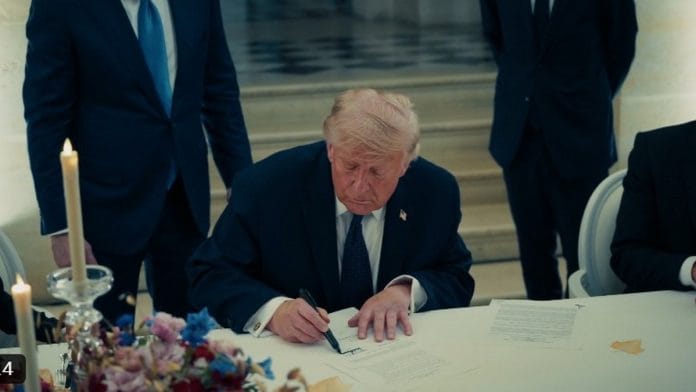
Even after such nasty and unpleasant remarks, Trump signed a copy of the US-Iran agreement at the Palace of Versailles. A photo of the signed agreement was sent to Tehran, and the document was then signed by Iranian President Masoud Pezeshkian.
The agreement gives Washington and Tehran 60 days to reach a final settlement, with the first round of follow-up talks scheduled for June 19 at the Bürgenstock resort in Switzerland.
Though hostilities may cease for some time, lasting peace is unlikely. New Delhi should use this brief period to fortify its resources.
Also Read: Reset, rapprochement or relief? What Modi and Trump bonhomie in France achieved
Fragile peace prospects
Talks are probably proceeding only because fatigue has set in after a hundred days of intense hostilities. The massive economic disruptions, destruction of valuable assets like oil wells and related infrastructure, and above all, the collapse of maritime trade through the region have ironically resulted in a situation that is conducive to a deal that looks like a bitter pill.
This bitter pill might work, considering the fact that the opening of the Strait of Hormuz will benefit Iran and Oman as trade resumes. Countries that are highly dependent on oil and gas from West Asia will bend over backwards to keep the peace deal effective and working. Finally, the US will reap the benefit of trade as every drop of oil sold will fetch them green bills.
Yet, trade and economics alone are not enough to keep the peace deal alive for long. After all, several peace deals have preceded the present conflict. What the two parties have signed is only a memorandum of understanding, and the actual deal for a total end to war will come next.
Between the two agreements, there is a huge gap, a lack of confidence, an enormous amount of mistrust, if not fierce hatred for each other, and several other stumbling blocks—a major one being Iran’s nuclear programme.
The Iran nuclear deal, or Joint Comprehensive Plan of Action (JCPOA), was a landmark multilateral agreement reached in 2015 between Iran and the P5+1: the US, UK, France, Russia, China, and Germany. It sought to curtail Iran’s nuclear programme, limit uranium enrichment levels and stockpile sizes, cease enrichment at certain facilities, and allow intensive inspections by the International Atomic Energy Agency (IAEA) in exchange for sanctions relief.
Under Trump’s first tenure, the US unilaterally withdrew from the JCPOA in 2018 and reimposed sanctions. Last year, the UK, France, and Germany triggered the snapback mechanism to reinstate UN sanctions, accusing Iran of non-compliance, while Russia and China opposed the move.
Subsequently, Iran’s unilateral decision to stop implementing modified Code 3.1 — a rule requiring early disclosure of nuclear facilities — further weakened IAEA monitoring of its nuclear programme. In its report, Verification and monitoring in the Islamic Republic of Iran in light of United Nations Security Council resolution 2231 (2015), the IAEA also cautioned that Iran had stockpiled more than 400 kg of uranium.
Thus, Iran holding highly enriched uranium, some of it enriched up to 60 per cent purity, which is technically close to weapons-grade levels of 90 per cent, is a serious threat to the region. This will become a rallying point for Arab countries and Israel to back the US demand for a total shutdown, voluntarily or by force, of the Iranian nuclear programme.
‘Peace’ means different things
The three parties to the conflict—Iran, Israel, and the US—are looking at the peace prospects differently and from their own national interest point of view.
It is unlikely that Iran will completely shut down its nuclear programme. But it will surely slow down and keep uranium enrichment under the weaponisation threshold, at least for the time being. Iran lost its apex leadership, some of its oil wells, ships, soldiers, civilians, and a large chunk of its military hardware. But it did not lose the war. Why should it blink first?
As for the US, it has saved itself from another Vietnam or Afghanistan moment. Though it did not put as many boots on the Iranian ground as it did in the other two places, and its loss was comparatively lower than that of Iran and Israel, its unholy haste in getting out of the messy situation is understandable. The anti-war cacophony on the streets of American cities could be bad news for Trump as the 2026 US midterms are nearing.
For Israel, the escalation of the conflict was creating socio-political complications domestically and a bad image globally, but it also provided a window of opportunity for the ruling party to polarise and highlight Iran’s nuclear threat to its survival. Tel Aviv could never forget what is attributed to its former Prime Minister Golda Meir: “If the Arabs put down their weapons today, there would be no more violence. If the Jews put down their weapons today, there would be no more Israel.” Only this time in 2026, Arabs are substituted by Iran. Israel has reasons to believe that Iran would use the peacetime to regroup and strengthen its war capabilities, going by its experience in the Oslo Accords and the 2006 Lebanon truce.
Also Read: Why the G7 needs India
India’s narrow window
For India, the current pause in hostilities signals a new opportunity to begin trade afresh and push for the infrastructure projects that were stalled due to the war.
All through the conflict, New Delhi maintained a balance between all the parties to the conflict and with the Gulf countries that were targeted by Iranian drones and missiles. India had to pay a heavy price due to escalating oil prices and the closure of the Strait of Hormuz. The lesson we need to learn is that we have to seriously invest more in increasing oil and gas reserves. But more importantly, we need to look for viable and long-term energy alternatives like solar, renewables, and thorium.
Peace or no peace in West Asia, India cannot afford another trade and energy disruption if it is serious about becoming a five-trillion-dollar economy soon and celebrating Viksit Bharat 2047.
Seshadri Chari is the former editor of ‘Organiser’. He tweets @seshadrichari. Views are personal.
(Edited by Asavari Singh)
Another sanghi spouting nonsense.
Self certified geopolitical experts!!
Modi met Netanyahu two days before the war and could do nothing. We shouldn’t assume that we’re big power and have huge influence.
Whilst supporting Israel, we also want to buy lots of oil from Israel’s adversary Iran!!
Everyone knows what happens when you try balancing two sides in geopolitics, especially with Trump. He will publicly ask Modi to come clean as to whom we support!!
Socialist India will comfortably forget $5-trillion economy hands down.
India should start buying large quantities of oil and natural gas from Iran. Indian companies like L & T should participate in the many opportunities the reconstruction programme will create.
Author has suggested that we must look at developing our solar, renewable and THorium ( nuclear) sources. Our Thorium program is a very long term one with five second stage reactors like the PFBR yet to be built, followed by the THird and final stage. All this will take another 30 to 40 years. So our goal of a 5 TN economy cannot be based on this option.Renewables like wind etc do not count for much, but TERI has suggested that we look at biogas production on large scale . maybe we have to look into this serously for feasibility. In the mid term, solar looks the best option, with extensive battery storage technology. We will depend heavily on CHina, but there is no other option.
Looking at the current option of oil and gas , we must step up exploration as the author points out, but must be prepared for failures also, since the sub continent has not been known to have vast reserves. The current strategy of imports from Russia , MIddle East and maybe the US will have to continue. WE may also have to be prepared for how to confront the USA in case their GOvt decides to insist on sanctions against Russian oil. Reaching GDP of 5 TN may also mean unravelling the present NDA Govt’s heavy tilt towards the USA. Is the Modi Govt prepared for the unpleasant task ?