




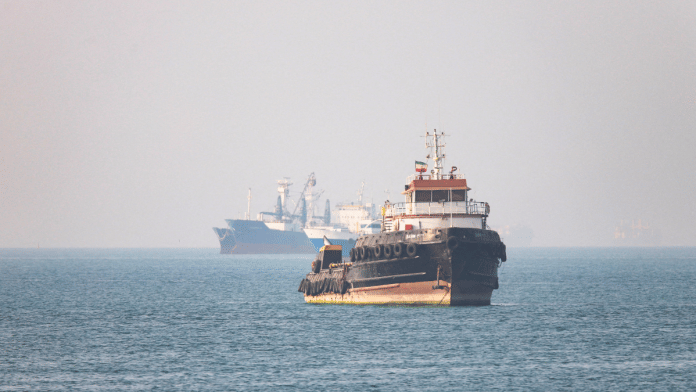

The US-Iran war has entered its fourth month now. The conflict started on 28 February, when the US and Israeli forces launched a joint attack on Iran, which retaliated with strikes on US bases across the Gulf and closed the Strait of Hormuz, causing global economic disruption.
The strait is no less than an Aladdin’s cave, where Iran, as a global seaport, controls global hydrocarbon movement and serves as a genie managing and controlling the strait’s operational zones. These negotiations centre on legality, commerce, naval dominance, and the impact on the global oil economy.
Like the fabled cave, Iran’s treasures cannot be unlocked by force; they open only when the right words are spoken — and the US needs to utter them right.
Currently, the strait is responsible for 20 per cent of the global oil trade, including liquefied natural gas, and most importantly, around 20 million barrels of oil pass through the passage per day, which is just about 33 km wide at its narrowest point.
Hormuz is the most recognised historical sea route, connecting Europe, Asia, and Africa. And Iran has become the gateway to the world’s most strategic hydrocarbon corridor. However, the question remains: why has there been no alternative route explored?
No tangible alternatives so far?
Well, it requires a serious strategic understanding of the current context, even though its historical significance is common knowledge.
To begin with, Saudi Arabia’s East-West Crude Oil Pipeline (Petroline) has a maximum capacity of 5 million barrels per day, which has now been increased to 7 mbp/d, and the Abu Dhabi Crude Oil Pipeline (ADCOP) has a maximum original nameplate capacity of 1.5 mbp/d, but it currently carries 1.8 million barrels daily. Both these pipelines bypass the Strait of Hormuz and are at present working at more than their original capacity.
Interestingly, amid rising geopolitical tensions in the Strait of Hormuz, the Dolphin Gas Project has emerged as an indispensable energy hub for Gulf countries. However, despite serving as an alternative transit route, its capacity is limited, as it serves domestic power generation rather than the global liquefied natural gas export market. And it again depends on ships transiting the Strait of Hormuz, as the project offers limited capacity.
Consequently, Gulf countries such as Saudi Arabia, the United Arab Emirates, Qatar, Bahrain, and Kuwait derive their national revenue from the Strait of Hormuz, which is considered a veritable treasure trove for the Gulf region.
The huge gap in hydrocarbon exports makes it difficult to rely solely on their bypass pipelines.
Also, the routes traverse the entire Arabian Peninsula, cutting through the Hejaz Mountains in Saudi Arabia and the rocky Hajar Mountains in the UAE. Moreover, the extreme desert environment and summer temperatures necessitate advanced cooling and pressure-monitoring technologies.
Due to seasonal sandstorms, external pipelines have to be robust enough to withstand abrasion and erosion, constraining the development of pipelines across the Arabian Peninsula.
The Gulf, especially Saudi Arabia and the UAE, exports oil at an average of four to five million barrels per day, with shipments transiting through both the Bab el-Mandeb strait and the Suez Canal/SUMED Pipeline system to Europe, Africa, and Asia.
To further nurture the Petroline and the ADCOP, the Suez Canal has a narrow passageway to control sea traffic, and the Bab el-Mandeb is a critical maritime choke-point connecting the Red Sea to the Gulf of Aden and the Indian Ocean.
Recently, Bab el-Mandeb became a source of anxiety in the Gulf, when Iran and the Yemeni Houthis acted in coordination with the ‘Axis of Resistance’ to counter Gulf proxies in the region.
The chokehold strategy was to create a ‘twin maritime bottleneck’ that would affect global oil supply and global container shipping, potentially endangering the majority of the Gulf countries’ national revenue.
Controlling the Strait of Hormuz means controlling global hydrocarbon exports, impacting global markets, and causing political and economic tensions in Asia, Africa, and Europe.
The limited crude oil will result in a continuous rise in oil prices and lead to inflation in the existing capitalist economy.
Recently, Iran has been discussing with Oman the implementation of a toll system at the Strait of Hormuz, which will further trigger the global economy in the capitalist system.
As a safety net, despite controlling the Strait of Hormuz, Iran has developed an alternative bypass route — the Goreh-Jask oil pipeline with a maximum capacity of 1 million barrels per day to maintain its revenue.
Thus, Iran not only generates revenue but also understands its geopolitical position and its impact on the global hydrocarbon market — it cannot be peripheral and will always be able to counter Western interference in the region, unlike other Gulf nations. Such positionality gave the ‘New Hormuz-led World Order’ an edge globally.
Now the key question is: How does such positionality shape this new order?
Also read: Hormuz crisis won’t replace the dollar with yuan. De-dollarisation is a myth
A bargaining chip for Iran
Iran’s capacity should not be seen as limited to disrupting shipping, but in the broader context of the restructuring of power, law, energy security, and regional sovereignty around the Gulf and across the world.
While the older order focused on US-led freedom of navigation, and the assumption that the US military is keeping the strait open, the new order underlines that the US is not the actor with limits on such arrangements. The continuously changing negotiation between the US and Iran, and the credibility of the ceasefire, highlight the US’ insecurity in influencing the existing world order.
Controlling the Strait of Hormuz gives Iran a bargaining position over global oil supplies, potentially disrupting Western economic interests in the region and positioning it as a strategic partner to Russia and China. Thus, transforming Hormuz from a sea corridor to a political instrument.
It further questions the US’ credibility in the region and the belief that possessing overwhelming military superiority means maritime security.
Moreover, the dependence on Hormuz has led to a new energy-security geography, where the future of the strait will not be shaped by Western naval dominance and Asian vulnerability, but by Tehran, Beijing, New Delhi, Tokyo, Riyadh, Abu Dhabi, and Doha.
The Gulf state will be pushed to prioritise de-escalation diplomacy, diversify pipelines, expand ports, develop alternative corridors, enhance missile defence, and pursue a calculated balance among the United States, China, and Iran.
Although such a ‘New Hormuz-led World Order’ may look ambiguous to many, Iran’s control over the strait emphasises its sovereignty, security, and the restriction on vessels. Thus, it is not merely coercion but a claim of regional jurisdiction.
Azeemah Saleem is an independent researcher on West Asia and North Africa. She holds a PhD in West Asian Studies from the School of International Studies, Jawaharlal Nehru University. She tweets at @AzeemahSaleem. Views are personal.
(Edited by Aamaan Alam Khan)