




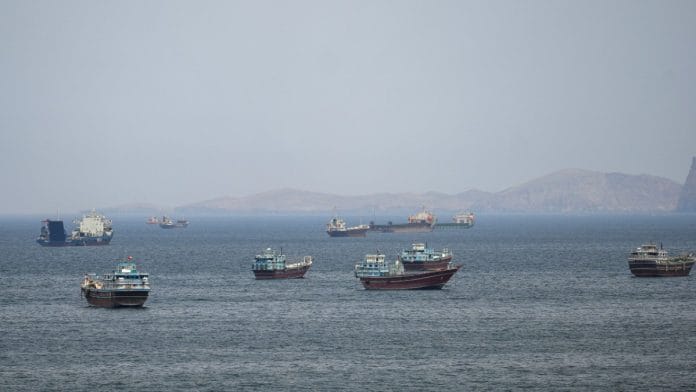

The ongoing Iran War has now shifted into a largely non-kinetic phase characterised by maritime blockades, digital warfare, and economic strangulation. As drone and missile strikes have largely subsided, strategic discussions have centred on the Strait of Hormuz being ‘double-blockaded’—with both the Islamic Revolutionary Guard Corps and the United States Central Command restricting maritime flows.
This disruption of one of the world’s most critical energy chokepoints has also revived familiar debates around de-dollarisation and the decline of the so-called “petrodollar system”. Yet much of this discourse remains analytically weak—overstated, historically shallow and often detached from actual financial data.
The central assumption is straightforward: increasing geopolitical unpredictability, especially due to the US policy volatility, has encouraged countries to reduce reliance on the dollar in trade and reserves. This narrative is often supported by claims of a rising “petroyuan,” greater gold accumulation, and a broader fragmentation of the dollar-centric order.
In the context of the Iran War, this argument is pushed further—that Gulf countries, wary of instability and the US’s role, will drift away from the petrodollar system, accelerating the decline of American monetary dominance.
Not all is false. It’s pitched incorrectly.
These claims rest on two major analytical fallacies. First, a conflation of de-dollarisation with the petrodollar system. Second, a misunderstanding of how both phenomena actually function in the contemporary global economy.
Fundamentals vs myths
To begin with, de-dollarisation and the petrodollar system are related but different concepts. De-dollarisation refers broadly to the trend of reducing reliance on the US dollar in global trade, financial transactions and central bank reserves.
By contrast, the petrodollar system specifically refers to the pricing and trading of oil in dollars and the subsequent recycling of oil revenues into dollar-denominated assets—one of the key powers of Pax Americana.
Recent data does not support any dramatic or systemic shift away from the dollar. According to the latest International Monetary Fund (IMF) figures, the share of international transactions conducted in US dollars has declined only marginally—from 56.90 per cent to 56.77 per cent. More importantly, the limited decline has not translated into a surge in the Chinese yuan. The gains have instead accrued primarily to rise in other currencies: mainly the euro, followed by the Japanese yen and pound sterling (together). The yuan’s share of global transactions has risen marginally.
The key point is that while the dollar accounted for about 90 per cent of global transactions in the 1990s, its share has fallen to the 56-58 per cent bracket in 2026, not due to Yuan-denominated trade, but euro-denominated trade. The euro was launched in 1999 and has ever since seen a steep increase in non-dollar trade and non-dollar foreign reserves.
This immediately complicates the narrative of a rising “petroyuan” displacing the dollar. Even where diversification is occurring, it is largely within the existing ecosystem of fully convertible, market-driven currencies—not toward a structurally constrained currency like the yuan, a point I will return to shortly.
Also read: Ceasefire won’t end Iran War. US just set the stage for a new phase of endless conflict
Petrodollar nostalgia
The second major issue lies in how the petrodollar system itself is understood and analysed. The conventional story traces its origins to the 1970s, following the collapse of the Bretton Woods system, the 1973 oil shock from the Yom Kippur War, and the subsequent US agreements with Saudi Arabia in 1974 to price oil exclusively in dollars.
Other Gulf states followed, leading to a system where oil revenues were recycled into the US financial assets, particularly Treasury securities. And, the US became the major security provider of the Gulf.
While broadly accurate, this account remains incomplete. The petrodollar system itself was never static or monolithic. By the 1980s, structural changes were underway. Falling oil prices and reduced demand forced the Gulf —especially Saudi Arabia—to cut output. The large surpluses accumulated in the 1970s gave way to deficits in the 1980s. This period also saw the rise of sovereign wealth funds, which redirected oil revenues away from traditional banking channels focused on the greenback toward global equity markets.
Equally important, the Gulf-centric petrodollar framework cannot explain the much larger accumulation of dollar reserves in East Asia. Countries like Japan, South Korea and later China generated massive trade surpluses with the US in the 1980s and 1990s and maintained currency pegs to the dollar to sustain export competitiveness.
These dynamics—rooted in manufacturing and trade imbalances—became far more important drivers of global dollar liquidity than oil revenues. And this holds despite the Asian financial crisis of 1997 and the slowing of Japan’s economic miracle.
This shift is crucial for understanding why disruptions in oil flows today—such as those in the Strait of Hormuz—have had limited impact on the dollar’s global role. Contrary to popular assumptions, there is no large or continuous “outflow” of petrodollars that has sustained the dollar’s dominance.
In fact, before the current war, flows from oil exporters into liquid dollar assets were minimal. This helps explain why the Hormuz blockade has not weakened the dollar per se. On the contrary, dollar-denominated trade has actually increased—from 49 per cent in February to 51.1 per cent in March 2026—despite geopolitical unpredictability.
Third, a persistent myth is the supposed causal link between oil pricing and dollar dominance. The argument suggests that if oil were increasingly traded in non-dollar currencies, the dollar’s global status would collapse. A related claim is that the US deploys military interventions to enforce the petrodollar system, citing cases such as Iraq, Libya, Venezuela, and now Iran.
This line of reasoning is also flawed for three reasons.
First, the US has not responded militarily to every instance of non-dollar oil trade. Several Gulf countries have already entered into agreements on yuan-denominated transactions—such as Saudi Arabia’s 2021 deal with Sinopec and Qatar’s deal with PetroChina, without US military interventions. These countries continue to rely on the US security guarantees, showing that geopolitical alliances are not reducible to currency arrangements only, especially when there is no alternative.
Second, the global energy landscape has fundamentally changed. The US is no longer a major oil importer dependent on Gulf supplies. Since 2011, it has emerged as a net exporter of oil, peaking in 2023 and now again after Hormuz disruptions. This development significantly reduces the strategic centrality of the petrodollar system in US policy, per se. The Carter Doctrine—formulated when US dependence on Middle Eastern oil was high in the 1980s—operated in a different context.
Third, the idea that oil revenues are automatically recycled into the US Treasuries is outdated. Gulf economies today are far more diversified in their investment strategies. For example, sovereign wealth funds allocate capital globally across equities, infrastructure and alternative assets. Many Gulf states are now net borrowers, issuing dollar-denominated bonds rather than accumulating Treasuries. This reverses the traditional image of Gulf countries as the “lenders” of the world.
A more accurate understanding of dollar dominance must therefore look beyond oil.
Also read: India needs to learn from US-Iran conflict, just like Tehran took lessons from Iraq war
Secondary supports
One critical factor is the Eurodollar system—an offshore market for dollar deposits and lending that exists outside the US regulatory jurisdiction. It is mainly in Europe, but not limited to that region. This market, estimated at over $13 trillion, plays an important role in global finance by increasing the availability and profitability of dollar-denominated assets. It allows institutions worldwide to borrow and lend in dollars, without US Treasury oversight, but still with high credibility.
Again, there are alternatives—such as offshore yuan markets—the scale pales when compared (around $82 billion). The structural advantages of the dollar system—deep capital markets, legal transparency and full convertibility—remain unmatched.
This brings us to the structural limitations of the yuan as a global currency. The issue is not geopolitical liking for the dollar, but institutional design. China maintains extensive capital controls and a managed exchange rate. The yuan is not fully convertible on the capital account, meaning that investors cannot freely move funds in and out of the country. While these controls help Beijing maintain financial stability and prevent capital flight domestically, they fundamentally limit the yuan’s attractiveness as a reserve currency.
Moreover, China’s currency is effectively pegged—first tightly to the dollar, and now to a basket of currencies closely linked to the dollar. This arrangement supports export competitiveness but reinforces dependence on the very system China seeks to challenge. A global reserve currency requires openness, liquidity, and trust—conditions that a tightly managed financial system like the Yuan cannot provide.
Currency pegs are also widespread across the Gulf. Countries such as Saudi Arabia, the UAE, and Bahrain maintain dollar pegs precisely because they value exchange rate stability and predictability in trade. This further entrenches the dollar’s role in global commerce.
Finally, it is important to recognise that global dollar liquidity today is driven far more by manufacturing surpluses in other regions in Asia than by oil exports. The 1970s model of oil-driven dollar recycling is no longer the primary mechanism sustaining the system. Even in a high oil price environment, the dominant sources of offshore dollar liquidity are export-oriented economies, not energy producers.
There are, of course, long-term challenges. The US now accounts for a significant share of global public debt, raising genuine questions about its sustainability. This has led to most economies doubling down on gold reserves, but its liquidity is challenging, storage is expensive, and it works best as an emergency back-up.
The lesson from the Hormuz crisis is therefore not the decline of the dollar, but the persistence of its structural dominance, where the answer is not Yuan-isation.
Swasti Rao is a Consulting Editor (International and Strategic Affairs) at ThePrint. She tweets @swasrao. Views are personal.
(Edited by Saptak Datta)
As the shares of the US economy and foreign trade decline in relation to the global total, a gradual sag in use of the US dollar is inevitable. This is also seen in central banks gradually reducing US Treasuries in their official reserves. Extensive imposition of sanctions by the US government is also making others search for alternatives.