






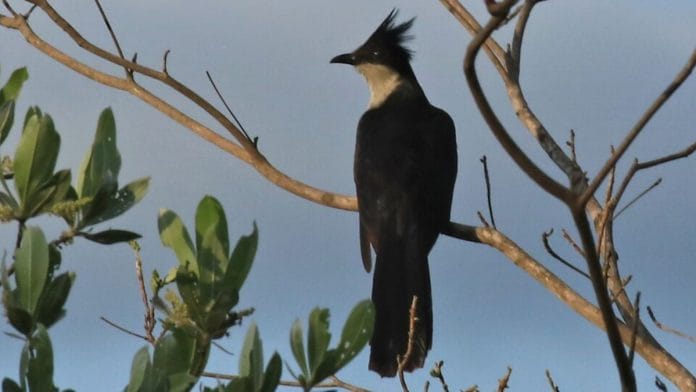


You can call the Jacobin cuckoo by any of its 50-odd names, but if you live and watch birds in India, you will probably grow familiar with no more than three or four of them.
There is, of course, the Jacobin cuckoo, named after the black-and-white habit of the Dominican order of friars, known in France as the Jacobins. You might know it as the pied cuckoo, since many black-and-white birds are called “pied”. Or you might simply call it chatak, its common name in both Hindi and Bengali.
To the scientific community, the bird is Clamator jacobinus, a name given in 1783 by the Dutch naturalist Pieter Boddaert, who worked from a specimen collected off the Coromandel Coast. Local names for the bird already existed, but that knowledge was set aside. The preserved creature was shorn of its name, renamed in a context wholly alien to its habitat, and returned—polished and formalised—as a newly christened bird. In something as simple as naming a bird from India and Africa, you can tease out the old interplay of power and knowledge.
The pied cuckoo is instantly recognisable: black and white, with a sharp crest and a long tail trailing a slim body. You can’t mistake it for any other bird—nothing else looks like it. The more interesting question is who gets to see it.
Almost everyone in India can spot the bird, at least once a year, just before the monsoon. But if you live in Tamil Nadu, Andhra Pradesh, or Telangana, you will see it far more often, because this subspecies does not migrate. The birds found across the rest of India fly thousands of kilometres to sub-Saharan Africa, reaching the east, the south, and parts of the west of that vast continent. As the richly detailed website birdcount.in recounts from a Wildlife Institute of India initiative, one bird from Dehradun was satellite-tagged in 2020 and tracked to Goa before it struck out across the Arabian Sea to Africa.
This is nothing short of a miracle. Here is a bird of roughly 66 grams, flying at least 2,000 kilometres—often as many as 5,000 kilometres—twice a year, between North India and Africa. Much of that is over the open Arabian Sea, where stopping to rest is not an option. It is like flying from Kashmir to Kanyakumari in a single, unbroken stretch.
Also read: There’s a mystery unfolding in Delhi’s Lodhi Garden—Grey and pied hornbills are co-parenting
Long-distance flight on tiny wings
North India welcomes the bird back in May and June with great joy, for its arrival is believed to herald the rains. In his epic Meghdoot, the 4th–5th century CE poet Kalidasa draws on the chatak, comparing its thirst for fresh raindrops to a Yaksha—a benevolent spirit—longing to be reunited with his beloved. From this, perhaps, comes the old belief that the bird will not drink from water bodies and takes in only drops of fresh falling rain. Indeed, it returns to India from Africa just ahead of the monsoon.
A research paper on what draws the bird back filled me with wonder at the natural world. In “Influence of Seasonal Variables on the Distribution of Pied Cuckoo (Clamator jacobinus) in India”, published in the Journal of the Indian Society of Remote Sensing, researchers Debanjan Sarkar, Bharti Tomar, Suresh Kumar, Sameer Saran, and Gautam Talukdar conclude that water vapour pressure was “the significant contributing variable” for the species’ arrival in northern India. They point, too, to the role of wind speed. At the risk of oversimplifying: the birds work with the monsoon winds to ease their long passage home. This holds, of course, for the migrating northern subspecies, not the year-round residents of the south.
What will this year’s El Niño mean for the chatak? As the monsoon turns weaker and scantier, will as many birds make it back? Will some, devoid of the lift they usually get, drop to a watery grave? We may not know until the season’s counts come in—and perhaps not even then, since so little citizen data reaches us from Africa.
But why are you still reading this article? If you live in India, you should be outside already, looking for the bird. It is easily seen, even in cities; you may well hear it calling first. Go and try. And when you find it, count yourself lucky, and let this grand force of nature humble you.
Bharati Chaturvedi is an avid birder. She is the founder of the environmental non-profit organisation, Chintan India. She tweets at @Bharati09. Views are personal.
(Edited by Prasanna Bachchhav)