






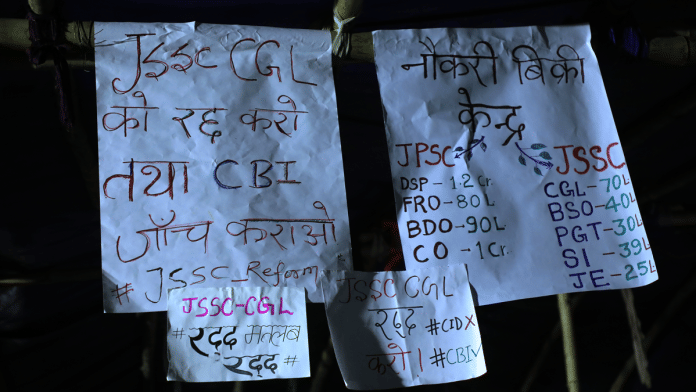


Public anger against the failures of Union and state government agencies to conduct examinations for admissions to colleges and recruitment for government jobs recently spilled over to the streets. Both the Union and Jharkhand governments have accepted key demands of the Gen Z protestors—the resignation of Education Minister Dharmendra Pradhan from the Union cabinet in the former, and the cancellation of the JPSC in the latter. While the establishment of fast-track courts to nail the perpetrators is a good first step, the malaise runs much deeper.
This series will take up the issue of recruitment scams, the failure of the judicial system to deal with them in a timebound manner, the establishment of fast-track courts and the need to overhaul the prosecution machinery in the country.
Let me start with a personal anecdote. As a rookie sub-divisional officer in 1988, when I was all of 27 years of age, the judicial peshkar (head clerk) drew my attention to an interesting case of 1962, where rent control, tenancy rights and demarcation of property were intertwined. The case was being routinely passed over, and the case file itself was running into over a thousand pages. I decided to fast-track it, for if it was not decided by me, the case would most likely be older than my successor.
One fine day, there was great excitement in the mofussil town of Ghatal. The High Court counsels engaged by both parties had arrived with their flowing black gowns and a team of assistants armed with thick volumes of case law. Unlike the usual ‘Your Honour’ one was used to from the district and sub-district lawyers, their mode of address was ‘My Lord’! The submissions from both parties were extensive. I spent the weekend mulling over the relevant Acts and precedents, but finally gave my judgement. To the best of my knowledge and recall, the opposite party did not go into appeal, although in terms of the hierarchy of courts, this was at the ‘bottom of the pyramid’.
Cut to 2024. A nine-member Constitution Bench of the Supreme Court headed by Chief Justice Dhananjaya Chandrachud gave the final judgement in the four-decade-old Property Owners Association v. State of Maharashtra. By an 8:1 majority, the bench ruled on whether all privately owned property qualifies as ‘material resources of the community’ under Article 39(b) of the Constitution. Here the focus is not on the judgement, but the legacy status of the case. The matter dated back to 1984, two years before Dhananjaya Chandrachud returned to Bombay from Harvard Law School after completing his doctorate.
While his personal record in case disposal was commendable, the system he presided over was overwhelmed with growing pendency: each year, the new cases filed in all courts at an aggregate level in the country exceeded disposals. The total pendency at the end of 2025 was 54 million cases, up 80 per cent from a decade earlier, according to an analysis by Data for India. The live register in the district and sub-district courts showed the biggest change — from 26 million to 48 million cases, an 85 per cent increase. Pendency in all High Courts cumulatively and in the Supreme Court of India had both gone up nearly 50 per cent in this period.
This was not surprising: against the sanctioned strength of 30,868 judicial officer posts in district and subordinate courts nationwide, only 23,558 judges are currently in position, leaving approximately a quarter of the 7,310 posts vacant.
Also Read: The long shadow of NEET paper leak: Parents haunted by guilt, children’s suicide notes
The long history of paper leak laws
The problem of mounting pendency perhaps explains the emphasis on Special Fast Track Courts in the July 2026 amendments to the Public Examinations (Prevention of Unfair Means) Act, 2024. Under the new anti-paper leak provisions, the police or designated agencies have been tasked to finish the probe within two months, while Special Fast Track Courts must deliver a final verdict within three months of the filing of the charge sheet.
The amendment has made punishments even more stringent by covering the entire gamut of cheating. Those resorting to unfair means can face imprisonment of five to 10 years and fines up to Rs 50 lakh. For organised crime, imprisonment could extend from seven to 10 years, with a fine of up to Rs 10 crore. Service providers involved in such offences could be fined up to Rs 5 crore along with an eight-year ban from conducting public exams.
While the Act covers examinations conducted by the Union Public Service Commission (UPSC), Staff Selection Commission (SSC), National Testing Agency (NTA), Railway Recruitment Boards and banking selection bodies, many states have also strengthened their laws and established special courts to address this issue.
However, one must also place on record that neither the problem nor the legislation to address the issue is new.
While many universities and school education departments in the colonial period drew upon Sections 420, 120B, 406, 465, 468 and 471 of the IPC (their equivalent sections being 318, 61, 316 and subsections 2/3 of 336 under BNS), the first state-specific law which provided the template for other states came from the Burma Public Examination Bill of 1935. The Burma Bill made unauthorised possession and leakage of question papers a punishable offence.
This was followed by the Central Provinces Recognized Examinations Act, 1937, which later became the Madhya Pradesh Recognized Examinations Act. One of the first post-Independence legislations to address the issue was the Punjab Universities and Boards of Intermediate and Secondary Education Malpractices Act, 1950. Soon thereafter, many states authorised university senates and syndicates to take necessary action. In the sixties and seventies, there were ‘flying squads’ that would conduct surprise inspections and debar not only individuals caught in the act, but also cancel examination centres.
The Bihar Conduct of Examinations Act, 1981, and the Maharashtra Prevention of Malpractices at University, Board and other Specified Examinations Act, 1982, also created frameworks to criminalise proxy candidates, question paper leaks and mass copying at examination centres — though tardy investigation and indifferent prosecution did not have any salutary impact. In the next decade, Andhra Pradesh brought in the Public Examinations (Prevention of Malpractices) Act, 1997, and UP introduced the Uttar Pradesh Public Examinations (Prevention of Unfair Means) Act, 1998, to curb this menace.
Also Read: PM Modi announces fast-track courts for paper leak cases. How FTCs came to be and how they function
Vyapam scam and the engine-bogey format
Despite all these laws, one of the country’s largest and most extensive recruitment and admission scams had begun taking root in the Madhya Pradesh Vyavsayik Pariksha Mandal (Madhya Pradesh Professional Examination Board) by the mid-1990s.
This came to be known as the Vyapam scam, which got its name from the board’s Hindi acronym. It involved large-scale rigging of examinations, through a nexus of politicians, bureaucrats, board officials, middlemen and coaching networks. The full scale of the racket came to light only in 2013.
The modus operandi included the ‘engine-bogey’ format. This involved seating a high-scoring proxy or smart candidate (engine) between two paying candidates (bogies), allowing them to copy or swap OMR sheets. Centre heads were also complicit in replacing blank or lightly filled OMR sheets inside evaluation centres with the connivance of board officials. Over 3,100 people were charge-sheeted and more than 150 separate criminal cases were filed. Around 2,000 people, including scores of medical students and high-ranking officials, were eventually arrested. The scale of the scandal led the Supreme Court to direct the CBI to take over the probe.
Over several years of specialised fast-track court trials, the CBI secured more than a hundred convictions. The period also saw the mysterious deaths of dozens of witnesses, accused individuals and whistleblowers, with figures ranging from 23 to more than 40 unnatural or sudden deaths — though the CBI later said it found no evidence of foul play or conspiracy in the deaths it investigated. The first verdict was delivered only in December 2015 by a Special Court presided over by a Special Additional Sessions Judge, specifically established to fast-track the Vyapam cases.
When the cases were transferred to the CBI, central fast-track special courts were set up specifically to deal with the massive web of Vyapam cases. Yet, even with these fast-track courts, some Vyapam cases are still pending.
Ultimately, the certainty of punishment is a bigger deterrent than the extent of punishment.
(To be continued)
This is the first instalment of a series on recruitment scams and why laws and special courts have failed to curb them.
Sanjeev Chopra is a Senior Fellow at the Centre for Contemporary Studies, Prime Ministers Museum and Library (PMML), New Delhi, where his Fellowship topic is Borders, Boundaries and Bluewaters of Bharat. Views are personal.
(Edited by Asavari Singh)