



New Delhi: Hours after Prime Minister Narendra Modi announced that special fast-track courts would be set up to ensure “swift and stringent punishment” in paper leak cases, the Delhi High Court moved quickly and designated a special court to exclusively hear offences under the Public Examinations (Prevention of Unfair Means) Act, 2024.
Through a notification issued Thursday, the Delhi High Court appointed Judge Anu Grover Baliga as Special Judge (PC Act) (CBI)-25, who will function as the specially designated fast-track court to try offences under the 2024 Act and connected crimes. The court will sit at the Rouse Avenue Court Complex.
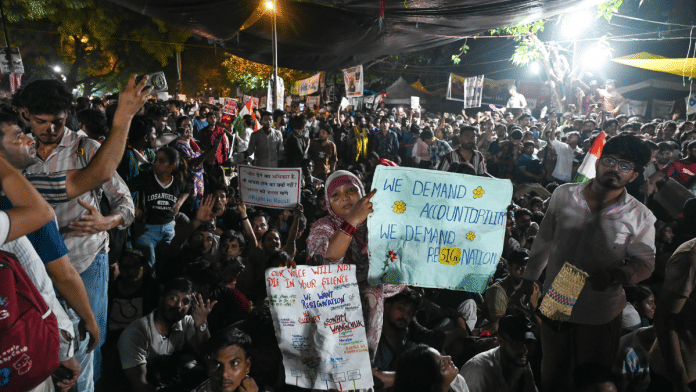
The decision comes amid protests over instances of job and entrance exam question paper leaks, with students demanding accountability and action against those responsible.
While governments often announce fast-track courts after incidents that trigger widespread public outrage, these courts remain one of the least understood features of India’s justice delivery system. They are neither a separate category of courts recognised by the Constitution nor created by a dedicated statute. Instead, they are regular courts assigned a narrower set of cases in the hope that they can dispose of them more quickly.
Also Read: A death sentence in 60 days: Pune rape-murder case sparks debate on fast-track trials
What are fast-track courts
Despite their frequent use in political announcements, there is no law enacted by Parliament that creates “fast-track courts” as a distinct category of courts.
Instead, they are ordinary sessions courts or courts presided over by judicial officers who already possess powers under the Bharatiya Nagarik Suraksha Sanhita (BNSS), 2023, or, in older matters, the Code of Criminal Procedure (CrPC). The only difference is that they are assigned exclusive jurisdiction over a particular class of cases.
Nothing is more important than the welfare and future of our youth!
We have decided to set up fast-track courts to ensure swift and stringent punishment for those involved in paper leaks. Have directed the concerned authorities and officials to take all necessary steps in this…
— Narendra Modi (@narendramodi) July 23, 2026
The administrative power to allocate work among subordinate courts flows from the High Courts’ constitutional control over the district judiciary under Article 235, read with their supervisory jurisdiction under Article 227.
Article 235 of the Constitution of India vests HCs with administrative and disciplinary control over district courts and subordinate courts, while Article 227 grants the High Court the power of judicial and administrative superintendence over all courts and tribunals within its territorial jurisdiction.
Origins of FTCs
Fast-track courts were first introduced in 2000 following the recommendations of the Eleventh Finance Commission, which had expressed concern over mounting pendency in criminal cases.
Their main objective was to reduce the massive backlog across the country’s district and high courts.
The Eleventh Finance Commission recommended the establishment of 1,734 Fast Track Courts across the country to clear long-pending cases before the sessions courts. The Centre accepted the recommendation and released central funds to states under Article 275 of the Constitution, which empowers the Parliament to provide statutory grants-in-aid to states requiring financial assistance. At the time, the scheme was envisaged as a temporary measure to tackle judicial backlog.
Although originally conceived as a five-year experiment, the scheme was repeatedly extended. On 31st March 2026, for instance, the scheme was extended again for the establishment of 790 courts. As per the information made available by the High Courts, as of 30 April this year, 775 FTSCs, including 398 exclusive POCSO (e-POCSO) Courts were functional in 29 states and union territories.
In 2002, the Supreme Court in Brij Mohan Lal vs Union of India, while deciding the constitutional validity of fast-track courts, directed the central government to continue with the FTC scheme, causing it to be extended till 2011. However, in 2011, the government discontinued the FTC scheme, and stopped giving financial assistance to the states for establishing these courts.
After that, several states like Arunachal Pradesh, Assam, Maharashtra, Tamil Nadu and Kerala have decided to continue Fast Track Courts, while others like Haryana and Chhattisgarh decided not to do so.
The 2002 case related to the appointment of retired judges to these courts and the absence of a specific statute establishing them. The court, however, upheld the scheme, holding that creating fast-track courts was a legitimate policy response to mounting arrears and did not violate the Constitution.
“At least one Administrative Judge shall be nominated in each High Court to monitor the disposal of cases by Fast Track Courts and to resolve the difficulties and shortcomings, if any, with the administrative support and cooperation of the concerned State Government. State Government shall ensure requisite cooperation to the Administrative Judge,” the court ruled.
However, the court also clarified that fast-track courts could not become a permanent substitute for strengthening the regular judicial system. It directed that serving judicial officers should ordinarily be preferred over retired judges and emphasised that ad-hoc arrangements cannot replace long-term judicial reforms.
Why are they back in focus
Amid growing concern over delays in the trial of rape and child sexual abuse cases, the Supreme Court, in suo motu proceedings titled In Re: Alarming Rise in the Number of Reported Child Rape Incidents (2019), directed the Centre to establish exclusive fast-track special courts in districts with large numbers of pending rape and POCSO cases.
Following this, a centrally-sponsored Scheme for the establishment of Fast Track Special Courts including exclusive POCSO Courts came to be introduced in October, 2019. The scheme has been extended twice, with the latest extension up to 31st March 2026, for the establishment of 790 courts.
The financial outlay under the scheme is Rs 1,952.23 crore with Rs 1,207.24 crore as the Centre’s share to be incurred from Nirbhaya Fund, according to the Press Information Bureau (PIB).
The latest fast-track courts to try paper leak cases follow the same model. Instead of creating a new judicial hierarchy, a designated judge will exclusively hear cases under a particular statute.
The Public Examinations (Prevention of Unfair Means) Act, 2024 was enacted after a series of high-profile leaks involving recruitment and entrance examinations, including NEET and other competitive tests.
The Act criminalises organised cheating in public examinations, including question paper leaks, unauthorised access to examination material, impersonation and tampering with examination systems. It also prescribes stringent punishment, particularly where organised criminal syndicates are involved.
By assigning these cases to a dedicated court, the government hopes investigations and trials will not be delayed by the heavy pendency in ordinary criminal courts.
(Edited by Ajeet Tiwari)
Also Read: Appointed to new fast-track court for NEET paper leak cases, who is judge Anu Grover Baliga