





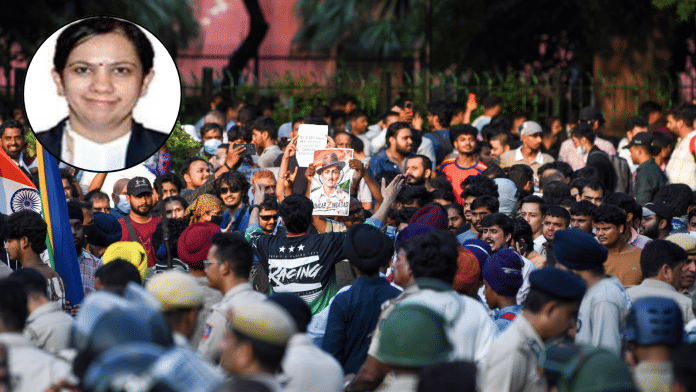


New Delhi: After Prime Minister Narendra Modi’s X post Thursday morning, the Delhi High Court set up a special fast-track court at Rouse Avenue complex to try offences under the Public Examinations (Prevention Of Unfair Means) Act. In the same order late Thursday evening, Chief Justice D.K. Upadhyaya appointed judge Anu Grover Baliga to the new court to hear all NEET paper leak-related cases.
Born in 1969, judge Baliga joined the Delhi Judicial Service (DJS) in 2000 and started as a civil judge in Tis Hazari courts. She joined the Delhi Higher Judicial Service (DJHS) as additional district judge at Dwarka courts in 2010 and is currently a senior member of the DJHS, due to retire in 2029.
She was the judge-in charge at the mediation centre at Tis Hazari courts and will now be presiding over cases relating to the 2026 NEET leak as a special CBI judge. She was earlier a special CBI judge at the Rouse Avenue complex for four months in 2022.
Prior to her transfer to Tis Hazari in December 2025, she served as a district judge at the commercial court in Saket. Her courtroom consistently ranked as a high-disposal unit in the Delhi District Courts roster. Statistical evaluations by the high court showed her name disposing of 18 cases in a month, according to documents available on the Delhi District Courts website.
Official records also show her practising actively as a metropolitan magistrate at Patiala House Court Complex in December 2006—20 years ago. In 2013, she was part of the reporters for Indian Law Reports (Delhi series) as an additional district and sessions judge. The same report was co-reported by current Delhi High Court judges, such as Justices Shalinder Kaur, Girish Kathpalia and even current HC Registrar Arun Bhardwaj.
The Rouse Avenue Court complex, set up in 2019, is specially designated for handling high-profile corruption cases related to sitting MPs and MLAs—including economic offences investigated by the CBI and Enforcement Directorate. Now, the newly designated fast-track court will hold the nation’s attention.
Modi Thursday, in his first acknowledgement of the protests in Delhi demanding accountability over exam paper leaks, posted about having decided to “set up fast-track courts to ensure swift and stringent punishment for those involved in paper leaks”.
“Have directed the concerned authorities and officials to take all necessary steps in this regard… those who try to harm the future of our youth will not be spared,” he added.
In a video message late Thursday, the PM also said that a new bill to curb examination paper leaks, including provisions for fast-track courts and harsher punishment for offenders, is on the anvil.
The Union Cabinet will discuss these stringent measures Friday and the government will try to get the bill passed in Parliament next week, he added.
(Edited by Nida Fatima Siddiqui)
Also Read: CJP protest isn’t another Anna movement. It’s something Modi govt doesn’t know how to fight