




New Delhi: Nearly one-fourth of all sanctioned judicial positions in district courts across India remain vacant as of 17 July this year, according to data provided in Parliament on 23 July this year, raising concerns about the speed of justice delivery. For high courts, nearly one-third of all sanctioned judge positions are currently vacant across India.
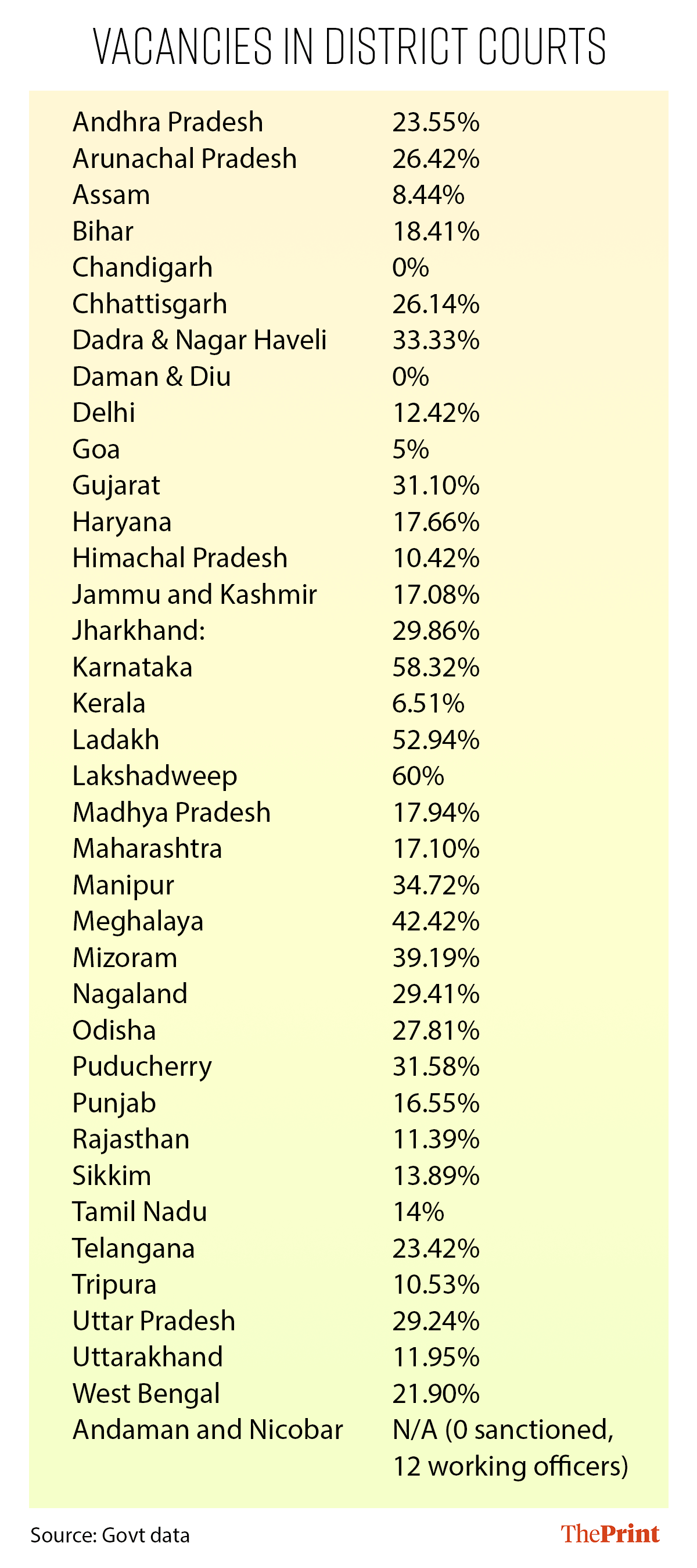
The data for district courts, provided by law minister Arjun Ram Meghwal in response to an unstarred question, shows that out of a total sanctioned strength of 30,868 judicial officers, only 23,558 are currently working. This leaves 7,310 vacancies nationwide, translating to an overall vacancy rate of 23.68%.
While union territories like Chandigarh and Daman & Diu report 0% vacancy, some states have more than 50% vacancy rate. Karnataka faces a critical shortage, with vacancies exceeding 58%—the highest among large states.
Uttar Pradesh, which has one of the largest judicial requirements in the country, is operating with over 1,000 judicial posts empty, a rate of 29.24%. Odisha maintains a 27.81% vacancy rate.
The data also touched upon the financial support provided to address these gaps.
For instance, Odisha has received Rs 146.42 crore over the last five years under the centrally sponsored scheme for development of judicial infrastructure. For the current financial year (2026-27), Rs 25.37 crore has been tentatively allocated for the state to continue building court facilities.
According to the data given out for high courts across India, nearly one-third of all sanctioned judge positions are vacant, presenting a major challenge to the upper tiers of the legal system.
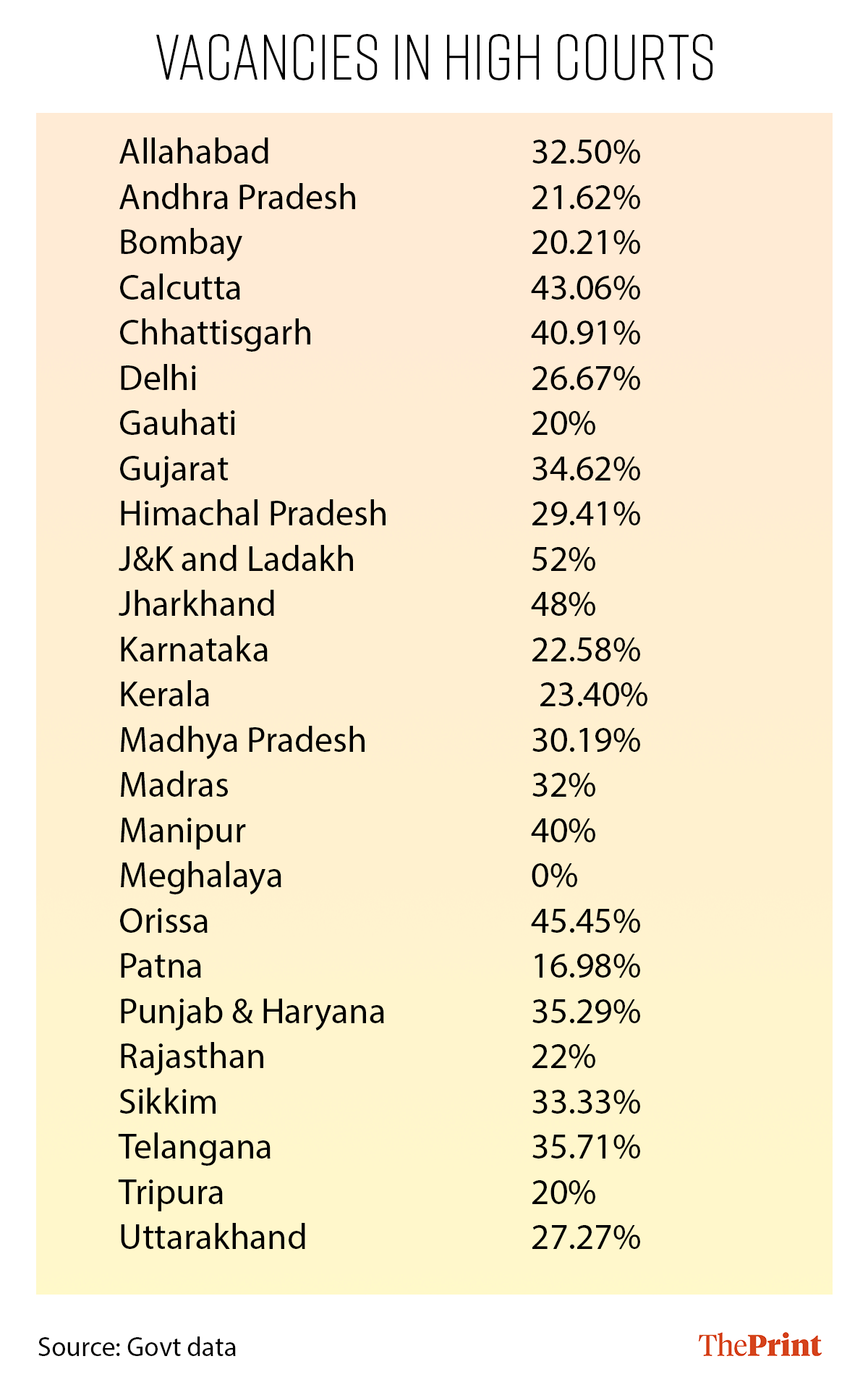
The data presented by Meghwal indicates that as of 1 July, 2026, the total sanctioned strength across all high courts stands at 1,122 judges. However, the working strength is only 781, leaving 341 vacancies nationwide. This represents an overall vacancy rate of 30.39%.
The government emphasised that the appointment of high court judges—governed by Articles 217 and 224 of the Constitution—follows the Memorandum of Procedure (MoP) established in 1998.
Under the MoP, the responsibility for initiating appointment proposals rests with the Chief Justice of the respective high court, who must consult the two senior-most puisne judges. Although the MoP requires recommendations to be made at least six months before a vacancy occurs, the government noted that this time limit is “rarely observed”.
The data identifies several “hotspots” where judicial vacancies exceed 40%, potentially impacting the speed of justice delivery in those regions. The High Court of Jammu & Kashmir and Ladakh faces the most critical shortage with a 52% vacancy rate, followed closely by Jharkhand at 48%, Orissa at 45.45% and Calcutta at 43.06%.
Even large courts with high caseloads, such as Allahabad and Madras, are struggling with vacancy rates of 32% or higher.
(Edited by Nida Fatima Siddiqui)
Also Read: Why India’s lower judiciary rarely reaches high courts. Supreme Court looks into ‘anomaly’