



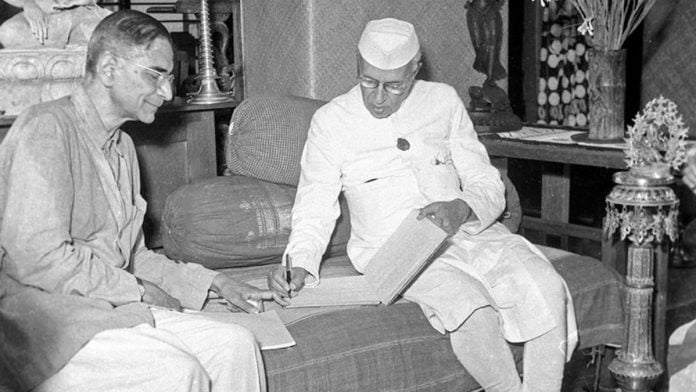
In old China, parents used to bind the feet of their female children to retain their small size, which was considered beautiful in those days. In post-independence India, Jawaharlal Nehru and scientist Prasanta Chandra Mahalanobis opted for a development strategy which they considered progressive, but which has prevented Indian agriculture from growing to its full stature. According to this strategy, the rate of economic growth is essentially a function of capital formation in large-scale enterprises, particularly in the public sector.
Hence, most of the capital and other resources of the country were diverted to achieve that end. In this strategy, agriculture is supposed to play no vital role except to provide food for bare subsistence, raw materials for agro-based industries, and surpluses for industrial growth. Development of agriculture for its own sake, or improving the economic and living conditions of agriculturists, was considered secondary; though, for political reasons, lip homage was paid to agriculture all the time. But for the policy constraints imposed by this strategy, Indian agriculture would have grown much faster, and by now our country ranked amongst the major exporters of farm products.
Nature’s bounty
India enjoys many advantages in respect of agricultural production. Our cultivable area exceeds 50 per cent of our geographical area. Though our population is large, per capita availability of arable land in India equals the world average if we leave out three countries viz. USA, USSR and Canada, and is 63 per cent more than in the rest of Asia. We also have ample supplies of water which can enable us to irrigate 113 m hectares of land. But our greatest advantage lies in our moderate climate which enables us to grow two to three crops in a year, whereas in most other countries, due to severe winters, only one crop can be harvested in a year.
Thus, it is not the lack of natural resources—land, water and sunshine—which is the cause of widespread under-nourishment of our people. The low productivity (yield per hectare) of our land, which is approximately one-third of what is obtained in advanced countries and two-thirds of the world average, is due to poor utilisation of nature’s bounty.
Also read: State capitalism is a negation of democracy. Laissez-faire is dead as a dodo: AD Shroff
Potential of Indian agriculture
The claim that the potential of Indian agriculture is of gigantic proportions is based not only on theoretical considerations, but on results already achieved in certain parts of the country. Punjab, whose agricultural land is less than 3 per cent of the national total, has in 1983-84 contributed 9.75 per cent to the national foodgrain production, registering a productivity which is more than three times the average of the country.
There is, however, nothing special about Punjab. On the National Demonstration Plots, scattered all over the country, which are laid out by the Indian Council of Agricultural Research to determine the production potential of crops in different parts of the country, mean yields of Paddy, wheat, maize, bajra and jowar have been obtained, which are 3.00, 2.56, 3.31, 6.34 and 6.12 times respectively of the national average yields. The overall low productivity of our agriculture is not due to the niggardliness of nature but the low rate of input application.
Before we discuss the reasons for the continued backwardness of Indian agriculture, let it be understood that the present accumulation of large foodgrains stocks in government godowns is not due to overproduction in the country, but unnecessary imports during the years 1982, 1983 and 1984. Thus, there was no scarcity of foodgrains in the country, and yet during these three years 8.02 million tons were imported. These imports were made not to make good any deficit in the country, but to keep farm prices depressed. In a year of record production, imports were also the heaviest since 1975. It is on account of this mismatch between record production and record imports that not only will the government of India lose heavily, but farmers too will suffer throughout the country.
Also read: Our entire national life has become politicised: MR Masani
Poor capital formation in the farm sector
Indian agriculture cannot be modernised on empty assurances only. Its capital and other needs will have to be fully met. It is surprising that no one in the Planning Commission has yet quantified the capital requirement for the modernisation of our agriculture, much less drawn out a scheme for raising it. The importance of assessing the amount of capital needed for agricultural development has been realised by the Food and Agricultural Organisation (FAO). They appointed a group of experts to study, with reference to the developing countries, the prospective and policy issues of world agriculture up to the year 2000. Among other subjects, they have also dealt at some length with the capital input requirement of the developing countries for their agricultural development. Our own experience of deployment of capital for agricultural development confirms the FAO estimate.
In our country, unless we double our farm production within the next 15 years, which is quite feasible, it will not be possible to reduce the poverty of our masses to any appreciable extent. Doubling of our production during the next 25-30 years will be of no great help, because, in that period, our population will also have nearly doubled, leaving us nutritionally and otherwise at the same level as at present. Therefore, the most crucial question is: how do our planners propose to raise capital formation in the farm-sector to the level required for doubling production?
There is, indeed, no inherent superiority in manufacturing industries as producers of wealth for the nation. On the same capital investment, returns from agriculture are much more than in manufacturing industries. The government’s own preference, however, is evident from the fact that in the public sector, capital formation in manufacturing has generally been 50 per cent more than in agriculture, though the contribution of the latter to the NDP is more than twice that of the former. Not only did the government not invest adequately in the farm sector, but it has also effectively retarded capital formation within the farm sector by turning the terms of trade against farmers.
Because productivity of wheat has not increased fast enough to cope with the relative price increases of other commodities, the real income or the purchasing power of farmers has sharply declined. Any impartial analyst can see that, as a consequence of price twists the drain of income of the farm sector to the rest has been of a higher order than what the government has been spending on agricultural and rural development.
Also read: Indira Gandhi knew newspapers can’t be independent without money, wrote Cushrow R Irani
Captive producers and captive consumers
The above-noted price situation is not due to the natural law of supply and demand, but due to policies pursued by the government. Briefly stated, these are: distribution of foodgrains procured within the country and purchased from abroad, at prices which are much lower than their economic cost, thereby forcing the farmers to sell their products at less than the subsidised price; imposition of restrictions on trade, processing and movement of foodgrains; continuance of indirect taxes on farm inputs both by Union and State governments; and forcing farmers to buy shoddy farm implements, domestically produced, at much higher prices though similar implements of a superior quality are available in international markets at cheaper rates. The farmers have thus been reduced to the status of “captive producers and captive consumers.”
In the distribution of scarce national resources too, rural people have not yet received their due. If the demands of power and credit from the rural areas are adequately met, the face of rural India can change within a decade. But in spite of the tall claims made, power made available to the farm sector is no more than one-sixth of the total consumed in the country; and direct advances to the farm sector by the scheduled commercial banks no more than one-seventh of the total advances made by them.
The price squeeze and the deprivation to which the farm sector has been subjected have considerably retarded the growth of inputs-consumption and agricultural production. These are consequences of the policies pursued so far. The first step towards rural progress would be to change these policies and let the farm sector retain its surpluses for its own development. This could be done by restoring the farmers’ right to sell their produce at the best price that they can get. This would be possible only when a network of rural warehouses is provided; all restrictions on trade, processing and movement of foodgrains are withdrawn; and the practice of dumping of doubly-subsidised imported foodgrains in the country stopped.
Moreover, the villages should be made more liveable by providing safe drinking water, better communications, schools, hospitals etc. In short, exploitation of the farm sector through price manipulation must stop, and the rural people should get their due share of budgetary allocations and scarce national resources such as power and credit, which ought to be in proportion to their contribution to the national income, if not to their numbers.
This piece is excerpted from the booklet Freedom First with the title “Indian Agriculture: A Stunted Giant”, which was published in January 1986. The original version can be accessed here.