



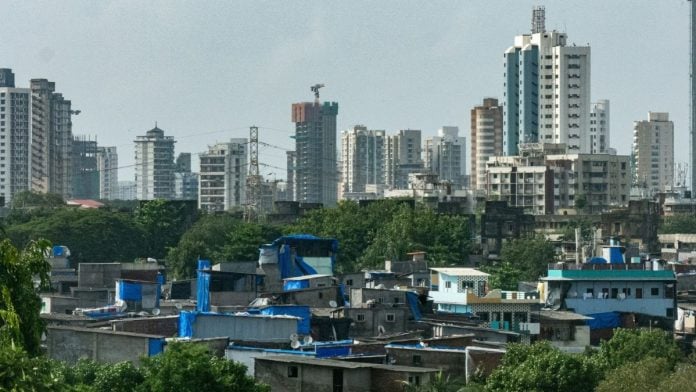
India’s 2011 Census classified 377 million people, or 31.2 per cent of the population, as urban. Satellite-based estimates cited in the Economic Survey 2025-26 put the urban share at 63 per cent in 2015. These figures use different methods and are not directly comparable, but the gap raises an important question: how accurately does India’s official system capture the transformation of its settlements?
The Standing Committee on Housing and Urban Affairs, in its report presented to Parliament on 25 September, acknowledged the limitations of India’s urban definition. Yet Census 2027 will retain the criteria for identifying Census Towns, unchanged since 1981: a population of at least 5,000, a density of at least 400 persons per square kilometre, and at least 75 per cent of male main workers engaged in non-agricultural activity.
The larger failure is not simply an outdated definition. It is a classic example of institutional inertia: the inability of government institutions to translate a recognised problem into a coordinated policy response. Its consequences extend beyond statistics to public spending, service delivery and the capacity of governments to manage urbanisation.
Six years, but no common direction
The postponement of the 2021 Census gave the government additional time to reconsider a classification framework unchanged for four decades. In March 2023, the Economic Advisory Council to the Prime Minister published ‘What Is “Urban-Rural” India?’, calling for a more dynamic approach to identifying urbanisation and the transition of settlements from rural to urban. Yet this did not lead to a common framework between the institutions responsible for counting urban India and planning for its development.
The Standing Committee’s report records that the Registrar General of India (RGI) wrote to the Ministry of Housing and Urban Affairs (MoHUA) on 15 February 2024, followed by a meeting on 22 February. Discussions covered population and density thresholds, the recognition of women’s and marginal workers’ employment, and the UN-backed Degree of Urbanisation.
MoHUA proposed lower thresholds for hilly and northeastern regions and changes to the workforce criterion but did not provide specific alternative thresholds. Thus, RGI considered the suggestions insufficiently objective.
MoHUA subsequently held expert consultations during 2024 and 2025 without RGI, and the findings did not translate into formal, measurable proposals jointly agreed upon by both institutions. By the time RGI and MoHUA appeared before the Committee in October 2025, Census preparations had advanced too far for substantial changes to be incorporated.
The discussion also failed to establish a clear mechanism for tracking urbanisation between Census rounds. MoHUA suggested that village-level Census data could help identify settlements changing and raised the possibility of inter-censal surveys. However, responsibility for taking these proposals forward remained unresolved. The result was a recognised policy problem without an agreed institutional response. Separate mandates of statistical exercise vs holding policy matters and operational constraints became reasons for delay rather than a basis for joint action, resulting in Institutional Inertia.
Also read: India is urbanising without a roadmap. It needs a better urban-rural handover plan
Consequences will extend beyond Census
First, scheme budgets may be based on an outdated population picture. Schemes such as PMAY-Gramin and PMAY-Urban, and health missions, use rural and urban population data to inform planning and resource allocation. If Census 2027 continues to understate urbanisation, budgets and programme planning may not reflect the real needs, resulting in a mismatch between where public money is planned and where services are needed.
Second, implications for Finance Commission grants. The current Finance Commission substituted missing census data with health ministry projections. The next commission will likely transition to Census 2027 data. Since these new figures notoriously understate urbanisation, the shift risks distorting how the government evaluates local needs and allocates grants.
Third, states will still be forced to fill the gap. States may have to independently identify urbanising settlements; this risks duplicated effort and inconsistent methods across states. Census is one of the country’s most expensive and extensive exercises, yet we will continue to need additional surveys and data collection exercises to make everyday decisions about roads, water, sanitation, housing and public services.
This is not merely a data gap; it reflects a failure to connect census investments with the information needs of routine governance. The consequence is higher administrative costs, fragmented evidence and decisions made without an up-to-date picture of local needs
Fourth, outdated data for national surveys. As highlighted in the Standing Committee’s report, continued reliance on census-based rural-urban classifications could affect surveys conducted by the National Sample Survey Office (NSSO) and the Labour Bureau, carrying the same limitations into employment and other statistics used for policymaking.
Fifth, Census Towns will remain to be identified through an ex-ante approach. In 2011, 3,894 Census Towns were identified, but the 2027 exercise risks relying on village-level data from 2011, leaving a sixteen-year gap in identifying settlements that have since urbanised. The Standing Committee cites 1,380 villages that were missed in the earlier identification process, showing that such gaps are not merely theoretical.
Sixth, women’s work remains under-recognised. By not changing the Census Town criteria of male non-agricultural workers, the definition may fail to identify settlements whose economies are changing through women’s employment. At a time when female labour force participation stood at 34.8 per cent in August 2026, this gender-specific criterion risks leaving an important part of India’s economic transformation uncounted.
Also read: City, village, or something in between? India’s urban transition needs governance roadmap
Three steps toward coordinated response
Census 2027 may now be too advanced for a major redesign, but the government does not have to wait another decade to respond. The priority must be to move from recognising the problem to building a coordinated system for managing urbanisation.
1) Create a national mechanism to bridge the institutional divide: NITI Aayog should convene a national coordination committee bringing together the RGI, MoHUA, the Ministry of Panchayati Raj (MoPR), relevant statistical agencies and state governments. The committee should establish a common approach to identifying urbanising settlements, tracking their transition between census rounds and using this information for planning and financing.
State governments must be central to this process because transition pathways and the criteria for constituting urban local bodies vary across states. The aim should be to make existing data interoperable and useful for decision-making, rather than create another disconnected reporting system.
2) Prepare institutions and communities for the transition: MoHUA and MoPR should jointly support states in preparing elected representatives, officials and frontline functionaries for rural-to-urban transition. Moving from a Gram Panchayat to an urban local body changes more than administrative boundaries.
It affects responsibilities, staffing, taxation, service delivery and citizens’ expectations. Joint training and state consultations should help local governments recognise emerging urbanisation pressures, assess transition options and plan for continuity in essential services.
Citizens should also be informed about what the transition means for them, so that awareness and preparedness precede administrative change.
3) Turn the urbanisation premium into a transition-planning opportunity: The Sixteenth Finance Commission’s proposed Rs 10,000 crore Urbanisation Premium, alongside its emphasis on state-level transition policies, offers an opportunity to help states manage the shift toward urban governance. Such policies must go beyond infrastructure investment to plan the transfer of funds, functions and functionaries, clarify responsibility for assets and liabilities, maintain essential services and prepare residents for changes in taxation and local administration.
Financial incentives will have limited value unless states have a clear plan for managing the institutional transition.
Also read: Villages in UP, Gujarat & Kerala become towns differently. Why it matters for development
India cannot afford to lose another decade
The way forward is not to expect a revised census definition to solve every challenge. It is to build institutions that connect evidence to decisions, national standards to state realities, and administrative change to the capacity required to deliver services.
India’s aspiration to become a developed country by 2047 will depend partly on how well it manages the transition of its settlements. Counting urbanisation accurately is essential, but it is only the beginning.
The greater test is whether government institutions can recognise change, work across administrative boundaries and prepare communities for it before the costs of inaction become entrenched.
Pallavi Laungani is a PhD student at OP Jindal Global University, researching rural-urban transitions in India, with a focus on institutional change, local governance and human development. Tarun Arora is an Associate Dean and Associate Professor at O.P. Jindal Global University, specialising in economics, urban policy and public policy.
Views are personal.
(Edited by Saptak Datta)