







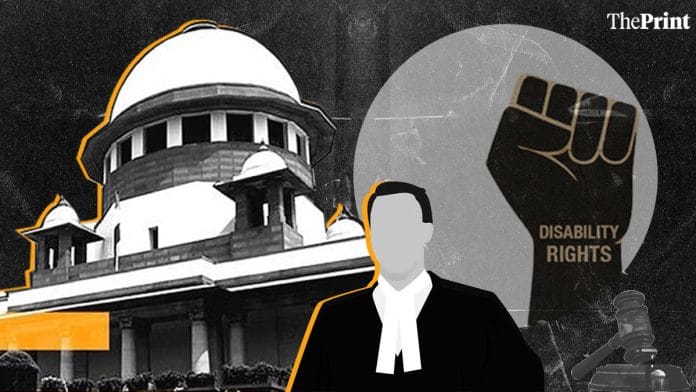


We often imagine legislative actions as static and unchanging — suspended in time. However, if the Indian Constitution is any proof, legislative interventions are rarely a monolith. Rights-granting acts are in a constant state of flux — often moulded and remoulded by bottom-up advocacy from those who hold those rights and top-down interventions by the judiciary. The RPwD Act is an exceptional example of the dialectic between rights bearers and rights upholders, continuously expanding the realm of rights for Persons with Disabilities (PwDs).
Chapter VIII of the RPwD Act placed accessibility at the heart of government responsibility and recognised it as a defining element of everyday life—from transportation to consumer goods. Chapter VI of the Rights of Persons with Disabilities Rules, 2017, further provided for the enforcement of these provisions. However, low budgetary allocations, lack of awareness about the Act, and disability being a state subject have created bottlenecks in the implementation of the Act. Given these circumstances, the judiciary has played a critical role – not just in expanding the envelope on the issue but in the implementation of the act itself.
Take, for example, the Rajive Raturi vs Union of India judgment in November 2024, which reinforced accessibility as a cornerstone in the rights ecosystem for PwDs. The Supreme Court noted that the absence of non-negotiable rules and excessive reliance on guidelines compromised the effective realisation of accessibility rights. It called for Rule 15(1), which dealt with accessibility to be invalid (ultra vires) as it was recommendatory in nature and failed to align with the RPWD Act’s intent. Consequently, the SC directed the Union Government to define clear mandatory standards of accessibility.
Building on this momentum, the Supreme Court extended the accessibility discourse into the digital sphere through its landmark ruling in Pragya Prasun & Ors. v. Union of India and Amar Jain v. Union of India & Ors. (2025). Although accessibility within the Information and Communication Technology (ICT) ecosystem had already been envisaged under the RPwD Act, 2016, its implementation remained uneven and fragmented. The case emerged from challenges faced by persons with disabilities in completing digital KYC procedures, exposing how inaccessible digital systems can become barriers to banking, telecommunications, welfare schemes, and other essential services. In a significant constitutional development, the Court held that the right to digital access is an intrinsic component of the right to life and personal liberty under Article 21. Recognising that access to governance, education, healthcare and economic opportunities is increasingly mediated through digital platforms, the Court held that Article 21 must be interpreted in light of these technological realities. Consequently, it ruled that bridging the digital divide is no longer a matter of policy discretion but a constitutional imperative, requiring the State to proactively design an inclusive digital ecosystem.
Recognising the growing centrality of digital platforms to economic participation and active citizenship, the Court observed that exclusion from digital systems can effectively undermine the exercise of other fundamental rights.
The combined effect of bottom-up advocacy and judicial intervention has shifted accessibility from a matter of voluntary compliance to a legal and regulatory obligation. Sectoral regulators are increasingly directing regulated entities to meet accessibility requirements. This is evident in SEBI’s directions on accessibility for mutual funds and stock market intermediaries, the RBI’s mandate for alternative KYC mechanisms for customers with disabilities, and the introduction of accessibility compliance requirements for OTT platforms. Together, these measures signal a growing recognition of accessibility as a regulatory obligation rather than a matter of institutional discretion.
Beyond accessibility
However, the Court’s contribution to the disability rights ecosystem has extended beyond accessibility to encompass broader questions of discrimination, dignity, reasonable accommodation, and equality of opportunity. In Jeeja Ghosh v. Union of India (2016), the Supreme Court held an airline accountable for the discriminatory deboarding of a passenger with cerebral palsy. It awarded compensation for the mental and physical suffering caused to the passenger. The judgment firmly established that exclusionary treatment on the basis of disability constitutes unlawful discrimination and violates the dignity of persons with disabilities.
The Court further expanded this jurisprudence in Vikash Kumar v. Union Public Service Commission (2021), where it recognised the right of persons with non-benchmark disabilities to reasonable accommodation, including the provision of a scribe in competitive examinations. Significantly, the Court held that the denial of reasonable accommodation itself amounts to discrimination, irrespective of the degree of disability, thereby shifting the focus from medical impairment to the barriers created by institutions and systems.
More recently, in Nipun Malhotra v. Sony Pictures Films India Pvt. Ltd. (2024), the Court addressed disability representation in public discourse. Rejecting stereotypical portrayals that reinforce prejudice, it distinguished between “disabling humour”, which demeans and marginalises persons with disabilities, and “disability humour”, which challenges social assumptions and fosters understanding. In doing so, it expanded disability rights jurisprudence beyond physical and digital access to include questions of representation, dignity, and social inclusion.
Also read: The RPwD Act has aged well. What are the gaps to be filled after a decade of progress
Enforceability of redressal bodies
The expansion and enforcement of disability rights has not been driven by the judiciary alone. The Office of the Chief Commissioner for Persons with Disabilities (CCPD) has also emerged as a key institutional mechanism for safeguarding rights under the RPwD Act, 2016. Beyond addressing individual instances of rights violations, the CCPD is mandated to identify, either suo motu or upon complaint, laws, policies, programmes, and procedures that are inconsistent with the Act and recommend corrective action.
More recently, in the case of Sarah Moin, the CCPD intervened to ensure that the National Testing Agency complied with accessibility requirements, reinforcing the appellant’s rights to accessibility and equal opportunity. The case illustrates the CCPD’s growing role not merely as a grievance redressal body, but as an active enforcer of disability rights and institutional accountability. However, its potential has remained underutilised. Limited engagement from the private sector, coupled with institutional challenges, has constrained its ability to drive accountability and influence systemic change. The growing concern over the weakening of this institutional mechanism is reflected in a recent petition filed by Shashank Pandey, in which the court has issued notice on a plea seeking to strengthen the legal enforceability of the CCPD’s proceedings.
The CCPD is just one example. The expansion of rights jurisprudence has not always been accompanied by corresponding changes in the institutions through which those rights are exercised. Although Chapter II of the RPwD Act guarantees access to justice, evidence, including the NALSAR report, suggests that courts and correctional institutions are inaccessible for many persons with disabilities.
Recent events have brought this contradiction into sharp relief. Harish Singh’s death by suicide was a stark reminder that courts are not only sites of justice but also workplaces, where reasonable accommodation is essential to equal participation. Similarly, in L. Muruganantham v. State of Tamil Nadu (2025), the Supreme Court was compelled to intervene to secure accessibility, healthcare, and dignity for prisoners with disabilities, reaffirming that disability rights do not cease at the prison gate.
These cases highlight a broader challenge. Too often, rights are realised only by those with the resources, support systems, or institutional access to claim them. But the promise of the RPwD Act was never contingent on model citizenship. Its guarantees extend equally to those at the margins of public institutions and public life. As we celebrate a decade of the Act, temperance lies in recognising that the true measure of success is not the expansion of rights alone, but their accessibility to those least positioned to demand them.
This is the second article in a three-part series on the 10 years of the RPwD Act.
Nipun Malhotra is Founder, Nipman Foundation & Director, The Quantum Hub (TQH). He is on Instagram @nipunmalhotra1. Harshita Kumari is Analyst, The Quantum Hub (TQH) . She is on Instagram @memoirs_of_a_bookaffair. Views are personal.
(Edited by Ratan Priya)