








On 7 August, on the sidelines of the BRICS culture ministers’ meeting in Bhopal, Indonesia’s minister of culture Fadli Zon and his Indian counterpart Gajendra Singh Shekhawat confirmed a joint action plan to restore a hundred sub-shrines ringing the great medieval Shaiva complex at Prambanan, in central Java. The meeting closed with the Bhopal Declaration, which commits its signatories to returning cultural property taken by theft or illicit means.
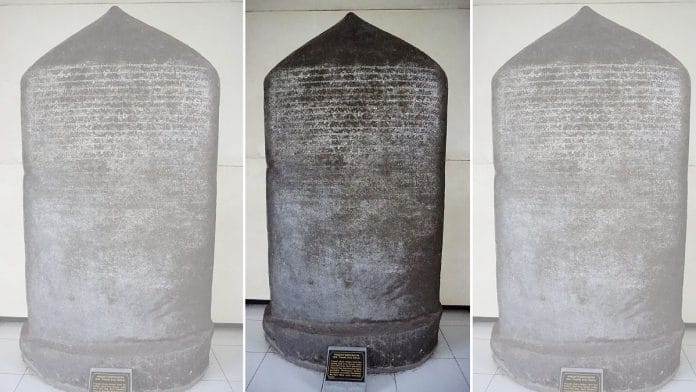
At the same bilateral, the ministers discussed the return of the Pucangan inscription—a slab of inscribed stone that has sat in a storeroom of the Indian Museum, Kolkata, for over two centuries. It was issued by the 11th-century king Airlangga, seen as a key national figure in Indonesia. Zon earlier told reporters in Jakarta that he had raised it with Prime Minister Narendra Modi during his visit, and that Modi had said he would take action.
Three months ago, Indian diplomats and academics successfully secured the return of the Leiden Plates, a crucial record of South India’s medieval connections, uprooted by networks of colonial European power. The Pucangan stone is, in a way, Indonesia’s Leiden Plates. Returning it is not only a moral duty, but a key step toward healing colonial scars in the Indian Ocean.
Medieval Java’s innovations
Prambanan, in Central Java, is a temple complex dating to the mid-ninth century CE—around the same time as the future imperial Chola dynasty was taking root in the Kaveri delta. Until the conqueror Rajaraja Chola raised the Brihadishvara temple at Thanjavur over a century and a half later, Prambanan was the largest Shiva temple anywhere in the Indian Ocean world. Its central sanctum held a three-metre standing image of Shiva mounted on a yoni, rather than a linga. Brahma and Vishnu stood on yonis of their own in the flanking shrines. This is just one among many features that distinguish the complex from developments on the mainland Indian subcontinent.
What the Prambanan complex was for remains contested. The Dutch scholar Roy Jordaan spent decades arguing—in his book In Praise of Prambanan (1996) and several papers after it—that the inner courtyard was designed to be deliberately flooded so that the temples appeared to rise from an artificial ocean, recreating the Puranic Ocean of Milk. Historian Jeffrey Sundberg, in his chapter in the edited volume The Creative South: Buddhist and Hindu Art in Mediaeval Maritime Asia (2022), further argued that the thousand ribbed finials studding the complex are a sahasralinga array. He viewed the spires as a thousand lingas, whose top-to-bottom fluting alludes to the mythical descent of the river Ganga through Shiva’s locks of hair. Sundberg argued that the finials would ritually sanctify every drop of rain that ran through them into the pool below. These intriguing proposals await scholarly consensus.
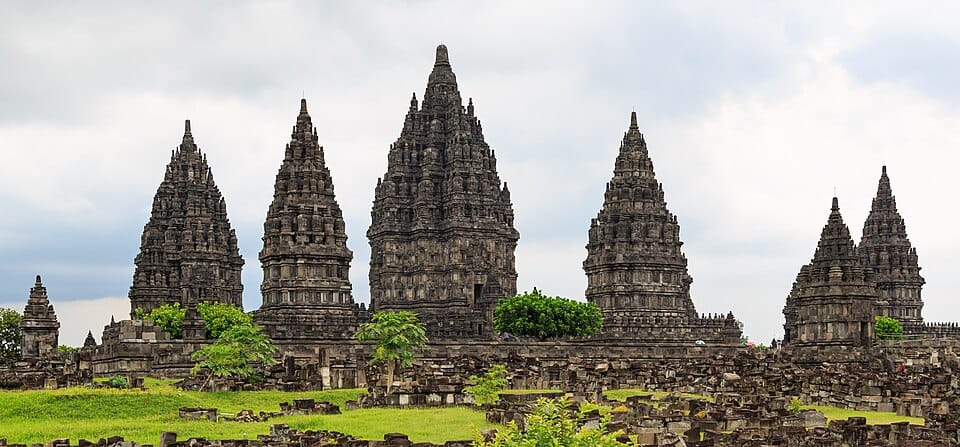
Java, and Southeast Asia, is frequently seen as a recipient of Indian ‘influence’, but no Indian temple up to the 9th century had ever attempted the monumentality of Prambanan. Water as sacred architecture—jala-vāstu—is conventionally traced to the Pallava dynasty of northern Tamil Nadu, whose 8th-century Vaikuntha Perumal at Kanchipuram had a drainage moat interpreted by some as an Ocean of Milk. Temples such as Prambanan, arguably the pinnacle of a distinct regional jala-vāstu culture, challenge us to think of architectural developments across the Indian Ocean world as multicentric. Indeed, as historian Anne Monius shows in Imagining a Place for Buddhism (2001), Tamil texts such as the Maṇimēkalai treat Cāvakam—Java—and Lanka as belonging to a single recognised domain, alongside the Tamil zone itself.
Also read: Coffee, community, conservation—how a Karnataka coalition is working for people and elephants
One ocean, several centres
Around 860 CE, the same time that Prambanan was being lustrated by monsoonal showers and ritual ablutions, King Balaputra of the Srivijaya confederacy in Sumatra, sent a gift to the Nalanda mega-monastery in present-day Bihar. Balaputra claimed descent from Java’s Shailendras. At Nalanda, he pulled off the most impressive example yet of ‘temple diplomacy’, a speciality of the archipelago, which involved religious patronage at cosmopolitan locations in neighbouring territories. Balaputra paid for a monastery to be built at Nalanda, and asked the Pala king Devapala to endow a village for its upkeep.
However, the fortunes of the Shailendras quickly took a turn for the worse. Early in the 10th century, Central Java’s court suddenly moved east, and the flow of inscriptions and monuments from the old heartland—including Prambanan—halted. Several explanations were suggested in the 1970s: a volcanic catastrophe, pressure from the Srivijayans, or the gravitational pull of maritime trade. Nearly 50 years later, there is still no consensus. The record simply goes dark and resumes in the east.
Meanwhile, Srivijaya itself was in the throes of momentous change. The kings of Kedah, on the Malay peninsula adjacent to the Strait of Malacca, were beginning to claim preeminence within the confederacy. By 1005, a Kedah king was conducting ritual diplomacy of his own, funding a Buddhist monastery and Shaivite gifts at Nagapattinam on the Tamil coast, sending ambassadors to Rajaraja Chola.
Whether Java’s withdrawal opened the door for Kedah, we cannot say. But within a decade, both ends of this geopolitical balance were smashed. In 1016, a minor ruler named Wurawari, possibly acting for Srivijaya, destroyed the East Javanese court during a royal wedding, killing the king and his daughter. And in 1025, Rajendra Chola struck Kedah, captured its ruler, and took the title Kadaram-konda, Kedah-seizer. The reality of what happened isn’t entirely clear to us today. Chola inscriptions do not mention a lasting presence in Kedah. Nasha bin Rodziadi Khaw, lead archaeologist at the Bukit Choras site, told me that excavations in the region have so far turned up little sign of an invasion. But something massively reordered the eastern Indian Ocean in those years.
Out of the wreckage came Airlangga. The Pucangan stone, mouldering in a Kolkata storehouse, tells his story: he was the son of a Javanese princess and a Balinese prince who escaped his family’s destruction by fleeing into the forest and lived three years as an ascetic. Around 1019, he was approached by priests of the Shaiva, Buddhist, and Mahabrahmana orders and installed as king. Over 15 years of campaigning, he was able to consolidate eastern Java and turn to building ports and courting merchants. As historian Ninie Susanti argues in ‘Rajendra Chola’s Invasion and the Rise of Airlangga’ (2009), the Javanese king was intent on seizing the transit trade Srivijaya had lost after the fall of Kedah.
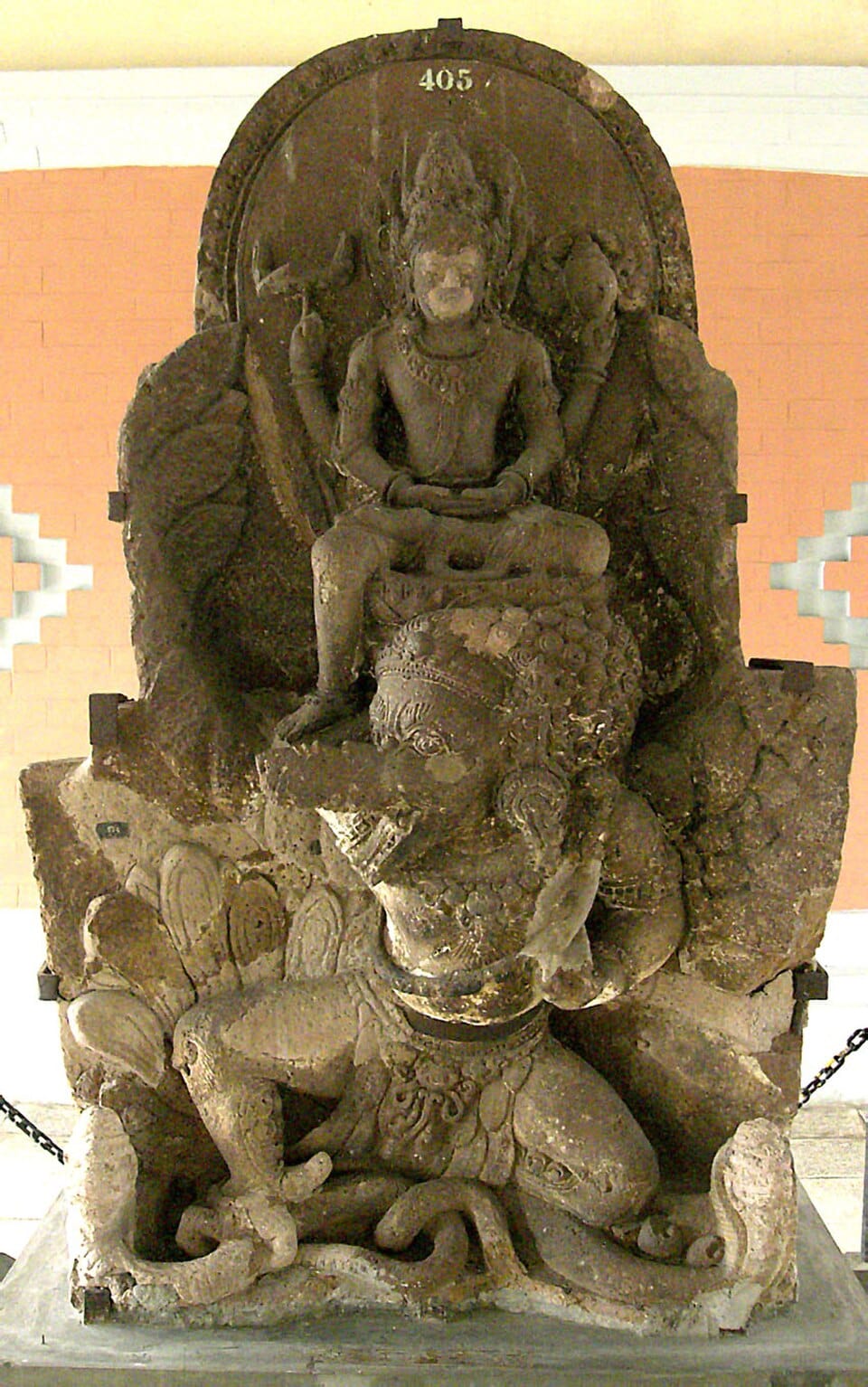
Meanwhile, the India connection continued to intensify. Airlangga’s Munggut inscription of 1022 lists the resident foreigners liable for revenue in a single Javanese village: kliṅ and ārya, men of the north and south of India; Sinhalese; men of Gauda (Bengal), of the Chola country, of Kerala, of Karnataka, of Champa (Vietnam), and Mons. Another of his charters refers to the rights and duties of merchant groups. In their paper ‘Towards a Corpus of Inscriptions Issued during Airlangga’s Reign in Eastern Java’ (2022), epigraphists Titi Surti Nastiti, Eko Bastiawan, and Arlo Griffiths find references to Tamil merchant guilds in the Munggut inscription, such as the añcuvaṇṇam, the maṇigrāmam, and the nānādēsi.
After a long and successful reign, Airlangga eventually became, in modern Indonesia, a founder-figure akin to Ashoka Maurya. His story, as a king who rebuilt a vanquished kingdom from exile, is a national inheritance. The Pucangan stone in Kolkata is one of the few documents that can give Indonesians his chronology and genealogy.
Also read: How a jobs crisis helped Tibet become the centre of the Buddhist world
Objects snagged in postcolonial borders
The Leiden Plates and the Pucangan stone—both keys to the entangled histories of the Indian Ocean a millennium ago—left their ports through colonial extraction. The Leiden Plates went out through a pastor employed by the Dutch East India Company. The Pucangan inscription was carried out of East Java in 1813 by Stamford Raffles, soon to be the founder of Singapore, during the British occupation of the Dutch East Indies. It was a gift to Lord Minto, Governor-General of India, along with a second Javanese stone that ended up on his Scottish estate, and a mass of palace manuscripts from Yogyakarta. Ironically, the British had only been able to seize the island thanks to an expeditionary force that included several thousand Indian sepoys, who in a few years would plan a mutiny that predated the 1857 uprising.
India cannot ask Europe to return what it took from us while holding the founding document of our Indian Ocean neighbour’s national mythos—especially one in which Indians had a hand in displacing. For moral and diplomatic reasons alone, the Pucangan stone must be returned. But should we need a stronger reason, the fact is that many objects the British colonial dragnet stranded here—snagged on the way to European estates and collections—are keys to questions nobody has been able to answer. What did the Chola invasion of Kedah actually entail for regional history? What does its near-absence in the archaeological record mean? What was Kota Cina, the Sumatran port where Tamil merchants settled after the invasion? The site was excavated a decade ago by a French-Indonesian team, with little Indian interest. What did medieval Indian merchant settlements in the archipelago, both Sumatra and Java, actually look like?
The medieval Indian Ocean rim is being studied by everyone except the subcontinent that supplied so many of its ideas and participants. Comforting ourselves with our imagined ancient centrality, content with exceptionalist narratives, we’ve withdrawn from archaeological sites that might hold the answers to our past.
The India-Indonesia Cultural Exchange Programme for 2025-28 already provides for archaeological field schools, joint research, and the digitisation of archives. These are important first steps, but only first steps. The really difficult challenge—especially at a time when Indian archaeology is being weaponised to prove partisan myths and grind ethnonationalist axes—will be to fund and participate in non-partisan international archaeology across the Bay of Bengal. Decolonisation requires us to admit that our histories were interwoven before colonisation violently knotted it, scattering clues to our shared histories across boundaries, languages, and knowledge regimes. As we comb out these snarls and reweave the fabric, the picture that emerges may not flatter anyone’s nationalism or sentiments.
Anirudh Kanisetti is a public historian. He is the author of ‘Lords of Earth and Sea: A History of the Chola Empire’, and the award-winning ‘Lords of the Deccan’. He hosts the Echoes of India and Yuddha podcasts. He tweets @AKanisetti and is on Instagram @anirbuddha. Views are personal.
(Edited by Prasanna Bachchhav)