








Cockroach Janta Party protests continue across India, drawing a membership of young people with “three certificates, zero callbacks”. Too many credentials, too few seats, not enough jobs home or overseas: The CJP’s grievances, strangely, mirror those of India’s best-regarded medieval specialists—multilingual Buddhist translators. Once in demand as far as Japan, over the course of the 10th and 11th centuries, Indian Buddhist translators found both international and domestic opportunities drying up. The rising monasteries of Tibet, capitalising on the opportunity, would go on to dominate the global Buddhist imagination for the better part of a millennium.
Built for export
In the early medieval Indian subcontinent, c. 600–1100 CE, Buddhist translators were specialists. They were the medieval equivalent of those who hold several degrees before going in search of a career today. Think of them as more akin to PhD holders than your average graduate.
As I argued in an earlier column on the decline of Nalanda (the North Indian mega-monastery), even getting admitted for a course of scriptural study here required literacy and mobility out of reach for most. It required you to get past gatekeepers whose job, as historian RK Mookerji put it, was to be “expert religious controversialists”, asking questions from both Brahminical and Buddhist materials, poking holes in candidates’ answers. Even if you were accepted into a coveted Nalanda guru-sishya-parampara (teacher-student-lineage), those credentials didn’t get you far in the bureaucracy of the subcontinent’s own courts, which by the eleventh century preferred Brahmin administrators and ritual experts.
What an elite Buddhist parampara did get you, though, was international demand. Tansen Sen, distinguished historian of India-China relations, studied this in his paper “The Revival and Failure of Buddhist Translations during the Song Dynasty”. From the early centuries CE onwards, various Asian kingdoms had actively sought experts to render Buddhist texts from Sanskrit into other languages. (In Northern India, in contrast to the south and the island of Lanka, Buddhist sects wrote in Sanskrit rather than in Pali.)
The early wave of translators in China tended to be Central Asians, with either direct or indirect ties to India. Translations were ordered for political, ritual and religious ends. An entire genre, the huguo or “state-protection” texts, existed to ward off war, famine, and disease on a kingdom’s behalf. In the 690s CE, the Indian monk Bodhiruci and the Khotanese monk Shikshananda each interpolated passages into Buddhist sutras to help legitimise Empress Wu Zetian’s seizure of the throne, making her the only woman to ever rule China in her own right.
Sen and other historians have argued that, after the initial wave of Sanskrit translations, Chinese-language Buddhist doctrine quickly took centre-stage. Here’s an example from an earlier column: The South Indian monk Vajrabodhi, of Nalanda pedigree, arrived in China in the 8th century by way of Sri Lanka and Java, making rain fall and trees blossom on command. His successor Amoghavajra—son of a Central Asian mother and an Indian father—built a royal cult around the bodhisattva Manjushri at Mount Wutai in China. With his own extensive Chinese ritual apparatus, this Manjushri became famous, drawing pilgrims from as far as the Gangetic Plains in the 9th century.
Also read: Pallavas to Mughals—a history of hero worship in medieval India
Brahmins, Kshatriyas, and China
In the late 10th century, with the accession of a new Chinese imperial dynasty—the Song—calls went out again for Indian translators. Two Brahmins from the Himalayan foothills, known in Chinese sources as Tianxizai (Dharmabhadra) and Shihu (Danapala), were ready and waiting. Historian Jan Yun-hua studied them in “Buddhist Relations between India and Sung China”, offering an insight into the translator’s curriculum.
One of these Brahmins, a Kashmiri Dharmabhadra, studied “shabdavidya” (literally “the knowledge of sounds”) in a monastery at the age of twelve. His cousin Danapala, at age fifteen, had “learned the regular and running-hand styles of the scripts prevailing in the five regions of India” from a Buddhist acharya around present-day Jalandhar. Danapala also “knew the writings of Sinhalese, Khotanese, and those of Srivijaya and Java”. Such an education would have ensured opportunities across much of Monsoon Asia. Since, at this time, Buddhist texts in multiple languages and scripts were circulating, these young men could work confidently in practically any court or monastery. Dharmabhadra, we are told, declared that “all the sages and saints of the past considered the translation of Sanskrit canons into Chinese as the means to preach Buddhism”.
This lofty sentiment soon crashed into reality. The 7th-century Tang dynasty of China had controlled the overland routes to and from India, but the 10th-century Song dynasty did not. So, when the cousins travelled overland, they were detained for months by the ruler of Dunhuang, the great oasis-town on the border of China proper. Being “forced to cast aside their staffs, water jars and other things”, they finally reached the Song capital in 980.
Another Indian translator, a North Indian Kshatriya known in China as Fatien, had set out, after graduating from Nalanda, with his brother and two monks from Western and Southern India respectively. Only the brothers survived the journey. These men were among the founding staff of the Song dynasty’s new Institute for the Transmission of the Dharma.
The elite among the Indian elite were able to take up this lucrative international position thanks to luck and determination, as much as privilege. At the Institute, though, they had finally “arrived”. This spectacular establishment had a translation hall, a stylists’ hall, a philological-assistants’ hall, and a convoluted process to ensure perfect renditions from Sanskrit to Chinese.
Also read: History of Indians in the Arab world—port builders, Jat governor, translators, and slaves
Floundering and flourishing
Thanks to Prof Sen’s work, we know the details of this process. Translations at the Institute began with establishing a mandala in the middle of an altar, one Indian monk at each side. After seven days and nights of continuous chanting, and ritual propitiations of sages and saints, the actual work began. Each text required an exhaustive workflow running from the chief translator through a philological assistant, a text appraiser, a transcriber, scribe, composer, proofreader, editor, and stylist—an extremely labour- and capital-intensive process.
However, the Institute was only ever able to attract a small trickle of Indian experts. Fahu (Dharmapala), a Kashmiri Brahmin possibly trained in Vikramashila, arrived in 1004 and worked on several projects over the decades. Yet, Sen writes, “of the more than fifty Indian monks who reached China between 985 and 1085, only three… served in the Buddhist translation projects at the Institute… As Jan Yun-hua points out, of the one hundred eighty-three Chinese pilgrims who returned after pilgrimage to India, only one seems to have worked at the Institution”.
Overland travel to China was increasingly difficult, and attempts to recruit in China largely failed. Archived letters suggest that the Institute and the emperors were aware of the problem. Ambition and funding were not lacking: It was the supply of Indian Buddhist Sanskritists, a vanishing elite. They were increasingly disconnected even from medieval Indian labour networks, let alone able to navigate upheavals in Central Asia to take up a punishing, if lucrative, job. In 1078, with the death of the last monk sufficiently fluent in Sanskrit, the emperor issued an edict ordering the Institute to wait until the arrival of Indian monks “versed in [the Buddhist] teachings”. It does not seem that any ever came.
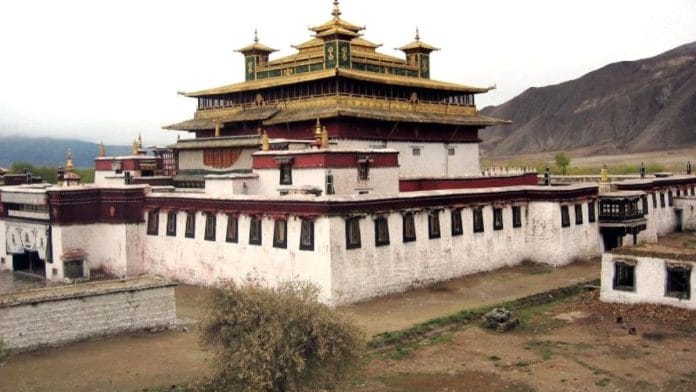
China’s centralised translation bureaucracy failed, with its multiple tests, cross-checks, validations, and certifications. But a decentralised set-up in neighbouring Tibet succeeded. New centres in 11th-century Tibet drew equally qualified candidates like Atisha Dipankara, a graduate of the mega-monasteries at Oddantapuri and Vikramashila who obtained his final certification in Sumatra. Scholar Roberta Raine, in “The Buddhist Translation Histories of ancient China and Tibet” counted over seven hundred translators, both Indian and Tibetan, active in medieval Tibet, compared to less than two hundred in China. The Tibetan Buddhist corpus comprises over 4,500 translated manuscripts, compared to China’s roughly 2,200.
Chinese Buddhist travellers were required to pass entrance exams and navigate a contorted bureaucracy before ever setting out for India; in comparison, Tibetan monks were relatively free to travel to India, study Sanskrit, and then return. They then worked usually in partnership with an Indian expert, rather than heading to a single national Institute, subject to bureaucratic standards and political whimsy. When elite Indian and Chinese institutions faltered under centuries of geopolitical pressure, it would be the younger, vigorous, and decentralised contender that would go on to dominate Asian Buddhism.
Anirudh Kanisetti is a public historian. He is the author of ‘Lords of Earth and Sea: A History of the Chola Empire’ and the award-winning ‘Lords of the Deccan’. He hosts the Echoes of India and Yuddha podcasts. He tweets @AKanisetti and is on Instagram @anirbuddha.
This article is a part of the ‘Thinking Medieval‘ series that takes a deep dive into India’s medieval culture, politics, and history.
(Edited by Theres Sudeep)