






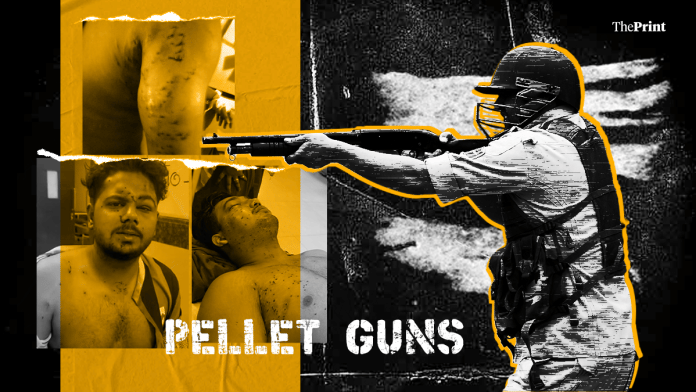


The recent use of so-called pellet guns to disperse protesters in New Delhi has once again exposed one of the most troubling contradictions in Indian policing. Beginning in 2010, the 12-bore Pump Action Shotgun became synonymous with the counter-insurgency campaign in Jammu & Kashmir, where it was used to control violent crowds. Thousands suffered pellet injuries, with many losing partial or complete eyesight. It has also appeared sporadically during the farmers’ agitation in 2024, the ethnic violence in Manipur in 2023 and, allegedly, during the Ladakh protests in 2025.
Each episode revives the familiar debate: Was the force proportionate? Were operational procedures for the use of pellet guns followed? Were the police properly trained to use them? Considering the science of pellet guns and the nature of the injuries they cause, is their use justified?
These are legitimate questions, but they miss the central issue.
The problem is not whether the use of pellet guns is justified or not. The real problem is that they were never designed to discriminate between one individual and another. A weapon engineered to fire hundreds of pellets cannot be transformed into a humane policing instrument simply by calling it “less lethal”.
History, ballistics and experience all point to the same conclusion—it is time for India to retire the pellet-firing shotgun from routine crowd control.
Also Read: India has a military Vision 2047. Now it needs a system to deliver it
A weapon born for war
The multi-shot smoothbore gun, or shotgun, is among the oldest firearms still in existence. Since the 16th century, long before the advent of rifled muskets and modern assault rifles, armies relied on smoothbore firearms loaded with multiple lead balls for warfare. The underdeveloped science of internal and external ballistics led to inaccuracy, which was compensated for by firing several projectiles at once.
The famous blunderbuss and early muskets embodied this principle. They were devastating at short range precisely because they did not require precision. A single discharge could wound several enemy soldiers or compensate for inaccurate aim amid the confusion of battle.
The Industrial Revolution transformed warfare. Rifled barrels, elongated bullets and breech-loading weapons dramatically increased range and accuracy. Professional armies rapidly abandoned smoothbore guns as primary battlefield weapons because precision consistently proved more effective than indiscriminate multi-projectile fire.
However, the shotgun survived by finding a different vocation.
Sportsmen discovered that a spreading cloud of tiny pellets was ideal for hitting fast-moving flying birds without damaging the flesh. Throughout the twentieth century, improvements in cartridge design, smokeless powder and interchangeable chokes perfected the sporting shotgun. It became and still remains a specialised hunting weapon, not an instrument of war.
The myth of ‘less lethal’ pellet guns
Understanding the danger requires an understanding of the science behind cartridge design and the external ballistics of the shotgun.
A shotgun cartridge is packed with pellets varying in number from six to over 600 for small-game and bird shooting, depending on the size of the prey. The bore size is determined by the number of spherical lead balls of that diameter that can be made from a pound of lead. In India, mostly 12-bore shotguns are used. The bore can be choked (constricted) at the end of the barrel to control the spread of the shot on exit.
The pellet gun used by the police is a 12-bore Pump Action Shotgun with a magazine of four cartridges. The cartridge used by the Indian police is Shot No 9, primarily meant for skeet shooting, which contains approximately 650 pellets of .08 inch in a standard 1⅛ -ounce charge. The pellets can be made of lead, steel, rubber or plastic. In India, so far, only lead pellets are used.
The pellets exit the muzzle at a velocity of 1,150–1,200 feet per second (fps) and spread in a widening cone with distance due to air resistance. During the first 10 to 15 yards, they behave almost like a single massive projectile, with a spread of 10-15 inches in diameter, delivering devastating energy at a velocity of 900-1,000 fps. At these distances, a shotgun can inflict wounds even more destructive than a rifle bullet because hundreds of pellets strike almost simultaneously.
Criminals have long exploited this characteristic. The Italian Mafia’s notorious Lupara, a short-barrelled shotgun, became feared precisely because of its devastating close-range lethality.
As the distance increases, the spread widens. At 20 to 25 yards, they spread to 20-30 inches in diameter, and at 30, 40 and 50 yards to 35, 40 and 50 inches respectively. Thus, as the cone of dispersing pellets widens with distance, the pellets can strike several people in their path.
The end result is a dangerous paradox. At close range, the weapon is lethally concentrated. At longer range, it becomes dangerously indiscriminate and can still cause serious injuries, including blindness and skull and spine fractures; even death remains entirely possible.
Neither characteristic is compatible with modern democratic policing. By contrast, a modern rifle, while being more lethal in single-shot mode, is highly accurate to target individual ringleaders or violent individuals. Thus, the “non-lethal” pellet gun is a myth. It is indeed statistically “less lethal” than a rifle but is highly inaccurate and indiscriminate.
The Office of the United Nations High Commissioner for Human Rights (OHCHR) and several international human rights bodies have repeatedly questioned the use of multiple-projectile shotguns for crowd control because they are inherently indiscriminate and cannot be aimed with sufficient precision to avoid unintended casualties.
The issue is therefore not merely one of excessive force. It is one of indiscriminate force.
Training cannot overcome physics
Police manuals rightly instruct personnel to aim the pellet gun below the waist and to engage the crowd only at a distance of 50 yards. At this range, the velocity of the pellets is only 350-400 feet per second, reducing their lethality. Muzzle deflectors have been introduced to keep the pellets from hitting above the waist. Such procedures are professionally sound.
Unfortunately, riots are not firing ranges.
Police personnel confronted by charging mobs experience stress, fear and tunnel vision. Human instinct drives them to aim towards the centre of visible mass — the chest — not the legs. This phenomenon is well documented in military and police psychology.
India’s experience reflects precisely this reality. Images from the recent Jantar Mantar protest are telling. They show an RAF jawan mounting the gun and holding it horizontally at shoulder height, without any downward tilt. Ideally, the tilt angle should be 30-45 degrees below the horizontal plane. The gun is also without a muzzle deflector.
An RTI response from two hospitals revealed that 10 persons were injured during the 20 July protest, with pellet injuries on the face, chest, arms and back. One victim is likely to lose vision in one eye.
Even perfect marksmanship cannot change the laws of ballistics governing the cone-like spread of pellets. When the point of aim is at 30 yards, the pellets can strike people within the spreading cone from 25 to 50 yards. Every pellet follows its own trajectory. Some strike the intended target; others hit bystanders, journalists or curious onlookers. Training can reduce risk. It cannot eliminate the weapon’s inherently indiscriminate nature.
Lessons not learnt
The deployment of pellet-firing shotguns in Jammu & Kashmir should have settled the debate on their use for crowd control. The first use of pellet guns was in 2010 during four months of protests following the Machil fake encounter. According to a study by Jammu and Kashmir’s premier Sher-i-Kashmir Institute of Medical Sciences, Soura, six persons were killed and 192 were injured by pellets. Six people lost vision in one or both eyes. Most injuries were above the waist.
In 2018, then Jammu and Kashmir Chief Minister Mehbooba Mufti informed the state Assembly that more than 6,000 people had been injured by pellet guns in Kashmir between July 8, 2016 and February 27, 2017. Of these, 728 had been hit by pellets in their eyes. At least 54 individuals had their vision impaired due to pellets. According to official figures presented in Parliament, 17 civilians died of pellet injuries between July 2016 and August 2017.
Doctors described complex ocular injuries rarely encountered outside battlefields. Many victims were permanently blinded. Others sustained disfiguring facial injuries. Some were bystanders caught within the cone of dispersing pellets. Every serious injury widened the political divide between citizens and the state. That is perhaps the greatest weakness of pellet guns. Even where their use may be legally justified, their strategic consequences are often counterproductive. Images of blinded civilians rapidly overwhelm the state’s narrative of restoring law and order. Modern democracies cannot afford weapons that impose such heavy political costs.
Also Read: Future of India’s IBGs rests on rollout speed, tech. History rarely rewards armies that wait
Retire the relic
The 20 July protest and the police crackdown were probably the most digitally captured such events in India. Apart from domestic and international media coverage, the mobiles of young protesters captured every minute detail and flooded the internet. All tenets of well-established graduated crowd-control procedure were violated with impunity. Mercifully, only seven pellet-gun cartridges were used. However, their use in the heart of Delhi has put the issue at centre stage.
History has an unmistakable lesson. Professional armies abandoned the smoothbore shotgun because they discovered that precision is superior to indiscriminate fire. Yet policing has resurrected precisely the characteristic that soldiers rejected more than a century ago.
Calling pellet-firing shotguns “non-lethal” obscures their true nature. They are not merely dangerous because police under pressure make mistakes. They are dangerous because they were designed to spread multiple projectiles over a widening area. No amount of training can fundamentally alter that reality.
A democracy should aspire to use force that is precise, proportionate and accountable. Weapons designed to hit many people simultaneously belong to another age. This relic has outlived its utility as an instrument of democratic policing. India should have the moral courage to retire it.
Lt Gen H S Panag PVSM, AVSM (R) served in the Indian Army for 40 years. He was GOC in C Northern Command and Central Command. Post retirement, he was Member of Armed Forces Tribunal. Views are personal.
(Edited by Asavari Singh)