




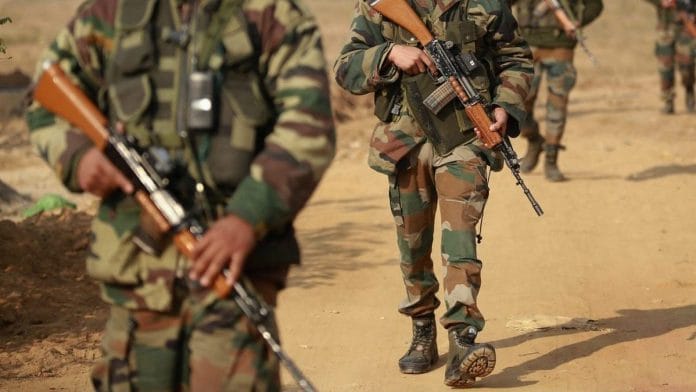

The Indian Army’s rollout of Integrated Battle Groups (IBGs) on 1 July is its most ambitious structural and organisational reform since Independence. Yet it also raises an uncomfortable question: can an army preparing for future wars afford to spend another 10 years implementing a reform whose necessity was recognised in 2002 and which was finally conceptualised in 2018?
Nevertheless, the reform has now certainly moved beyond concept papers. The first phase involves converting the two divisions of XVII Mountain Strike Corps into five IBGs and one Fire Support Group (at the Corps level) over the next two years. The refined model would then be extended across the Army’s 42 Infantry, Mountain, Rapid, Armoured, and Artillery Divisions, and 12 Independent Armoured/Infantry Brigades.
However, the creation of IBGs must not become another prolonged restructuring exercise. It must become the technological nucleus of the Indian Army’s future battlefield. And it must happen in the next five years.
Also Read: Operation Sindoor 2 could unfold in 5 yrs. Pakistan is learning from Iran
The evolution of the IBG
The origins of the IBG lie in a fundamental operational problem. Traditional combined-arms divisions, which have been the default fighting formation of armies for two centuries, are manpower-intensive, headquarters-heavy, and relatively slow to mobilise. Their deployment is optimised for prolonged campaigns rather than the compressed timelines likely in future conflicts. The brigade battle groups created out of divisional resources for operations also lacked organisational cohesion.
The Indian Army learnt the lesson the hard way during Operation Parakaram in 2001-02 when it took three weeks to mobilise and lost the window of opportunity and advantage of first mover against Pakistan. Consequently, the Army started functioning with division-size battle groups since 2003-04, which were planned to be progressively launched into battle to execute the Cold Start operational strategy.
However, even these were too large and slow to mobilise. In 2018 General Bipin Rawat caught the bull by the horns and ordered a detailed study for evolving the IBG. In 2019 field exercises were conducted in 9 Corps in the plains and 17 Corps in mountains with experimental IBGs to test and refine the concept.
Another factor driving the creation of IBGs is that India and its adversaries, China and Pakistan, are armed with nuclear weapons, precluding full-scale decisive conventional wars. Conflict will be limited in time and space, and dominated by high-end precision and lethal military technology, and rapid manoeuvre. In this context, Operation Sindoor is a classic example. In such a conflict, pre-emptive operations along disputed borders to seize territory are most likely. Executing or responding to such threats requires very agile formations. Divisions are too unwieldy and slow to respond in such conflicts.
The intention is clear: reduce mobilisation time, compress the sensor-to-shooter cycle, and increase operational flexibility. The concept is sound. The challenge lies in implementation.
What should the ideal Indian IBG look like?
Unlike traditional brigades that were reinforced with divisional resources to become combined-arms groups before operations, an IBG is designed as a self-contained combined-arms formation of 5,000–6,000 troops. Its composition will be tailor-made, keeping in view the terrain, mission, and enemy threat. It can be mechanised forces or infantry-predominant, or balanced, with its own components of artillery, unmanned aerial vehicles (UAVs), engineers, air defence, intelligence, electronic warfare, communications, and logistics under a single commander. To retain agility and flexibility, some combat support and logistic support elements may continue to be provided from Corps resources.To retain agility and flexibility, some combat support and logistic support elements may continue to be provided from Corps resources.
It is pertinent to mention that the raising of five IBGs and one FSG under 17 Corps is a pilot project to be completed in two years. Hence, the final organisation and composition may undergo further modification. Nevertheless, every IBG should incorporate certain common features.
The first is genuine combined-arms integration with permanently assigned combat, combat support, and logistics support elements. The integration of fighting arms — armour, infantry, and mechanised infantry — can be on an as-required basis or as composite units.
Second, every IBG should have an integral Intelligence, Surveillance and Reconnaissance (ISR) unit, which should include dedicated reconnaissance, UAV, electronic warfare, and signal intelligence sub-units.
Third, every IBG should be supported by integral artillery and long-range precision strike capability extending well beyond conventional artillery ranges, which can be integral or come from the FSG. Fire support must be integrated into a real-time sensor network. The future battlefield is increasingly defined by what can be seen, identified, and destroyed within minutes.
Fourth, command-and-control systems must employ an AI-enabled battlefield management and decision support system that fuses data from satellites, drones, radars, and ground sensors into a common operational picture.
Fifth, logistics require a complete redesign, with predictive maintenance, autonomous resupply, distributed ammunition dumps, and digital inventory management.
Without the above capabilities, an IBG becomes little more than a smaller division.
How other armies are adapting
India is implementing a brigade-centric model nearly two decades after the US Army and about a decade after the PLA. The challenge, therefore, is not to replicate their structures but to leapfrog directly to a drone-enabled, networked combat system.
The US Army’s Stryker, Infantry, and Armoured Brigade Combat Teams were created between 2003 and 2005, post Iraq War 2.
These have demonstrated over two decades in Iraq and Afghanistan that permanent brigade-level combined-arms organisations reduce reaction time while improving tactical flexibility. Their effectiveness, however, derives less from organisation than from overwhelming network integration, ISR assets, precision fires, and joint air support. Interestingly, the division headquarters was retained for command and control, with a varying number of brigade-size teams.
China’s military reforms are perhaps even more relevant. Since 2015, the People’s Liberation Army has restructured all its divisions into 78 Combined Arms Brigades (CABs) operating under 13 Group Armies which are equivalent to a corps. CABs are heavy, medium, and light (for mountains) depending upon mission, terrain, and threat. Every brigade is designed to operate within a highly networked system combining drones, long-range rockets, electronic warfare, cyber capabilities, and space-based surveillance.
Eastern Ladakh 2020-24 demonstrated that tempo matters as much as numbers. The PLA achieved strategic surprise by rapidly deploying four to six Combined Arms Brigades. India eventually generated much greater combat power of nearly three divisions, but mobilisation lag allowed China to establish tactical advantage before Indian formations fully concentrated.
The Russia-Ukraine war has further transformed military thinking. Russia entered the conflict with Battalion Tactical Groups that relied heavily on artillery and armour but lacked sufficient infantry, logistics, and command resilience. The limitations became apparent early in the war. It switched back to its traditional brigades, which were always organised as modular combined-arms formations as part of a division.
Ukraine, meanwhile, began with combined-arms brigades, which were transformed through drone and technological innovations. It has demonstrated how smaller brigade-sized formations equipped with drones, commercial satellite communications, precision fires, and decentralised command can repeatedly offset numerical disadvantages. Technology has flattened traditional hierarchies.
The lesson is unmistakable. Modern brigades no longer fight because they are bigger. They fight better because every sensor, shooter, and commander operates on the same digital battlefield. Connectivity has become combat power.
Execution cannot become another decade-long reform
My greatest concern is the pace of implementation. If the two divisions of XVII Corps require two years for conversion into five IBGs and one FSG, extending the model across the remaining force could easily consume another decade.
That timeline is incompatible with India’s strategic environment.
The previous Chief of Army Staff, General Upendra Dwivedi, appears to have recognised this challenge by introducing the Rudra Brigade concept with existing resources. However, the Rudra Brigade should be viewed as an operational bridge rather than the destination. It preserves momentum while the Army completes the more comprehensive technological transformation required for fully capable IBGs.
The Army now needs a campaign-mode approach. While the pilot project progresses, all other divisions must functionally convert into IBGs on the Rudra model with existing resources. This will enable doctrine formalisation, training, and preparation for the induction of technology and additional resources, without sacrificing operational efficiency.
Also Read: The most important lesson of drone and missile warfare in Iran & Ukraine is economic
The way forward
The Army should pursue three parallel reforms. First, the government/Ministry of Defence should approve and own the transformation, and back it with dedicated funding for technology infusion, rather than treating modernisation as a separate process.
Second, accelerate implementation through the simultaneous conversion of multiple formations with existing resources, and induct technology and additional resources to complete the process in five years.
Third, institutionalise continuous adaptation. The IBG should evolve every few years based on operational experience, emerging technologies, and lessons from ongoing conflicts worldwide.
The formal launch of the IBGs marks an important milestone, with the potential to become the foundation of India’s future warfighting capability. But if organisational restructuring outpaces technological transformation—or if implementation stretches over 10 years—the reform risks arriving just as the character of war changes again. India cannot afford that luxury.
History rarely rewards armies that reorganise after the next war begins. India’s IBGs must therefore be judged not by how many are raised, but by how quickly they become the most technologically integrated fighting formations in the region, which out-mobilise, out-see, out-decide, and out-fight their adversaries.
Lt Gen H S Panag PVSM, AVSM (R) served in the Indian Army for 40 years. He was GOC in C Northern Command and Central Command. Post retirement, he was Member of Armed Forces Tribunal. Views are personal.
(Edited by Asavari Singh)
Just three days into a war fought with Integrated Battle Groups, the government will announce that the treasury is empty and ammunition is exhausted. Ultimately, slogans like ‘it is time to end the war, not the age of war’ and ‘India is a peace-loving country’ will be deployed—all just to save face and hide the humiliation of relying on 29.5 squadrons of aging fighter jets.