







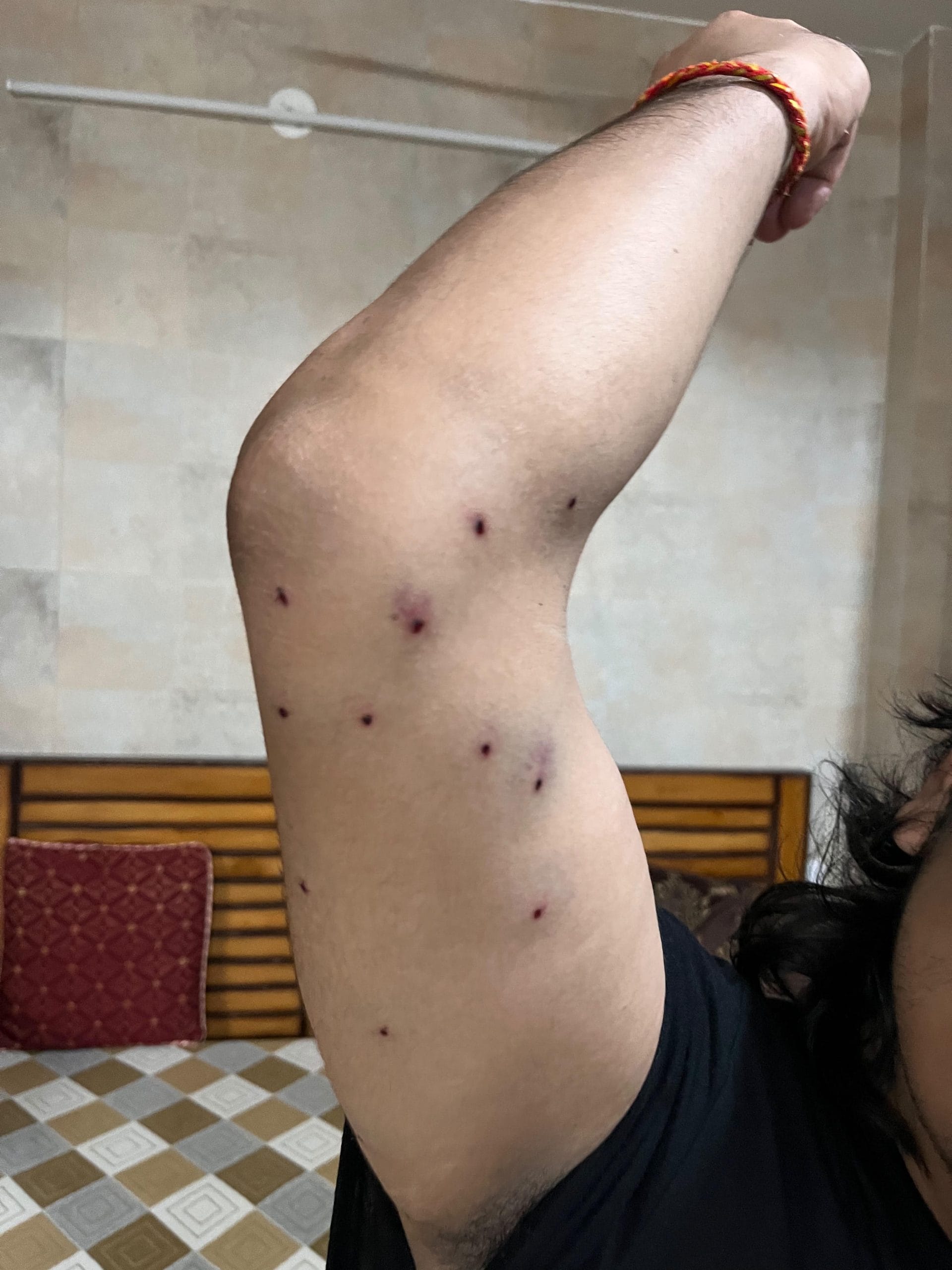
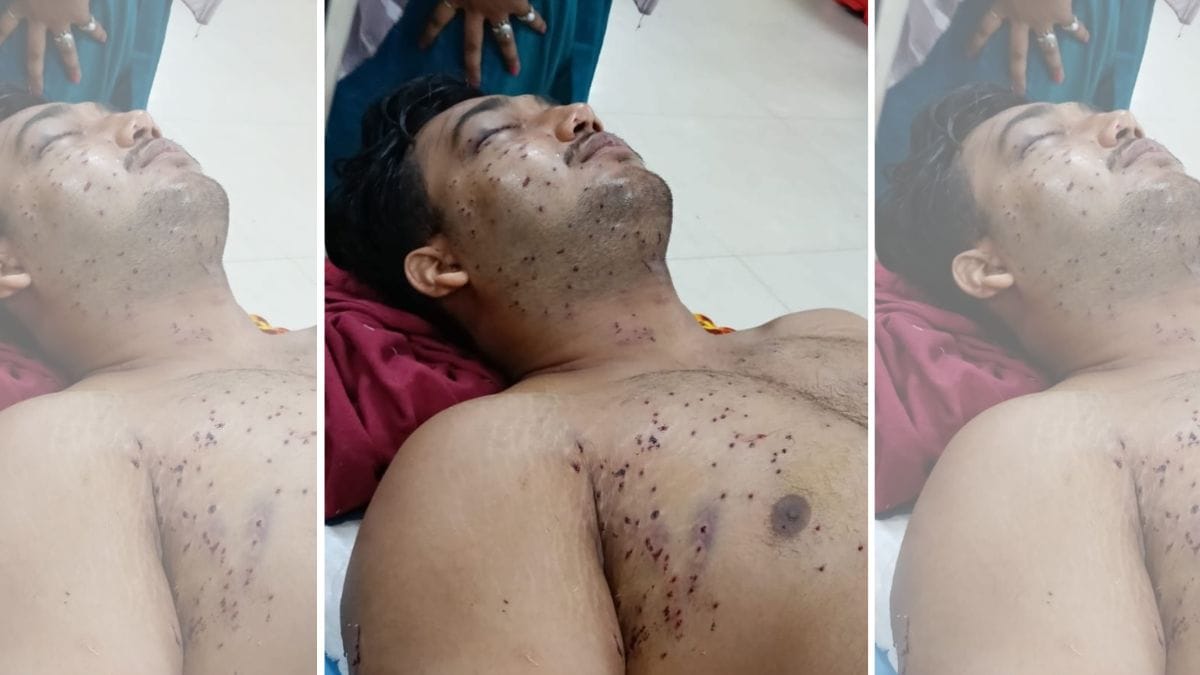
New Delhi: A burst of tiny red dots on the skin, with devastating implications depending on the point of impact. They can cause blindness, penetrate the skull or the spine, and from close range, even be lethal.
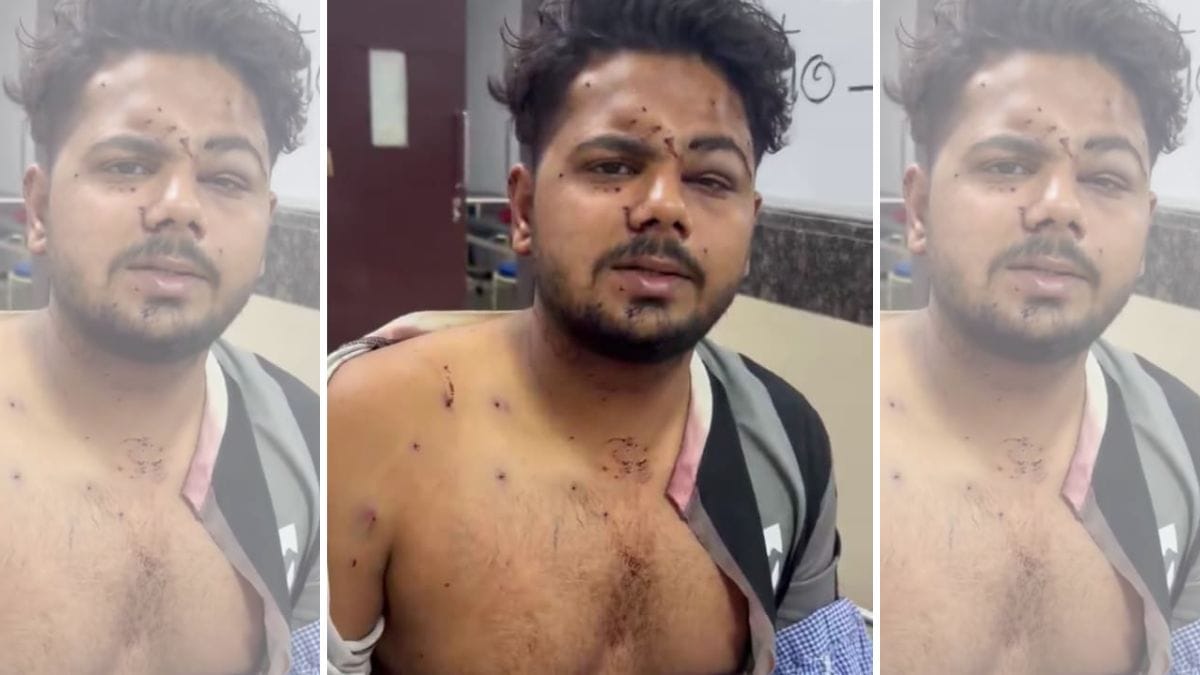
Ever since Monday’s march to Parliament, visuals of protesters showing this burst of tiny red dots on their torso and even their face have flooded social media.
At least three protesters suffered serious injuries from pellet guns allegedly fired by the Rapid Action Force (RAF) during the Cockroach Janta Party (CJP)-led march from Jantar Mantar.
Among those injured were Sheikh Irshad Mansoori, admitted to Lady Hardinge Medical College, Sahil Lochab, admitted to the AIIMS Trauma Centre, and a sports journalist, who was treated at Safdarjung Hospital. Mansoori remains in hospital, under treatment for pellets that pierced his left eye, shoulder and chest. Lochab underwent surgery to remove pellets lodged in his abdomen, while the sports journalist sustained multiple pellet injuries to his upper torso, according to hospital records.
This marks one of the rare instances of pellet guns being used against protesters outside of Jammu and Kashmir. Classified as a “non lethal” weapon, but used only as a last resort, pellet guns remain among the most controversial crowd control measures because of their potential to cause permanent disability.
However, the pellet gun has, over the years, undergone several modifications—a deflector fitted to the gun to direct the pellets downward so they strike below the torso and avoid the eyes and face, and plastic-tipped pellets to reduce penetration into the skin.
So, what are pellet guns, how do they work, who makes them, and why have they remained one of India’s most controversial crowd control weapons? ThePrint explains.
ThePrint made multiple attempts to reach the CRPF spokesperson as well as Inspector General (RAF) Seema Dhundia for comment via calls and WhatsApp, but did not receive any response till the time of publication. RAF is the anti-riot wing of CRPF.
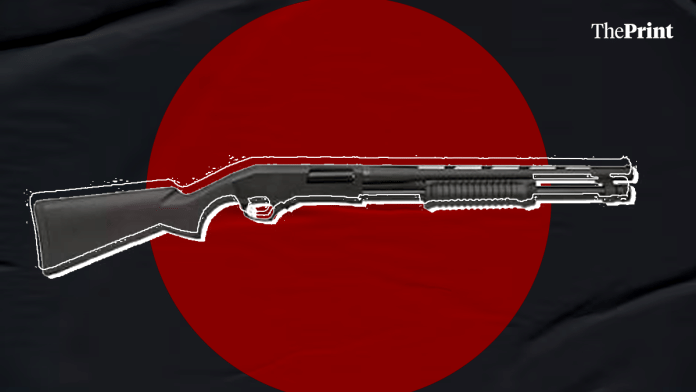
A 12 bore pump action shotgun
The so-called pellet gun used by security forces is a 12 bore pump action shotgun that fires a cartridge containing hundreds of small spherical projectiles, or pellets, made of a lead alloy. 12 bore is the measure of the barrel.
When fired, the cartridge releases a spray of hundreds of tiny pellets that fan out and disperse with a speed of 100 to 150 meters per second, injuring multiple people in a single shot. These pellets, manufactured at the Ordinance Factory in West Bengal’s Ishapore, are part of the RAF’s armoury and each company, which has 100 to 120 personnel, is issued two or more of these guns.
On Monday, nine companies of RAF were deployed in Central Delhi, which has now been increased to 15 companies.
“The pellets are tiny metallic balls, roughly 2–3 mm in diameter. They are classified as less lethal, but they pierce the skin and are designed to inflict enough pain to disperse a crowd. That is precisely why pellet guns are not the preferred method of crowd control and are meant to be used only as a last resort,” a senior officer from the security establishment said.
The officer added that while pellet guns are categorised as less-lethal, the severity of injuries depends largely on the range from which they are fired and the part of the body they strike. A close-range shot can cause grievous injuries, while pellets striking the eyes, as seen during the 2016 unrest in Jammu and Kashmir, can result in permanent blindness.
The pellet-firing shotgun was adopted by Indian security forces for crowd control in Jammu and Kashmir in 2010, after widespread unrest in the Kashmir Valley. Their use, however, came under intense scrutiny in 2016 after security forces deployed them extensively during protests that followed the killing of Hizbul Mujahideen commander Burhan Wani. Over 200 people were injured, some lost vision after pellets struck their eyes. In some cases, pellets got lodged in the brain or spine, leading to a lot of backlash and widespread demands for the weapon’s withdrawal.
The concept of the pellet gun came from bird hunting, the officer quoted earlier explained. A hunter would load a cartridge containing multiple pellets, so that when it was fired, the pellets spread out and increased the chances of hitting more than one bird at a time, the officer added.
Lead to plastic, a deflector
Traditionally, pellets were made of lead or lead alloy. However, following widespread criticism after the 2016 Kashmir protests, a decision was taken to make them “less lethal”. Pellets with plastic heads were subsequently introduced.
Another change in specifications was the introduction of a deflector, which is fitted to the front of the gun to ensure that, when fired, the pellets are directed downward instead of striking the upper body, face or eyes of protesters.
“This deflector is mounted on the weapon and ensures that the spray of pellets is deflected downward so that anyone it hits is struck below the torso,” another officer said. “But again, this is a measure used only in extreme situations. Otherwise, the most effective and preferred methods of crowd control are tear gas, lathis and water cannons. Pellet guns are reserved for very serious scenarios.”
The officer said that the use of pellet guns is a key part of riot-control training, with personnel being taught the limited circumstances in which they should be deployed because pellets fired from close range can cause severe injuries.
Apart from pellet guns, security forces have other less-lethal crowd control options, including rubber and plastic bullets. Rubber bullets are fired from gas guns and do not penetrate. Plastic bullets, introduced in Kashmir in 2017 as part of a graded response to violent protests, are single-projectile, non-penetrative rounds that can be fired from service rifles such as the INSAS and even AK rifles.
Unlike pellet cartridges, which disperse multiple pellets over an area, plastic bullets are a single projectile, intended to strike a single target which reduces the risk of widespread injuries.
This officer too said that the severity of injuries caused by pellets depends on several factors including the distance from which they are fired, the part of the body they strike and the physical condition of the person hit.
“If a personnel is aiming to fire at a target 100 metres away, but someone in the crowd is standing 50 or 80 metres away, that person is likely to suffer more serious injuries. So the distance from which the pellets are fired matters,” a second officer said, adding: “Similarly, if the pellets strike the eyes, face or head, they can cause serious injuries, including permanent impairment. That is why personnel are repeatedly trained that pellet guns should be used only as a last resort.”
(Edited by Gitanjali Das)
Also Read: Fractures, blood clots, head injuries: Inside Delhi hospitals after lathicharge at CJP march
Of course. For third-rate RAF/Indian police who wear cricket helmets, cricket pads and face rioters/protestors, shotgun is so tempting. Seema Bhundia and Sandeep Lambda should use it on each other.
Articles like this one naturally create frustration because they focus on civilian injuries from law enforcement action, which can feel one-sided if the violence that prompted the response isn’t given equal real estate in the same story.
From a police operational standpoint, high-velocity stone-pelting or heavy debris thrown at short range is classified as lethal force…a heavy stone hitting an unhelmeted skull or visor-less face can easily cause fatal traumatic brain injury or permanent disability. When crowds cross that threshold, commanders often argue that failing to deploy weapons like pellet shotguns risks the safety of the unit and allows mob violence to overwhelm the area.
Force becomes an imperative when violence escalates. It reflects standard law enforcement doctrine.