





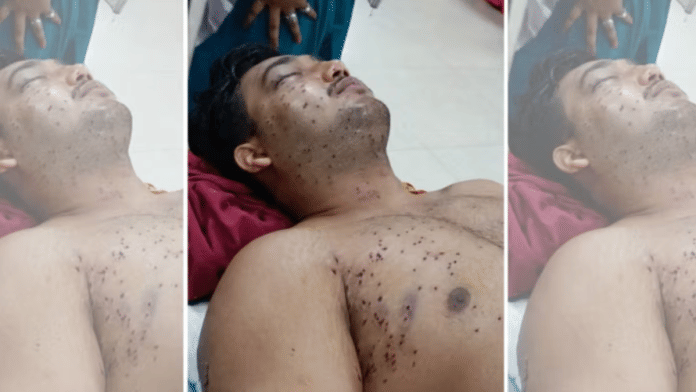


New Delhi: At least 10 protesters were treated at two government hospitals in Delhi for “pellet, shots or projectile injuries” sustained during their 20 July march to Parliament, according to the facilities’ responses to two RTI applications.
The responses came about three weeks after the Delhi Police and security personnel lathicharged, dropped tear gas and allegedly fired pellet guns to prevent protesting students from marching towards Parliament from Jantar Mantar.
The two RTI applications were filed by TMC national spokesperson and Rajya Sabha MP Saket Gokhale
In its response, the Lady Hardinge Medical College (LHMC) revealed that it had treated at least nine patients with “pellet, shots or projectile injuries”, while Safdarjung Hospital said it treated one patient.
Earlier, the Delhi Police and security personnel from the Rapid Action Force received severe flak for their use of “disproportionate” force against the protesters, including allegedly using pellet guns.
The Delhi Police had denied the use of any pellet guns in the national capital during the 20 July march. The crowd-control measure is not part of its armoury. Pellet guns, however, are a part of the Rapid Action Force’s (RAF) arsenal.
Pellet guns were introduced as a crowd-control measure in Jammu and Kashmir by the state police and the CRPF around 2010, and pellets have in many documented cases blinded people.
The Supreme Court in 2016 asked the Centre to ensure security forces apply their minds before firing pellet guns. The next year, the government told the apex court that the use of pellet guns should be the “last resort” during crowd control.
The RTI responses
According to the RTI response from LHMC, dated 7 August, nine patients with “pellet, shots or projectile injuries” were treated at the hospital.
It added that 81 injured people were admitted, out of whom 35 were police officers, and 46 were protesters. It said the 46 protesters were “presented independently”, and the 35 injured police officers were brought by the police.
Very important
Until now, there were reports of 5 people with pellet gun injuries during the Jantar Mantar protests on 20th July.
However, records procured from hospitals show that the confirmed number is AT LEAST DOUBLE i.e. 10 persons.
The break-up is:
👉 Lady Hardinge… pic.twitter.com/qo8MjDKKjj
— Saket Gokhale (@SaketGokhale) August 10, 2026
Out of the injured, 14 had head and facial injuries, five had fractures, 36 had lacerations and contusions, while one had ocular, respiratory and dermal injuries and nine had “pellet, shot or projectile injuries”, the response read.
ThePrint reached out to the LHMC director through mail for a comment, but there was no response. The report will be updated as and when a response is recived.
The second RTI response from Safdarjung Hospital, also dated 7 August, said that the hospital treated one patient with pellet injuries. “Pellet injury – 1 case presented on July 20,” the report read.
According to the RTI response, 25 police personnel and four protesters were received between “12 a.m and 11:59 pm on 20 July with injuries stated or recorded as having been sustained at or in the vicinity of Jantar Mantar”.
The Safdarjung Hospital spokesperson told ThePrint that a 28-year-old male was presented to the hospital on the evening of 21 July with “alleged pellet injuries as informed by the patient himself”.
“Upon arrival, he was promptly attended to by the concerned medical team and underwent appropriate clinical evaluation. Necessary medical treatment was provided in accordance with established protocols,” the spokesperson added.
They further added that the patient was discharged on the same day “following a detailed clinical examination”.
“The patient was found to be in a stable condition and was discharged on the same day. He was advised to report to the Surgery Outpatient Department (OPD) the following day for review and further follow-up as required,” the hospital said.
Reported cases
Following the 20 July Sansad Chalo march that turned violent, five alleged cases of pellet and gunshot injuries were reported at the time.
Sheikh Irshad Mansoori, who works for a Gurugram-based company, suffered pellet wounds in his face, left eye, neck, shoulder, chin and chest. Mansoori was treated at the LHMC.
Sahil Lohchab, a resident of Delhi’s Najafgarh, allegedly sustained pellet injuries in his right eye, causing corneal perforation, with high chances of permanent loss of vision. He was treated at AIIMS.
Hospital sources said a third reported case was Prashant Singh, a student from Ambedkar University, who allegedly suffered pellet injuries in his right arm, chest and the “inguinal region”. Singh was treated at LHMC.
The fourth case reported was about a young journalist at Outlook magazine, who suffered at least 30 pellet injuries on his upper body. The young male journalist was treated at Safdarjung Hospital.
Hospital sources said a fifth case involved another Gurugram resident who suffered a “gunshot injury” to her right ear at the protest site and was later treated at Ram Manohar Lohiya Hospital.
(Edited by Sugita Katyal)