



Every few weeks, an Indian city will produce a killing so out of proportion to its context that the only way to understand it is to affix the cause.
Last year, a Bengaluru delivery executive was killed in an incident of “road rage” because his two-wheeler brushed against a car’s side-view mirror. Earlier in June, A young man on a Mumbai local was knifed to death on the first day of the monsoon during a “personal argument” over whether the compartment’s door should be closed. A few days ago, the President’s bodyguard was shot in the head in Baghpat, Uttar Pradesh, after an argument over bursting firecrackers. He, however, survived the assault. And now, a man in Faridabad was shot dead on Dhanteras night by his neighbour over a “parking dispute”.
These killings have one thing in common: men who see everything as an insult to their ‘maardangi’, and believe violence is the only way to reclaim their wounded pride.
Of course, each of these attributions, derived from the language of police briefings, is accurate in the narrowest sense. They make the killings sound like a byproduct of simply existing in a city – inevitable, the way a traffic jam or a power outage is. They shrink these murders to the size of the inciting incident.
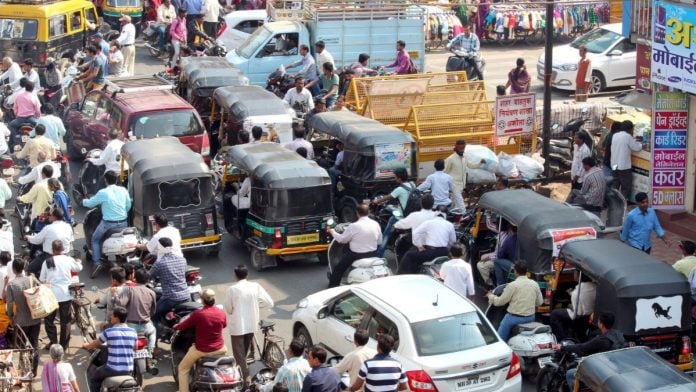
Road rage, in particular, has done heroic service for the Indian man. It gives the decision to chase or ram strangers off their vehicles the colour of pure happenstance, as if men just happen to be around, sitting behind the steering wheel.
Price of humiliation
The man killed in Faridabad was Paramjeet Dhankhar, a 42-year-old executive with a software company in Singapore, visiting home to celebrate Diwali and his nephew’s wedding. His quarrel with his neighbour, Mohan “Monu” Sharma, a 44-year-old scrap dealer, stemmed from the small, everyday annoyances that sour life in buildings across India.
These included things like Sharma’s dog relieving himself in the common areas or arguments over who parked where. According to reports, Sharma damaged the building’s main gate in October, which was caught on the victim’s CCTV, leading to a reprimand from the police. Sharma had, even then, in the presence of police officers, threatened to kill Dhankhar.
On the day of the murder, matters came to a head at a police post 500 metres from their home, where Dhankhar’s friends reportedly abused and manhandled Sharma. The Times of India reported that “both sides returned home at 6 pm. But the humiliation is likely to have fuelled (Sharma’s) anger.” That evening, Sharma rang Dhankhar’s doorbell, asking him to come out to sort the parking dispute.
The building’s CCTV – released to the public a few days ago – is nightmarish. Sharma can be heard addressing his victim as “Dhankar sa’ab” and “Brother, brother please.” When the conversation derails, Sharma asks Dhankhar if he has ever seen what a widow looks like, followed by, “You have such great faith in God; let me send you straight to him.” With that, he draws his licensed pistol, firing straight into Dhankhar. When the victim stumbles out onto the road, Sharma follows him, changes the magazine, and keeps firing – nine out of 15 bullets struck him. Then Sharma turns toward Dhankhar’s son, who has taken cover behind some cars, shouting, “Happy Diwali, I will kill everyone today.”
The footage is hard to watch, but harder to accept that it happened in our backyard, not some B-grade revenge drama, unfolding at a distant single-screen theatre. The dime-store villain who says things like, “I don’t talk to pups, send your father” was the staple of dacoit country and lawless small towns, not the second-floor neighbour in an NCR residential building.
But look beyond the tragedy, and you see a sequence India knows well. When a man is supposedly humiliated in public and decides that he cannot abide the insult, violence is the only recourse to undo it. In the villages of Haryana and western Uttar Pradesh, where khap panchayats still ordain marriages, a family’s ‘izzat’ is lodged in the bodies and choices of its women – and any woman who steps outside the circumscriptions of caste and religion is understood to have wounded her father and brothers.
The “honour killing” that follows is meant as repair. It is a restoration of pride. And what happened in Faridabad is no less than an honour killing. Pride is now tethered to new kinds of property. A man’s izzat rests in whatever he considers his own – a car, a parking area – and the deference he believes he is entitled to. Any challenge to these is a wound inflicted in public. One would imagine that the city, with its anonymity and promises of upward mobility, would loosen izzat’s grip on the individual. If anything, it has given men so much more to be touchy about. Every man with a car and a perceived slight is his own khap panchayat, ready to dispense speedy justice.
Also read: LSR gave us an extraordinary privilege called freedom. Outside, men take it away daily
Fragile egos in cities
Consider the murder of delivery executive Darshan N, in Bengaluru last October. The 24-year-old’s scooter grazed the side-view mirror of a car, and he apologised before riding on. That wasn’t sufficient for Manoj Kumar, a Kalaripayattu instructor at the wheel, who followed the bike for nearly two kilometres and rammed it from behind. Darshan died on the spot. What Kumar seems to have wanted was the ritual of submission performed at length, maybe the rider standing with folded hands, absorbing whatever the driver felt like saying, and then paying for the damage. Those of us who drive in cities will recognise that impulse, even if we never act on it.
If the izzat of the village was its women, the city hasn’t let them go either. And nothing riles up an Indian man quite like a woman driver minding her own business.
On a September Sunday morning, Shivani Chauhan, a 27-year-old motorcyclist known by her moniker Sia, was out on Gurugram’s Golf Course Road when four men in a car began to tail her. According to the viral video she would go on to post, the men abused her and made obscene gestures at her. Chauhan chose to ignore them and rode on, which was enough to anger the driver, Kalyan Bainsla. The gym owner from Palwal steered into her motorcycle. The impact ensured that Chauhan fell to the ground, narrowly escaping being run over by another vehicle.
A SIT later concluded that Bainsla had rammed her deliberately, though any woman who has driven past a carful of men could tell you that. Chauhan’s offence, as far as the men in the car were concerned, was to treat their attention with disinterest.
The urban Indian man nurses his izzat like his ancestors, continuing to believe it is something owed to him by everyone. A city full of jostling strangers only offers him several chances a day to feel slighted. Which one will he decide is worth killing for?
Karanjeet Kaur is a journalist and a partner at TWO Design. She tweets @Kaju_Katri. Views are personal.
(Edited by Saptak Datta)