




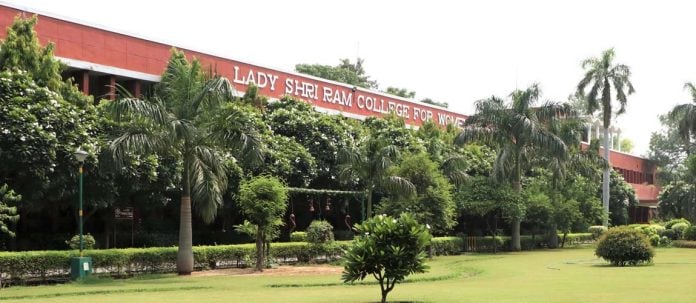

Not much has changed in the ten years since I graduated from Delhi’s University’s Lady Shri Ram College. Men were raping us then, and men are raping us now. In 2017, Manohar Lal Khattar said that rapes could be prevented if women “dressed and behaved properly” and today, Prime Minister Narendra Modi is facing a “cultural shock” hearing that “our daughters” are protesting against him. Thankfully he has decided to forgive these “misled children”.
In the eyes of the state, women are either lecherous succubi or naive children without agency. For the men that raped the teen in Astha Kunj Park in Delhi, she was both. She was 17 years old and in a park with another man — the greatest sin.
After news of the rape spread, LSR, being close to the park in question, did what most all-girls colleges would do: they shut down the campus and shifted classes online for the “sake of safety”. The fine-print reads “to prevent a protest” but you would need a magnifying glass to catch that.
The same thing happened across women’s hostels and PGs after the 2012 Delhi bus gang rape case — curfews were tightened and women needed special permissions to remain “outside” at night. Some colleges even reported instances where campus guards slut-shamed students for entering the campus after the curfew.
So, if women can’t a) be outside with a man, b) be outside after a certain hour, or c) be outside wearing certain clothes, where are we supposed to be?
Forgetting the male gaze
Inside the gates of an all-girls campus, sometimes you forget you have a body. In the hours between your groggy 8:45 am elective and the 5 pm auto to a yellow-line metro station, you are free from the suffocating and ever-present burden of wondering whether or not a man wants to touch you. You can jump without remembering that some breasts are built bouncy. You can sit with your un-waxed legs spread wide, letting the sun hit your knees, letting the grass touch the back of your thighs. You can eat without sucking in your stomach. In an all-girls campus, you forget the nagging realities of your womanhood, you are just a person. For many of us, that is an extraordinary privilege.
Most men don’t realise what it means to live as a woman under the unrelenting male-gaze. Or how it affects our sense of self, how our inner lives become so inextricably tied to the dichotomous fear that men won’t find us attractive, or that they might find us too attractive. We walk this line every day, all the time. Our “marriageability” and “rape-ability” are two sides of the same coin that position us as objects to be assessed, claimed, and controlled by men. Outside the gates of an all-girls campus, we are only a body.
When I was a student, my friends and I would dance in the park behind LSR. We were 19, 20, 21, smoking our first secret cigarettes, exploring this new-found freedom, trying to understand our own changing bodies, ideas, and place in this world. Then the men started recording us. The auto ‘bhaiya’ changed the angle of his mirror to stare at our chests. Some of these men would even sit in their cars, unzip their pants and masturbate in broad daylight. Before the #MeToo movement, I did not know this was assault.
And so, we stopped dancing. We went inside because the “outside” was taken. The “outside” has always been taken away from us. Even now, some of us are still learning how to dance again.
Also read: 13 rape, sexual assault cases reported across Delhi-NCR since September began
The world outside LSR
It is a strange experience to walk out of an oasis of feminist thought into a street where men wait behind corners to assault you. In 2019, I reported on DTC Bus Route 544, which ran its course through prominent all-girl colleges like Gargi and Kamala Nehru. A 19-year-old first-year psychology student from Kamala Nehru said she had been molested seven times on that same bus. A former DU student said this had been happening since 1985.
The fact that dodgy infrastructure leads to antisocial activities is a well-documented fact. Organisations like Safetypin have been trying to mainstream audits of public spaces for over two decades, and yet, the government has been unable, or rather unwilling, to direct resources towards any consistent management and maintenance of these utilities.
An LSR student told me that a pink police booth stationed behind the back-gate of the campus was lying empty but had “suddenly become functional” as of yesterday. This sudden and sporadic resurgence of governance is not merely an indicator of bureaucratic inefficiency, but an abject indifference to the real issues of women. We only wake up when the headlines shake us awake.
Come election time, women-empowerment is a wonderful slogan to rally around – it is perfectly vague and non-committal. But to address rape in its systemic form means to address that irritating, all-pervasive word called patriarchy. That very word continues to keep power-hungry men in positions of power. Why would they give up that power? The only politician I have heard use the word ‘patriarchy’ in recent times has been Rahul Gandhi – but then, his party is not in power.
The overused ‘P’ word
As of 2024, 151 sitting MPs and MLAs have cases against them related to crimes against women. Of them, 16 are facing rape charges.
I have watched, over the years, as this “academic” and overused ‘P’ word has pressed the snooze button in conversations. I can see men zone out when I shift the conversation from “rape is bad” to “patriarchy affects everything.” Many men I know fall in the “not all men” category — they haven’t raped anyone. But I cannot convince them that I carry my body as an apology every single time I step out of the house. Men find it hard to understand that their inability to call out their friends helped create the very ecosystem that made my own assault possible, that “women are problematic too” is a weak counter to a structure that creates men who put rods inside underage girls.
I’m not writing this for the government — they should know their jobs. I am writing this for all of us — especially the men, sitting hunched over their phones, tweeting their outrage, this is what you can do: remember that men sanction other men. Political leaders sanction their followers. Rape exists within a culture that starts at home, in friend groups, at work, at the gym, in the metro, in Whatsapp chats. Listen to your female friends. Look in the mirror and face the complicity of your own privilege. Create opportunities, pass the mic, relinquish your power.
The truth is, women don’t want to be “your daughters” or mothers, sisters, and wives. We just want to dance again.
Nandita Singh is an LSR-graduate (2016), former journalist, and communications consultant. Views are personal.