



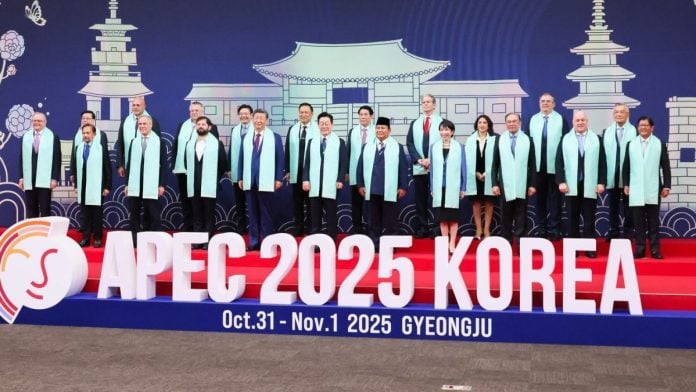
Three nuclear powers, deeply mired in controversies and conflicts that are increasingly becoming highly detrimental to global peace and progress, met for the first time to guarantee international security through peacebuilding. Touted as Yalta 2.0, the three leaders, US President Donald Trump and his Russian and Chinese counterparts, Vladimir Putin and Xi Jinping, respectively, met for the first time for a trilateral meeting on 19 November at Shenzhen’s Kylin Villa, China, on the sidelines of the Asia-Pacific Economic Cooperation summit.
After a 90-minute meeting, the three leaders issued a joint statement pledging to maintain strategic stability and international security, pursue dialogue on reducing nuclear risks, and reform the United Nations.
While both China and Russia officially distanced themselves from any reference to Yalta 2.0, the trilateral was nothing short of an apology for the Yalta Conference. As the Second World War was nearing an end, the then US President Franklin D Roosevelt, British Prime Minister Winston Churchill, and Soviet Premier Joseph Stalin met at Yalta, Crimea, then part of the Soviet Union, from 4 February to 11 February 1945.
The Yalta Conference established major plans to redraw the map of Europe and determine German war reparations, while also finalising the framework for the United Nations Organisation (UNO) to oversee the postwar world order. The Yalta Conference had its own inherent contradictions, like overdependence on individuals rather than ideological moorings, capitalism versus communism conflicts and extreme mutual distrust. While Stalin wanted a larger geography in Eastern Europe, America and Britain were determined to prevent Russian expansionism without antagonising the Soviet Union.
Within a year, there was a leadership change in America and Britain, resulting in the Yalta agreements vanishing as if they never existed, sowing the seeds of the Cold War.
Uncanny similarity to the Yalta Conference
A few similarities cannot be overlooked in the recently concluded trilateral meeting. Trump, Putin and Xi met more as individuals than as collective representatives of their respective people or with a long-term national strategy. Again, in all three countries, a change in leadership may result in the discontinuation of the agreements, or whatever little of it has been agreed upon.
The most important difference in the two meetings is the Asia-Pacific Economic Cooperation (APEC) meeting, which facilitated the trilateral. Like the Quad meeting that was piggybacking on the ASEAN summit in Manila, the trilateral was held on the sidelines of the APEC summit.
Established in 1989 with an ambitious vision to promote free and open trade and investment across the then Asia-Pacific region, now the Indo-Pacific Region, and facilitate economic integration to create a cooperative economic community, APEC has become redundant, to say the least. Geopolitical rivalry, the emergence of nationalist tendencies and protectionist trends in economic policies and competitive regional economic platforms have weakened APEC considerably.
Meanwhile, America, which anchors APEC, has found a new forum in the Indo-Pacific Economic Framework (IPEF) and wants to use Quad as a security bulwark against its main competitor, China, even as it does not want to step on the toes of Beijing. Whatever happens to APEC or the US policies toward the trilateral and the two newfound partners, India needs to do a massive amount of homework.
Also read: Nepal PM Balen Shah’s results-driven diplomacy with India
IPEF’s risk
India’s Indo-Pacific vision and involvement have huge potential but several limitations too. It is mainly anchored in Security & Growth for All in the Region (SAGAR), MAHASAGAR, the Look East Act East Policy, and the Quad—all rely heavily on maritime security and diplomatic partnerships.
India has no place in three of the major regional trade platforms—APEC, the Regional Comprehensive Economic Partnership (RCEP) and the Comprehensive and Progressive Agreement for Trans-Pacific Partnership (CPTPP). This results in a big setback in geo-economic engagements with the emerging economies of the region. Most global businesses prefer to keep their value chains and supply chains with the members of these forums, especially RCEP. Being outside RCEP and CPTPP places Indian exporters at a tariff and regulatory disadvantage in the Global South and East Asia, making them victims of supply chain marginalisation.
So, India has to heavily rely on IPEF as a substitute for multilateral trade deals, which comes at a great risk because IPEF is an executive-level arrangement rather than a ratified treaty organisation. Continuing weaponisation of tariffs by the Trump administration has highlighted the vulnerabilities India faces in IPEF as in bilateral trade.
To bridge this trade lacuna without exposing domestic industries to sudden multilateral tariff cuts, the Narendra Modi government has introduced several measures such as accelerating bilateral trade deals with key RCEP/CPTPP economies—such as the ECTA with Australia, CEPA with the UAE, and active negotiations/upgrades with ASEAN, the UK, the EU, and New Zealand—to secure market access while isolating China.
India is also using non-FTA mechanisms like the Supply Chain Resilience Initiative (SCRI) with Japan and Australia, Quad critical minerals and semiconductor partnerships, and IPEF’s Clean/Fair Economy pillars to attract investment without tariff liberalisation. Domestically speaking, the government’s introduction of the Production-Linked Incentive (PLI) schemes seeks to build domestic manufacturing competitiveness before committing to deeper multilateral tariff reductions.
Meanwhile, as a leader of the Global South, India needs a new economic framework, like the Global South Economic Organisation (GLOSEO), to bring the emerging economies on one platform and promote cooperative economic partnership.
Seshadri Chari is the former editor of ‘Organiser’. He tweets @seshadrichari. Views are personal.
(Edited by Saptak Datta)