




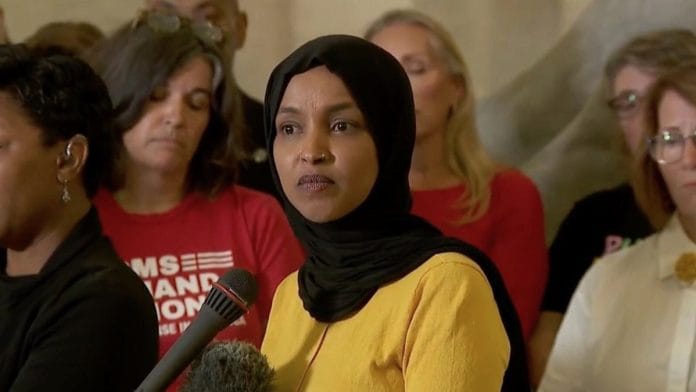

Ilhan Omar is one of only two Muslim women ever elected to the United States Congress, and one of the most recognisable progressive politicians in American politics today. She has advocated for universal healthcare, a living wage, and addressing climate change.
Her personal story is equally remarkable. Omar was born in Somalia, and her family, fleeing a civil war, spent several years in a refugee camp in Kenya before eventually resettling in the US in the 1990s. She went on to make history as the first African refugee and the first woman of colour to represent Minnesota in Congress.
She is seen as someone willing to stand up to powerful interests and push back against those who attack minorities, immigrants, and vulnerable communities. She can be a hero for many. But that is not the entire truth. It is comforting to believe in heroes, but reality is rarely that simple.
When Omar suggested that Indian Muslims are in the eighth stage of genocide, I cannot say I was entirely surprised. I did find the claim exaggerated, even for her.
Like many Western politicians, activists, and influencers, Omar often seems willing to speak with great confidence about societies she understands only from a distance. A few headlines, stray reports, and social media narratives are taken up to make sweeping statements about the lives of millions of people.
Having lived the reality of being an Indian Muslim, I don’t argue that there are no problems to address. And as a Pasmanda Muslim, I know there are inequalities within Muslim society itself. Muslim women continue to fight for greater rights and opportunities. And yes, there are times when some of us face discrimination or become targets because of our religious identity.
But prejudice and social tensions are hardly problems unique to India. I have only recently watched anti-immigrant riots in Belfast.
So, an international figure speaking on my community’s behalf without any real understanding of our situation is simply disappointing. Omar didn’t care to do any real research on the lives of Indian Muslims. She reduced complicated realities into a slogan that generates attention.
Not a small, voiceless community
Indian Muslims live in a democracy and are perfectly capable of voicing our struggles on every front. We are an integral part of India.
We make up around 14 per cent of India’s population—the third-largest Muslim population in the world. We are not a small, voiceless community hidden from public life. We shape India’s economy, culture, politics, and national identity. From language to architecture and from cinema to music, our contribution is woven into the story of modern India.
Former President APJ Abdul Kalam is remembered as India’s Missile Man and remains one of the most respected figures in the country’s history. Muslims have served honourably in the armed forces, police, and intelligence services, defending the nation and its borders. Entrepreneurs such as Azim Premji have built global companies and donated crores toward education and social development. Countless Muslim artisans, weavers, mechanics, and workers continue to contribute to the everyday functioning of India’s economy. Needless to say, Indian Muslims are not a community on the verge of extermination.
We vote, we contest elections, we debate, we criticise, we organise, and we participate in public life like every other community in this country. That is our reality. We’re not a silent people waiting for outsiders to speak for us.
This is why I find the language of genocide difficult to take seriously.
I am not against international figures speaking about minority rights in India. In fact, I welcome it. What disappoints me is when people speak with such certainty while understanding so little of the reality they are talking about. As an Indian Muslim, I feel betrayed by Omar’s statement.
Also read: US is retreating from the Indian Ocean. It has done this before, and regretted it
Omar inconsistent on human rights, minorities
I would welcome criticism or concern from someone who has shown the same commitment to minority rights everywhere. Someone who has spoken with equal passion about Hindus facing persecution in Pakistan, the struggles of minorities in Bangladesh, or the historic trauma of Kashmiri Hindus. We Indian Muslims call it imaan ka pakka hona—being firm and consistent in your principles.
Unfortunately, that consistency is missing in Omar. The Democrat politician readily criticises India, but she does not direct the same scrutiny toward Pakistan, where minority communities continue to face systematic discrimination. A member of a minority community cannot become president or prime minister in Pakistan. Hundreds of girls from minority communities are reportedly abducted, raped, and forcibly converted in the country every year.
Forget criticism, Omar often seems friendly and supportive toward Pakistan.
Even if one were to argue that foreign policy is a different matter, I remember when journalist Aarti Tikoo Singh spoke about the suffering of both Kashmiri Muslims and Kashmiri Pandits. Instead of engaging with Tikoo’s points, Omar at the time seemed more interested in questioning her journalistic objectivity.
What stayed with me was not the disagreement itself, but the complete lack of sympathy for Pandits. There was no space for a minority community that had been forced to leave its homeland.
This is where my disappointment stems from. I expect a politician who speaks so passionately about human rights and minorities to show the same empathy for every victim without caring about identity.
I welcome anyone who wishes to speak about the challenges faced by Indian Muslims. Difficult conversations are necessary, and external voices can sometimes draw attention to issues that deserve greater scrutiny. But these voices must belong to people who have put effort into learning our reality.
Most importantly, I want them to see us as we are. Not as victims waiting to be rescued, not as symbols in their political struggle, but as citizens with agency.
When that voice comes—one free from prejudice and agenda, rooted in a genuine concern for humanity—I will be the first to endorse it.
Amana Begam Ansari is a columnist, writer, and TV news panellist. She runs a weekly YouTube show called ‘India This Week by Amana and Khalid’. She tweets @Amana_Ansari. Views are personal.
(Edited by Prasanna Bachchhav)
Muslims should be kicked out of India as soon as possible. Muslims are the worst minority to have in any country. They have transnational loyalty. Deep inside their heart theey all support pakistan and jihadis like Al Baghdadi and Bin Laden.
Look at Lebanon what these muhammadans did to that once prosperous country.
Muhammadans worship a terrorist and rapist called muhammad bin abdullah, a stupid F***ker from KSA who considered himself as prophet. A fake prophet who copied entire Torah, who tells his followers he can split moon into 2 and the most disgusting fact about him is he raped a 9 year kid.
Ilhan Omar should live in Pakistan for 5 years and in India in 5 years to understand before she makes any statement about India and Pakistan.