





The primary task of the Indian armed forces is to guard the nation’s sovereignty. While this is a given, there is another duty they perform — ‘aid to civil power’, when asked to do so. India’s citizens have seen the forces accomplish these duties with aplomb. But, there are very many requests that come their way that defy logic and common sense — and sometimes makes one wonder whether the missions and roles of the armed forces are understood correctly.
The proposal for the Indian Air Force to help transport question papers of the NEET-UG 2026 re-test to different centres needs to be examined through a prism of professionalism — leaving aside the element of bureaucratic incompetence; is it really ‘aid to civil power?’
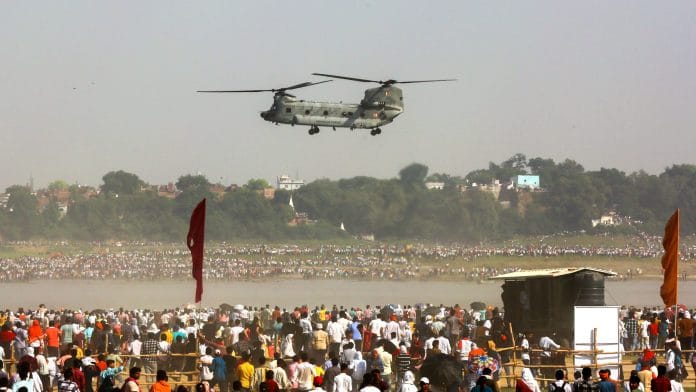
‘Aid to civil power’ is very evident in Humanitarian Assistance and Disaster Relief (HADR) missions that the services carry out on a regular basis — flood relief, accident relief, casualty evacuation etc. Then there are tasks that go into nation building. For example, only the IAF has helicopters that can transport bulldozers for road building, from the plains into the mountains and valleys where no means of surface communication exists; that the border roads network has undergone a sea change is partly thanks to the Mi-17, Mi-26, and Chinook helicopter fleet of the IAF under-slinging road building machinery to the narrow hills and valleys of the Northeast. India’s wildlife conservation has also benefitted from IAF airlifts, with tigers being transferred by Mi-17 from one wildlife sanctuary to another. This effort has been exemplified in the recent past by IAF’s C-17 fleet flying-in Cheetahs from South Africa and Namibia for the regeneration of this magnificent, but extinct, species in India.
Then there are even more mystic tasks done by the Air Force. On 24 October 1995, a total lunar eclipse had to be photographed for scientific studies (at the request of the Department of Science and Technology) as the sun’s shadow moved across northern India; the only aircraft that could keep pace with the movement of the shadow was the tri-sonic MiG-25 Foxbat. And sure enough, a specially equipped twin-seater MiG-25 flew at Mach 2.5 (two and a half times the speed of sound) at 80,000 feet to bring back priceless footage for the scientific community.
Roping in the IAF
HADR missions on television look exciting and breathtaking (which they are), but when one has to spray water over the hot methyl isocyanate tanks that spread death in Bhopal in 1984, the challenges are different. In the event, Mi-8 helicopters of the IAF did exactly that in the service of the nation — as there was no other alternative available in the civil flying fleet. During the Covid crisis, besides ferrying vaccines to remote areas, the IAF brought cryogenic tanks from Singapore. Lately, the Air Force has been involved many times in fighting forest fires, almost in every corner of the country, with bambi bucket-equipped Mi-17 helicopters, which are not available in the civilian arena.
With the high visibility of such Air Force missions in the media, it is natural for many agencies to approach the Ministry of Defence for providing ‘airlifts.’ While some truly fall under the ambit of ‘aid to civil power’ when no other civilian agency can undertake the task, some do not. The clearly visible reason behind the attempt to ‘rope-in the IAF’ begins with an over-the-top laudatory letter about how ‘the nation is proud’ of the IAF and the ‘wonderful task’ it is doing — and “could the IAF do this for us please, free of charge?”
This writer was in Air Headquarters when a request came for the airlift of an outsized mural which, as the request said, “cannot be taken by road but only by an IL-76 of our IAF.” A polite refusal was sent back requesting them to use the road container service which was readily available in-country. Similarly, there were requests for aerial photography (free of course!) of marathons in metros and cities — politely refused as civil helicopters are available for hire.
Also read: Modi govt has failed India’s young. Exam fraud costs lives
A fundamental issue
Media reports of the likelihood of distribution of NEET question papers to different cities by the IAF raises a fundamental issue. The armed forces have to keep their powder dry through peacetime training and be ready for conflict at any time. Any task extraneous to this basic dictum has to be clinically evaluated for three reasons. First, can manpower and equipment be diverted from the primary peacetime tasks without affecting operational efficiency? It must be remembered that the operational life of equipment does not have an infinite value and ‘aid to civil power’ eats into the total life of costly, and not easy to replace, hardware.
Second, too much exposure to the civil environment can blunt the warrior’s sword that is meant for a violent task. It has an effect on discipline, morale, and ‘militariness’ of the body politic of the armed forces. There was a method in the madness of locating cantonments far from cities — a physical distancing element that has now become defunct with the expansion of cities and towns. Third, and very importantly, is there no alternative in the civil domain making the IAF the only option available? The proposal to use IAF aircraft for transporting NEET papers needs to be evaluated against these yardsticks.
As per a Ministry of Civil Aviation report, India’s civil airline fleet has 853 aircraft; in addition, there are 458 aircraft (including helicopters) with state governments and private operators. From such an extensive inventory, it is inconceivable that the required number for the NEET task cannot be requisitioned — and provided with necessary security during transportation. An inability to do so would reflect poorly on the depth of our aviation capability; scarce IAF assets should be preserved for their primary role.
The author is former Additional Director General, Centre for Air Power Studies. He tweets @bahadurmanmohan. Views are personal.
(Edited by Aamaan Alam Khan)
In a corrupt socialist country like ours, air force is used like a courier service.