





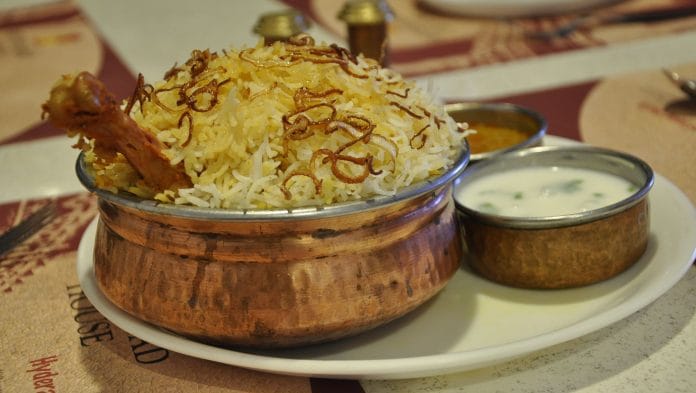


I have always feared that, among other things, biryani would become another casualty of Hindutva groups who love associating it with Muslims. And with Hyderabad’s obsession with it, this was just waiting to happen.
An X user posted a video saying biryani should not be sold because it is from Hyderabad, and that local shops that sell vegetarian biryani should call it pulao. In all honesty, I wish biryani had originated in Hyderabad, because then we would have the perfect city to claim it.
Anyway, this verbal diarrhoea got me actually thinking about biryani itself, because despite it not being from Hyderabad, it is an absolutely omnipresent dish. In fact, it is so good in the city that even vegetarians do not want to feel left out — and they don’t want pulao, but want the same thing with vegetables.
How biryani came to India
Let’s make a few things clear first. Biryani’s origins can be traced to Central Asian kitchens, but the dish is essentially Indian. In fact, pulao as we know it is generally associated with being vegetarian, but in Central Asia it is largely a dish of slow-cooked meat and rice.
The techniques for biryani came to India via migrants from the region and even Persia. The dum technique used to make it was apparently perfected in the royal kitchens of the Mughals. The dish eventually made its way into states and cities under the Mughal Empire.
Hyderabad and the Golconda kingdom (covering most of present-day Telangana and Andhra Pradesh), founded in 1591 by Muhammad Quli Qutb Shah of the Golconda dynasty (1518–1687), were eventually conquered by the Mughal emperor Aurangzeb. The Nizams of Hyderabad were appointed Mughal governors of South India, and they would have brought the dish along with them, as their khansamas travelled with them.
It is in the royal kitchens of the Nizams of Hyderabad that the Hyderabadi version of biryani was perfected. While the dish itself would have been restricted to the elite, or served at functions, there is also another angle to how biryani became popular in Hyderabad.
Thanks to the presence of hundreds of Irani cafés, many of which served as cultural centres, biryani soon became a favourite among locals. Irani café owners have told me how different and meat-heavy the dish was in cafés and Irani restaurants until a few decades ago.
Apparently, the meat-to-rice ratio was 65:35, and not the 20:80 ratio it is today.
Also read: Forget Hyderabad hype. Bengaluru biryani scene has gone unnoticed
Kalyani biryani and Hyderabad
Another story about how a version of biryani, called Kalyani biryani, became famous is also very interesting and dates back to the pre-Independence era. The Nawabs of Basavakalyan under the Nizams (now in Karnataka) were known for extending their hospitality by feeding people from their dominions whenever they visited Hyderabad for legal work (as the courts and High Court were located there).
People would be served mutton biryani, but apparently the arrangement was affected after the annexation of Hyderabad in 1948, as many of the Nawabs faced financial difficulties. That is when the Kalyani Nawabs, as they were known, substituted mutton with beef, creating a different version of biryani called Kalyani biryani, which remains fairly popular in the city today.
And with Telugu people forming a significant part of the elite under the Nizams, biryani essentially ended up becoming an all-pervasive dish. Whether you are at a Hindu, Muslim or Christian wedding in Hyderabad, biryani will always be present.
It’s also an easy dish to make for large numbers of people at one go, which is why it is so readily prepared. Cooks who make biryani at weddings often can’t cook for smaller numbers, which is pretty interesting. I remember one man whom we hired to cook for a small group of 20, but he insisted on using his regular degh (cauldron).
Either way, one can visit the fanciest place in Hyderabad or the smallest hotel, and both will have biryani. The dish may vary in taste, quality and preparation, but it has been democratised in the sense that the elite have not distanced themselves from it despite its becoming a common dish. Such is the aura of biryani.
Yunus Lasania is a Hyderabad-based journalist whose work primarily focuses on politics, history and culture. He posts on X @YunusLasania. Views are personal.
(Edited by Prashant Dixit)
Please be on guard against Hinduphobia on this publication.
Accusing Hindutva groups for everything and always playing victimization card makes the matter worse for everybody.
Believe this guy, and he would make you believe that Bhagya Nagar (Hyderabad) exists out of Bharat, Nizams are not Muslim, Nizams discovered the solar system, and Hyderabad is the center of Milkyway Galaxy. Ok
Pillaf is Persian (not Arabic or Muslim culture). Similarly, the process of mixing vegetables with spices did not brew in Moghalai kitchens. Alright?
This blogger is a poor student of history. He doesn’t do sincere research…neither comprehensively nor authentically. He repeats the same incorrect talking points manufactured by fake historians. It is a lie being peddled and it is a sin.to do so.
Please think before you believe the gobbledygook he puts across. Appropriated revised history is falsified history. Editors may please exercise caution in whom they pay to write this kind of bogus made up stuff.