







In my previous columns on the defeat of Left-Wing Extremism, I discussed how laws, welfare schemes, and institutions such as well-run schools, hospitals, forest produce collection centres, and skilling programmes helped the development discourse gain strength and draw larger numbers into the governance framework.
However, the final assault on LWE came through a well-coordinated anti-insurgency operation known by the acronym SAMADHAN, which is appropriately translated as “solution” in English.
The eight-pronged action plan, represented by the eight letters of SAMADHAN, marked a comprehensive strategy for the ‘final assault’. S was for “smart leadership”, A for “aggressive strategy”, M for “motivation and training”, A for “actionable intelligence”, D for “dashboard-based KPIs (Key Performance Indicators) and KRAs (Key Result Areas)”, H for “harnessing technology”, A for “Action Plan for Each Theatre”, and N for “No Access to Financing”.
Smart IPS leadership
The commanders of the CAPF and the concerned state police forces led from the front, and did not shy away from ground-level engagement with LWE.
Among them were officers such as CRPF DG Gyanendra Pratap Singh (IPS, 1991 batch), Chhattisgarh DGP Arun Dev Gautam (1992 batch), ADG Vivekanand Sinha (1996 batch), CRPF IG Shalin (2001 batch), and P Sundarraj (2003 batch), the long-standing IGP of Bastar. These officers led frontline anti-Naxal operations, coordinated local intelligence and commando raids, strengthened ground-level strike capabilities, and ensured area domination.
Here, one must make a special mention of the Greyhound force created in Andhra Pradesh by IPS officer KS Vyas to tackle rising Maoist threats. They were credited with neutralising top Maoist leadership, leading to a significant decline in Left-Wing Extremism in Andhra Pradesh. The force was well-trained, well-armed, combat-ready, typically under 35, and drafted into the civil police after their tenure. In Jharkhand, LWE was decimated in operations led by high-ranking officials such as ADGP (L&O) Madhusudhana Reddy and ADGP (Intelligence) Mahesh Chandra Laddha.
Aggressive action
Just before the government officially met its target of making India free of Naxalism by 31 March 2026, P Sundarraj enumerated the aggressive strategy in an interview.
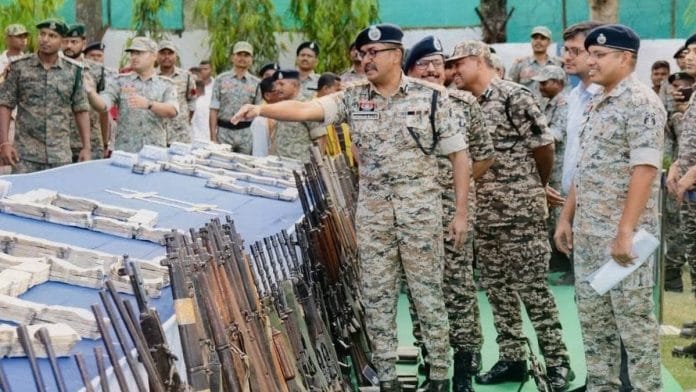
“All the security forces and agencies, including the DRG, Bastar Fighters, CoBRA, STF, and central paramilitary forces, came together with a single objective to meet the goal,” he said. “The establishment of security camps over the years proved to be a decisive factor. With forces deployed across the region and camps set up strategically, the Naxals found it increasingly difficult to escape. This also choked their supply networks. Top leaders and mid-level cadres were either neutralised or forced to surrender.”
Also Read: How IAS-IPS officers turned PESA, FRA, TRIFED into tools against Naxalism
Motivation and actionable intelligence
The point to note about these IPS officers is that they opted for this challenge voluntarily, and by all accounts, did not regard it as a punishment posting. It was their on- ground commitment which motivated their team members to put their best foot forward.
The involvement of Bastar Fighters in the anti-Naxal operations improved actionable intelligence for the forces, as they had the best local network for information.
As the MHA was co-ordinating the response across states, the secure dashboard gave key stakeholders a real-time estimate of the planning and movement of LWE cadres, especially as they moved across states in an attempt to bypass jurisdictions. This dashboard also ensured that forces across states acted in unison.
Dashboard for KRAs and ‘harnessing tech’
One of the key result areas was the surrender and rehabilitation of LWE cadres. A surrender is far more effective than an encounter — for while an encounter leaves a halo of martyrdom, a surrender indicates the inability to resist the might of the state. The reasons could be pragmatic, or the drying up of resources, or ideological frustration, but the end result is a clear signal to everyone that this is indeed the beginning of the end.
Needless to say, technology, whether for communication, logistics, weapon systems, night-vision devices, bulletproof jackets, or medical equipment, including anti-malarial drugs and coverings, gave the uniformed forces a clear advantage.
This also meant that officers and staff engaged in the delivery of development services were now more confident of reaching out to communities, thereby forming a virtuous loop, which in turn reduced support for insurgents. Their narrative of an exploitative state was countered by visible positive interventions.
Theatreisation of operations
We have heard of theatreisation in terms of defence forces. It means the jointness of command of the three wings of the Army, Air Force, and Navy. The underlying idea is that when more than one uniformed force has to take up a joint task, they should not be operating in silos, but under one commander. The same principle was now applied in LWE districts as well.
Thus, the contiguous districts of Chhattisgarh formed one ‘theatre command’, and all security forces were placed under one operational commander, allowing for faster decision-making. Likewise, there was another theatre command for the Jharkhand districts. Each theatre now focused on the specific threat in its area, and there was a bespoke strategy for each one of them.
This involved sharing intelligence and coordinating action between state police, CAPFs, district reserve forces, home guards, civil defence volunteers, forest officials, and specialised aviation or logistics support from the armed forces to manage the terrain challenges of remote, forested areas.
Also Read: How Dantewada Collector OP Choudhary pushed education in the Naxal-dominated district
Financial asphyxiation
Last but not least, the ‘no access to financing’ component of the SAMADHAN strategy, launched in 2017, is a critical pillar aimed at dismantling the operational capabilities of Left-Wing Extremism by breaking its financial backbone. By treating LWE as a criminal enterprise requiring funding, the state has actively targeted the economic resources necessary for weapons, logistics, and extortion.
In order to understand this ‘financial asphyxiation’, one may refer to The Incredible Banker by Ravi Subramanian, a fast-paced financial thriller in which a global bank gets involved with the LWE funding portfolio in the jungles of Malkangiri. Published in 2011, it explains in graphic detail how ‘terror funding’ is facilitated inadvertently by professionals who overlook KYC norms in their quest for one-upmanship in a competitive business.
This is where the NIA and the Enforcement Directorate stepped in to dismantle the network of front organisations, contractors, and sympathisers that facilitated money flow. By invoking stringent sections of the Prevention of Money Laundering Act (PMLA), assets and properties linked to LWE activities were seized. Even more importantly, this helped curb illegal mining and extortion from truck drivers, apart from disrupting weapons and ammunition supply.
One final point. Once a problem has been overcome, we often do not recognise the efforts that have gone into its resolution. The ‘new normal’ does not acknowledge the labour behind sorting out a challenge that once seemed insurmountable.
While the political helmsmen, the administrative mandarins, the brave hearts of the IPS, CAPF, and IFS have found some acknowledgment on these pages and elsewhere, the real heroes are the foot soldiers — the teachers, nurses, Anganwadi and ASHA workers, banking correspondents, panchayat officers, the “Newtons” who ensured that people voted, and all those feisty correspondents who reported stories of valour, and also pointed out the aberrations in the way we worked our systems.
The state must do what is right
The might of the state has won, but now the state must do what is right: ensure that schools run, hospitals function, skills are developed, forest produce is collected, eco-tourism flourishes, KVKs and DICs provide state-of-the-art extension services, and, most importantly, everyone gets a chance to partake in the journey of Viksit Bharat.
Then, and only then, will the last nail in the coffin of LWE be hammered.
This is the final instalment of a four-part series on Left-Wing Extremist regions.
Sanjeev Chopra is a Senior Fellow, Centre for Contemporary Studies, PMML, New Delhi, a Trustee of the Lal Bahadur Shastri Memorial, and the festival director of Valley of Words, a pan-India literature and arts festival based out of Dehradun. He tweets @ChopraSanjeev. Views are personal.
(Edited by Asavari Singh)