




There can be no two opinions that substantial credit for the conclusive victory over Left-Wing Extremism, or LWE, must go to the brave hearts of the Central Armed Police Forces and state police forces — many of whom lost their lives in the last decade.
But credit must also go to civil servants who translated laws and schemes into trust-building interventions on the ground.
This column will first discuss interventions under the Panchayats (Extension to Scheduled Areas) Act (PESA), the Forest Rights Act (FRA), and the Tribal Cooperative Marketing Development Federation of India (TRIFED), because these created the ground conditions before the Home Ministry’s SAMADHAN framework for tackling LWE could gain acceptance among tribal populations in the deep forests and adjoining areas.
Also Read: How Dantewada Collector OP Choudhary pushed education in the Naxal-dominated district
BD Sharma: the activist collector of Bastar
We shall first talk about PESA, which in 1996 overturned a long-standing assumption—dating back to Verrier Elwin and earlier colonial administrators such as Herbert Risley, MV Grigson, and RV Russell—that tribal communities (formerly called aboriginals) could not defend or protect their own interests.
Historically, areas with a large tribal presence had been placed under the Excluded and Partially Excluded Areas under the Government of India Act of 1935, and under the Fifth and Sixth Schedules after India became a Republic. They were cut off from the dominant political discourse of the territorial state, and the “special” responsibility for their development was cast upon the Governor.
This produced an anomaly: while the 73rd Constitutional Amendment (1992) enabled a three-tier Panchayati Raj and effective decentralisation across the country, Scheduled Areas were excluded.
Activist IAS officer BD Sharma, who had been Collector of Bastar, realised that top-down schemes rarely succeed. He therefore strongly advocated tribal self-governance by recognising the ability and competence of village communities to manage their affairs according to customary law.
As Commissioner for Scheduled Castes and Scheduled Tribes (1986-91), he questioned the exclusion of Schedule V areas from the provisions of the 73rd Amendment. His advocacy contributed to the enactment of PESA in 1996.
PESA attempted to shift the balance of power toward communities by providing a mechanism for self-protection and self-governance. The Act acknowledged that tribal communities were competent to govern themselves and respected the validity of their way of life and value systems.
From PESA to FRA
Implementation of PESA, however, fell short of its potential and expectations, as Prof (Col) Shashank Ranjan noted in a paper for MP-IDSA. Administrative inertia, bureaucratic resistance, and gaps between formal law and customary practices limited immediate impact.
Addressing some of these issues, Dileep Singh Bhuria, chairman of the committee that worked on PESA, argued that the Act could mark the beginning of a new era in the history of tribal people, who had long paid an inordinate and often devastating price for India’s chosen development model. Bhuria pointed out that membership of a panchayat or a gram sabha without access to land and forest resources was not meaningful.
This recognition paved the way for the landmark Scheduled Tribes and Other Traditional Forest Dwellers (Recognition of Forest Rights) Act, 2006 (FRA).
This Act sought to correct historical injustices by recognising the rights of forest-dwelling communities—granting ownership and management rights to those who lived in forests before 13 December 2005—and by facilitating sustainable forest management. Unlike prior regulatory regimes that treated forest populations as beneficiaries of top-down protection, the FRA placed the gram sabha at the centre of rights recognition and forest governance.
Gadchiroli’s turnaround
The transformative potential of the FRA is evident in Maharashtra’s Gadchiroli district, long considered a Naxal hotspot.
Due to the efforts of a team of dedicated forest officers led by Shree Bhagwan, Gadchiroli adopted a rights-centred approach to forest governance under the FRA, laying the foundation for trust between tribal communities and the state.
Their work fast-tracked recognition of individual and community forest rights, strengthened gram sabhas, and linked tenure security with sustainable livelihoods and ecosystem restoration. The initiative produced measurable gains in rights recognition, local governance, livelihood resilience, and forest protection. And it so became a replicable model for rights-based forest management.
It was in Gadchiroli that India’s first community forest rights (CFR) recognition was granted, in August 2009, to Mendha Lekha village. The FRA recognised pre-existing rights irrespective of forest classification, granting communities control over minor forest produce—including bamboo and tendu leaves—and management rights through the gram sabha.
As of today, forest-dwelling communities in Gadchiroli collectively have forest rights over 5,110.07 sq km of the district’s 9,902.8 sq km of forest—an “unparalleled” figure nationally. Scheduled Tribes and Scheduled Castes account for 38.17 per cent and 11.25 per cent of the district’s population, respectively.
Bipartisan support has been critical to the Gadchiroli intervention. The first transit pass enabling a gram sabha to sell bamboo to aggregators of its choice was handed to Mendha Lekha by then Maharashtra Chief Minister Prithviraj Chavan in the presence of Union Rural Development Minister Jairam Ramesh. Deregulation and CFR recognition continued despite shifts in political power.
During his first tenure (2014-2019), Chief Minister Devendra Fadnavis introduced schemes including financial support of Rs 1.78 lakh for recognised CFR villages. The Maharashtra Governor’s office directed the state to amend minor forest produce regulations, allowing gram sabhas in Fifth Schedule areas to own, auction, and dispose of collected minor forest produce to buyers offering the best price.
Last year, TISS professor Geetanjoy Sahu wrote that 1,109 CFR-recognised villages in Gadchiroli exercised these rights and households in CFR-recognised villages now earn at least Rs 7,000 per month from forest resources. Forest governance, he added, is now more “democratic, decentralised, and transparent”.
IAS, IPS on the ground
The Maharashtra government deliberately posted some of its best IAS and IPS officers to the district.
As a sub-divisional magistrate, IAS officer Manuj Jindal converted underutilised buildings into training centres for Particularly Vulnerable Tribal Groups (PVTGs) in Bhamragad. Mittali Sethi, a 2017-batch officer, adopted a community-focused approach, bridging policy and everyday rural needs. Assistant Magistrate Shubham Gupta used artificial intelligence to monitor and improve tribal students’ nutrition and introduced bike ambulances to bring medical assistance to remote villages.
There have been outreach efforts from the police as well. IPS officer Neelotpal initiated “One Village One Library,” establishing over 73 libraries and turning many police stations into literacy and learning hubs—an effective way to bridge the gap between citizens and the police. His colleague Ankit Goyal launched “Police Dwaar – Ek Khidki,” a single-window system that has helped over 270,000 people in Naxal-affected areas access government welfare schemes.
These measures reinforced state legitimacy at the grassroots and demonstrated that security operations would be accompanied by governance and service delivery.
Also Read: Life of a surrendered Maoist in Gadchiroli. Cash, kids in school & hammers over AK-47s
TRIFED and tribal enterprise
Last but not least is the development intervention strategy of Pravir Krishna, a 1987-batch IAS officer of the Madhya Pradesh cadre, who served as Managing Director of the Tribal Cooperative Marketing Development Federation of India (TRIFED) from 2017 until his superannuation. He shifted the traditional approach to tribal development from welfare and free aid to building self-reliance.
PESA and the FRA had already recognised forest-dwelling communities as masters of their ecosystems; Krishna’s contribution lay in changing their historical status from wage-earners under MGNREGA to independent enterprise owners.
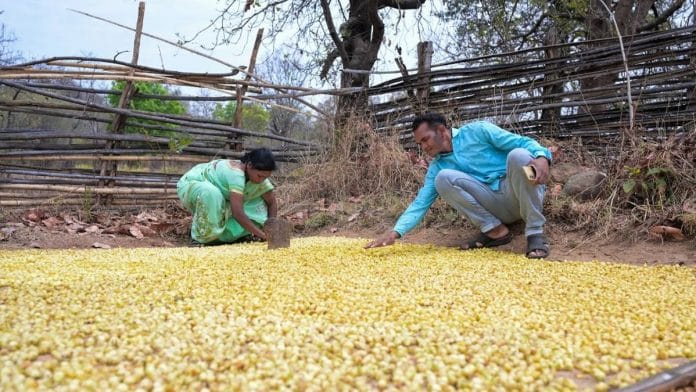
He leveraged the Pradhan Mantri Van Dhan Yojana to create a vast network of Adivasi start-ups by establishing thousands of Van Dhan Vikas Kendras (VDVKs) across the tribal belt. A typical Kendra comprised tribal members who pooled resources to collect, process, and package minor forest produce (MFPs) such as tamarind, honey, hill-grass brooms, and fruit juices. The initiative connected over 50 lakh tribal gatherers to markets, granting them economies of scale and entrepreneurship opportunities, and keeping profits within the community rather than losing them to middlemen.
Although there was an MSP scheme for forest produce, it was largely dormant until TRIFED was nominated as the nodal agency—an intervention that proved especially crucial during the COVID-19 pandemic when traditional tribal livelihoods were severely disrupted.
By ensuring swift procurement of over 48 varieties of minor forest produce, TRIFED injected over Rs 2,000 crore directly into the tribal economy via Direct Benefit Transfers, providing a vital safety net during the economic downturn. The Van Dhan units also provided skill training, branding and market linkages, enabling many tribal entrepreneurs to move up the value chain. These initiatives fostered a positive perception of the government—key to coordinated anti-Naxal operations under SAMADHAN, which we will take up in the next column.
This is the third article in a series on Left-Wing Extremist regions.
Sanjeev Chopra is a Senior Fellow, Centre for Contemporary Studies, PMML, New Delhi, a Trustee of the Lal Bahadur Shastri Memorial, and the festival director of Valley of Words, a pan-India literature and arts festival based out of Dehradun. He tweets @ChopraSanjeev. Views are personal.
(Edited by Asavari Singh)