




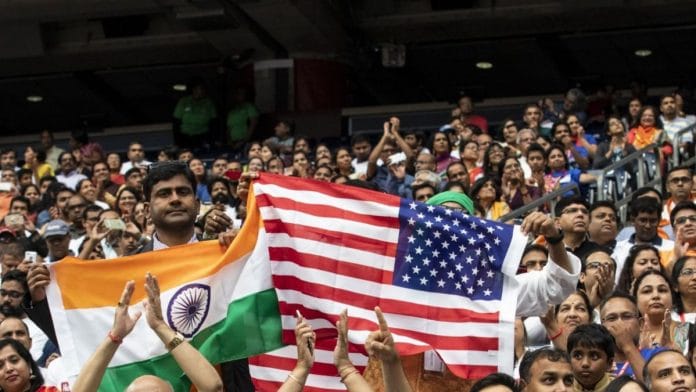

After years of simmering undercurrents, anti-Hindu sentiment has surged in recent months. This hostility became a tangible threat when a 19-year-old individual plotted a mass shooting at a Hindu temple near Chicago during Navratri. During the festival, Hindus fast and pray to Goddess Durga, the primordial feminine divine, for nine days and gather at places of worship.
Many Hindus attributed the prevention of this tragedy to divine intervention, as the assailant’s weapon malfunctioned at a critical moment.
Contemporary hostility toward Indians, and Hindus in particular, often reflects a repackaging of historical Islamic and British colonial biases and contempt. Colonialists constructed narratives that associated Hindus with backwardness, primitiveness, and savagery to justify their dominance over their colonial subjects. They depicted Hindu society as afflicted by various social maladies, particularly concerning the status of women. Colonial discourse erroneously, but consciously, asserted that practices such as Sati, dowry, female infanticide, slavery, caste discrimination, etc. were intrinsic to Hindu society.
In subsequent decades, following India’s independence, Marxist academicians, including Indian scholars, latched onto those inaccurate “outsider” etic colonial narratives against Hindus. Much of what we saw in the Hindu Americans’ struggles against California history textbooks reflected those religious and ideological biases. Hindu Americans fought a long, sustained battle to correct some of those inaccuracies.
When the earliest immigrants from the Indian subcontinent, then under British colonial rule, arrived in the United States in the late 19th century, they were labeled “Hindoo”, irrespective of their actual religious affiliation. Their arrival, particularly on the West Coast, was described in contemporary discourse as a “tide of turbans” or a “Hindu invasion.”
Systemic racism
Labor competition in the early 20th century led to significant unrest in the United States. In 1907, mobs in Bellingham, Washington, forcibly expelled mill workers belonging to the Indian subcontinent. Approximately 500 white workers gathered with the stated intent to “scar them so badly that they will not crowd white labor out of the mills.” The rioters proceeded through the town, breaking windows, throwing rocks, assaulting individuals, overpowering police officers, and removing workers from their workplaces and homes.
Similar incidents occurred along the West Coast, where organisations such as the Asiatic Exclusion League were established in California in 1905, which advocated against immigration from the Indian subcontinent in addition to its campaigns targeting Chinese and Japanese immigrants. The Immigration Act of 1917 subsequently established the “Asiatic Barred Zone,” effectively halting immigration from the subcontinent.
In United States v. Bhagat Singh Thind (1923), the Supreme Court of the US held that Indians were not “white” and therefore couldn’t become naturalised citizens. Mr Thind, “a high-caste Hindu of full Indian blood, born at Amrit Sar (sic), Punjab, India”, was not a “white person” within the meaning of the statutes relating to naturalisation of aliens, the court had observed.
California’s Alien Land Law (1913) and similar laws restricted property ownership, and marriage laws limited who Indian men could marry. As a result, many married Mexican-American women.
The Immigration Act of 1965 abolished the discriminatory national origins quotas that had governed entry into the United States since the 1920s. This legislative change reopened immigration, leading to the arrival of many more Indians, primarily professionals, many of them Hindus. The Act facilitated the entry of non-European immigrants, including highly skilled Indian workers. The Indian immigrant population grew from 206,000 in 1980 to 2,688,000 in 2019, a 13-fold increase over about four decades.
In the decades after 1965, Indian Americans became one of the most educated and prosperous minority immigrant groups in the United States. Despite making up just over 1 per cent of the population, Indian Americans have the highest median household income. Indian Americans are also among the most educated groups by four-year college degree attainment (79 per cent). Additionally, about 77 per cent of Indian Americans, aged 25 and above, hold a bachelor’s or advanced degree.
The Immigration Act of 1965 saw a resurgence of violence against immigrants of Indian origin in the 1980s, exemplified by the “Dotbusters” attacks in Jersey City, which targeted women for wearing bindis. A bindi is a coloured dot applied to the centre of the forehead, near the eyebrows, and holds cultural and religious significance throughout the Indian subcontinent and Southeast Asia.
Incidents of temple vandalism began to occur in places such as California, New Jersey, and New York, accompanied by an increase in hate speech against Indians and Hindus. Resolutions criticising India’s Citizenship Amendment Act (CAA), the farm bill, the abrogation of Article 370, and “anti-caste” discrimination legislation in certain Democrat-controlled municipalities and city councils, as well as in state legislatures, have, at times, served as proxies for whipping up anti-Hindu sentiment in the United States.
On 12 September 2022, the Teaneck Democratic Municipal Committee (TDMC) passed a resolution categorising several Hindu organisations operating in the US as terrorist groups. The resolution further called upon the Federal Bureau of Investigation (FBI) and other US investigative and law enforcement agencies to investigate and prosecute Hindu organisations, actions perceived by many as attempts to intimidate and marginalise the Hindu community.
Also read: India needs more Jamnagars. Anti-business, knee-jerk anti-Americanism hurt national interest
Anti-Hindu academics
During the global recovery from the COVID-19 pandemic, a group of academics convened the “Dismantling Global Hindutva Conference” in 2021, which was perceived by many as an effort to criticise Hindus and Hinduism from academic platforms.
The conference aimed to examine “the historical development of ‘Hindutva,’ the fascist dimensions of the ideology, and the perpetuation of violence against religious minorities and other marginalised communities.” Hindutva in Sanskrit means Hindu-ness. Hindus argued that the conference constituted an affront to Hinduism, Hindu texts and traditions, and well-meaning followers of Hinduism who refuse to adhere to the dogmas and orthodoxies of the Left-secular ecosystem.
Several of the conference’s main organisers were identified as Leftist activists and academics fiercely antagonistic to a resurgent ancient civilisation confidently overcoming the yoke of a thousand years of mental, physical, economic, and intellectual colonisation. A Rutgers University academic involved with the conference supported the event ‘Holi Against Hindutva‘ on US campuses and used a slur against Hindu divinities. Holi is a Hindu religious festival, popularly known as the festival of colour, while Bhagwan Rama is a revered Hindu god.
Additionally, a Harvard Kennedy School academic tweeted, “Hindus are sick people of India; it is their religious books who (sic) train the mind.” In 2021, a day after the US Capitol riot, the Rutgers University professor announced her new course, “History of South Asia II (Mughals to Modi),” via Twitter. The tweet featured an image of the Capitol with an Indian tricolour among numerous US flags and flags supporting then-president Donald Trump. The accompanying text stated: “One of my opening images will be this, from DC yesterday, with the question — What do we need to know to explain why there is an Indian flag here?”
Although Swami Vivekananda’s 1893 appearance at the Parliament of World’s Religions in Chicago and the establishment of early Vedanta societies generated curiosity and admiration among certain Western intellectuals and spiritual seekers, Hinduism is frequently portrayed in the West through a Christian missionary lens as “heathen,” “idolatrous,” or backward, with particular emphasis on caste and so-called “exotic” practices.
The recent surge in online hate, culminating in a foiled mass shooting, should be understood within this historical context. Contemporary rhetoric surrounding H-1B visas and job security has facilitated the targeting of individuals of Indian and Hindu origin, reminiscent of patterns observed in the late 19th and early 20th centuries. The Minneapolis Annunciation Catholic School shooter inscribed “Nuke India” on his weapon. These threats have shifted from abstract notions to tangible dangers in the perception of those who harbor such animosity.
Avatans Kumar is a linguist and a recipient of the California News Publishers Association and the San Francisco Press Club’s journalism awards. Views are personal.
(Edited by Aamaan Alam Khan)