






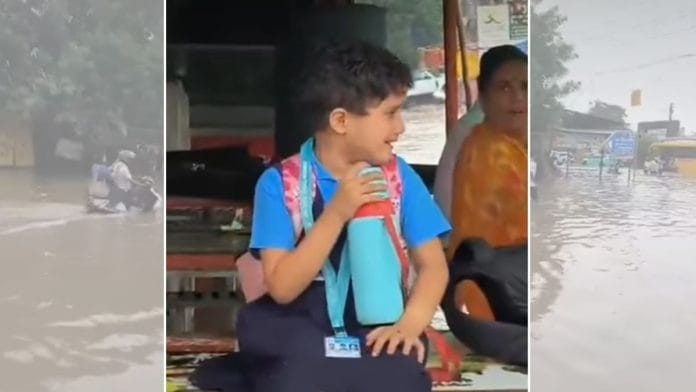

If Gurugram could manifest as an emotion over the last week, it would probably choose rage and helplessness. In the city that houses the offices of more than half the world’s Fortune 500 companies, an exhausted little schoolgirl sat on the highest bench of a daily needs shop, surrounded by a pool of murky water, and wailed into the open.
Adults stuck at the shop tried to console her, but the child—holding on to her pink plastic water bottle with all her might—would not stop crying for her parents. Two other equally morose children sat in front of her, stranded after their school bus gave way after the city experienced 75 mm rainfall in the span of a workday. These kids weren’t the only ones stuck in the deluge. About a dozen private-school buses carrying kids from nursery upward were mired nose to tail in the filthy pond that sprang up between Subhash Chowk and Rail Vihar.
One hopes that the children reached home safely, though the trauma they endured will likely linger. Their parents suffer with them. Siddharth Kasid, 39, all but gave up on Gurugram that day, after witnessing firsthand the danger that his child was in. The employee of a multinational investment bank spent the afternoon looking at his five-year-old daughter’s location on an app, tracking the school bus’s movement. When Kasid realised that the flooded stretch outside his home meant that the bus wouldn’t be able to reach it, he started walking toward it through waist-deep water, dodging open manholes and rubble from the metro construction—a walk he later described as “more intense and gruelling than the trek to Vaishno Devi”.
On reaching the spot, Kasid found 10 stalled buses with very young children inside. Along with his daughter—who asked if it was Holi—he was able to bring back a few other students with him, walking them single-file. Kasid then echoed the question several of Gurugram’s residents, rich and poor, have been asking for years. “We pay hefty taxes and exorbitant school fees, and this is how the city is maintained? I hate it now,” he said. “Gurugram is simply not worth living in anymore.”
By next afternoon, a portal opened up on a stretch of the service lane at IFFCO Chowk and swallowed Gurugram’s pretensions about itself. Underneath the crucial junction, which connects the city with the international airport and South Delhi, is a master sewer line bearing the waste of DLF Phase II and MG Road. The line had been leaking for a while, and last week, it finally dissolved the earth holding up the carriageway and turned into a sinkhole.
This isn’t even novel for IFFCO Chowk: The ground has opened up in 2019, 2020, and 2021, when part of a retaining wall of a flyover collapsed. Of course, now 20 metres of the pipe will be replaced, another 100 relined. The Gurugram Metropolitan Development Authority (GMDA) has also—post-haste—floated a Rs 8 crore tender to upgrade the master sewer on other stretches.
A sinking feeling
Gurugram’s residents no longer register the city’s monsoon as a surprise. They experience it as paranoia, anticipating the rains with dread. After all, this is a city of private enclaves connected with one another by public failure.
Last week, the GMDA’s master drain backed up into South City II once again. Two years prior, the same waterlogging had caused the death of a pet dog, who got electrocuted. South City II’s residents were forced to switch on their own pumps to push the sewage runoff back onto the public road. For their attempts to save their houses, which cost upwards of Rs 3 crore, the residents were threatened with an FIR for damaging public property.
For three decades since the city’s inception, Gurugram’s citizens have made their peace with paying double for the services their taxes should uphold. The private economy thrives when the city’s richest become convinced that they can buy their way out of a terrible state of affairs.
Water—drawn from a dwindling water table—arrives by private tankers, priced anywhere between Rs 8,400 and Rs 26,000 in the peak summer months. Electricity is from 24-hour power backup, advertised on brochures of real-estate companies. Kids will anyway go to private schools, as their parents did. Private security is uniformed and ready with their boom barriers and registers. The city authorities will provide waste management when they feel like it—otherwise, RWAs will step up to fill in the gaps.
Every essential service can be ordered off an app, and the options are aplenty. I’m actually surprised that Gurugram’s entrepreneurial spirit hasn’t yet managed to convince the authorities that they should be allowed to operate private sewer lines or stormwater drains. And if that works, can private stretches of the highway be far behind? (Though the Delhi-Gurugram Expressway was built and tolled under a private concession, which the NHAI eventually took back in 2014.)
Alas, these services remain stubbornly, inconveniently public, treating the 100-crore apartment and the tin shanty with the same measure of complete indifference. There are limits to secession, but at least in this one aspect, the rich and the poor are equal losers.
Also read: There is no fundamental right to cheap Kumbh airfares
The ‘flexible planning’ of Gurugram
Last week, the Indian Express reported that in a briefing to Prime Minister Narendra Modi, Haryana chief minister Nayab Singh Saini put forth two modish-sounding proposals to tackle Gurugram’s perennial waterlogging issue, as part of a larger overhaul of the city’s drainage network. These include specialised injection wells—a subsurface structure that channels rainwater into aquifers—with an absorption capacity of 48-80 litres per second. It works in conjunction with high-volume underground storage tanks, meant to capture surface runoff immediately. All of this will be monitored via a SCADA system, the standard among critical infrastructure industries.
All these solutions—due to be implemented over a one-year timeline for four major bottlenecks—are straight out of the technocratic imagination. High-impact projects meant for high-velocity metropolises populated by a driven, high-intent population.
Later on, the same report cited a planning expert trying his best to sound optimistic about the proposals. CR Bisnoi, retired Executive Engineer of the Municipal Corporation of Gurugram, said that “what Gurugram needs are also some old-school solutions—making ponds and reservoirs in parks, and removing encroachments from drains.”
The water bodies Bisnoi is referring to have dwindled in the last few decades. In 1956, Gurugram had more than 640 natural water bodies; by 2018, that number stood at 251. These are the results when a city is cobbled together through the statutory power of relaxation, which allowed the Haryana government to waive land-use restrictions in the public interest.
Anthropologist Shubhra Gururani, who has studied Gurugram closely, posits the concept of “flexible planning”.
“The making of Gurgaon relies on regulated improvisations of urban land laws that pave the way for political/caste elites to productively navigate the ambiguities in the plan, reconcile multiple contradictions, and enlist a range of material and symbolic techniques to produce an uneven geography of urbanization,” she wrote in the introduction to Subaltern Frontiers of Agrarian Urbanism (2023).
For a city assembled by private builders, there were few pesky regulations to adhere to. Between July 2025 and March 2026, the state issued 1,500 occupancy certificates prematurely. When 22 housing societies were inspected, 14 were found to be only concrete shells.
Nowhere is this attitude more apparent than in the fact that Gurugram elected its first municipal mayor in 2011, in an election riddled with allegations of horse-trading. For context, the MGF Metropolitan Mall opened its doors in 1998.
Also read: Mohan Bhagwat doesn’t decide if Muslims belong in India. The Constitution does
A case of two laados
Public services improve when people with the power to become a nuisance to the government insist that they improve. A few days ago, 14,000 contractual sanitation and fire department workers struck work for three weeks, and piles of garbage arose again in Gurugram. Several RWAs were forced to ask the state to hand them the municipal sanitation budget so they could hire private contractors themselves.
Gurugram’s residents are no doubt responding to a crisis the best way they know how. But the trouble with private arrangements is that it slowly erodes the collective bargaining power of a constituency.
And that’s why Gurugram MLA Mukesh Sharma’s Instagram feed is pristine: It is full of inaugurations and meetings he has addressed. There isn’t a single post acknowledging the distress that the city’s residents have endured. CM Saini, meanwhile, is busy campaigning in Punjab, congratulating the prime minister, blaming the Congress, but hasn’t yet been able to reassure the beleaguered citizens of his state.
He did post a very sweet, heartwarming message for a young child from Northeast India, who had spoken about being labelled “Chinese” in a viral video. “You’re a daughter of India, laado!” Saini comforted her. She no doubt is—but so is the young girl in that other viral video clutching her pink bottle, who also happens to be a daughter of Haryana. Maybe someday, that video will also make its way to Gurugram’s representatives.
Karanjeet Kaur is a journalist, former editor of Arré, and a partner at TWO Design. She tweets @Kaju_Katri. Views are personal.
(Edited by Prasanna Bachchhav)