








I have lived in Goa for five years, but it wasn’t until last year that I managed to get my hands on a mankurad, the most feted of Goan mangoes. Sure, the cultivar has a GI tag, but its Portuguese name, Malcorado, translates to “poor-coloured”, so how good could it possibly be?
As a North Indian who has lived away from home for well over 15 years, my childhood memories lead my taste buds by the nose. Those memories are drenched in the uncomplicated buttery-honey notes of the safeda and the heady scent and lingering tang of the sindoori. But nothing has, or ever will, come close to my ardour, my reverence, for the langra and the malda – and years of urushiol burns on my mouth have only sweetened the rapture.
However, all those feelings suffered a humbling when they encountered the smooth, caramelly mankurad. The langda will still come back with me from every trip home, but the mankurad has split the loyalty of someone who thought she had taken sides for life.
Something about the fruit instinctively inspires a competitive parochialism among its devotees. It’s a feat that more self-effacing members of summer’s bounty – say, the litchi, kharbuja or phalsa – cannot summon. Every year, Twitter warriors begin their regional variety death matches, while the pacifists get them to acknowledge that no one who gets to eat a mango at all is a loser. One might take inspiration from the bard – Mirza Ghalib – who famously had two non-negotiable conditions for mangoes: “Aam me sirf do khubiyan honi chahiye // ek meethe ho’n aur bohot saare ho’n.” Mangoes should be sweet, and there should be plenty of them.
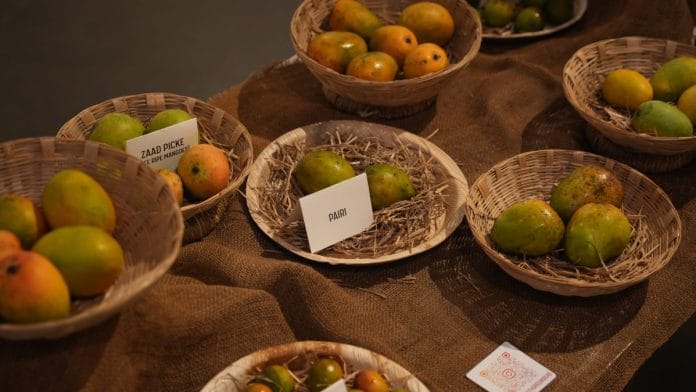
Both those conditions were satisfied at a recent private event that I had the good fortune to attend. Revati and Charles Victor, who hosted it, had just concluded a heritage mango tasting as part of a three-day event at the Museum of Christian Art in Old Goa, in collaboration with The Goan Kitchen. The Victors have spent over a year researching the Goan mango, a subject they realised had vanishingly few resources devoted to it. In the last few months, they have sourced several of the 105 rare varieties of Goan mangoes from markets, private farms and, occasionally, houses with just a couple of trees. These include varieties such as the Jesuit, Colaco, and Monteiro, some of them named after the families that reared them.
The MoCA event sold out within minutes. “The mango is a cult,” Charles told me. “People who hadn’t been able to register were calling the museum to ask if they could attend the presentation, even if they didn’t get to eat the mangoes. They just wanted to be in the room while someone talked about the fruit.” It was easy to see why at the private tasting, which began with a brief presentation that walked us, by way of history, literature and religion, into the trivia of grafting.
On the table were 13 Goan varieties, with heavy-hitters like the Costa mankurad, mussarat, Fernandin, and Hilario, as well as ones I had never heard of: Nicolau Afonsa, the udgo, and the sakare naare. Each seat was accompanied by a grading sheet with columns for colour, aroma, texture, juiciness and an overall score that could be assigned to each mango. At one point, a refractometer appeared to measure a cultivar’s Brix, the sugar-content scale that fruit and wine nerds use to settle arguments. At the MoCA tasting, we were told, someone said that one of the mangoes smelled like the Worli sewer. Nobody was able to unthink it afterwards.
The mango venture will continue beyond this edition. “There’s a lot to uncover: the taste, the provenance, the histories… it’s the most extraordinary mango story you’ve never heard,” Revati said. “This project is going to grow into its own, much like the many mango trees all across Goa.”
Also read: India’s ‘mango diplomacy’ reaches Seattle. Kesar frenzy empties shelves in hours
Is mango worthy of a museum space?
The cult has also taken over another Goan institution this summer. The Museum of Goa in Pilerne is hosting a month-long multimedia exhibition dedicated to the fruit. Mangoes and Meanings: Histories, Ecologies and Cultural Imagination brings together 40 artists, along with events such as photo walks through the Mapusa market, a poetry night, and even a mango market.
What’s most refreshing about the exhibition – which had drawn curious visitors even on a rainy weekday afternoon – is how far it goes in its inclusivity. Several of the exhibits tap into childhood memories and the sheer joy associated with the mango, and not one accompanying curatorial note relies on intimidating jargon. The museum’s director, Sharada Kerkar, told me that the team had wrestled with whether they should even attempt this exhibition.
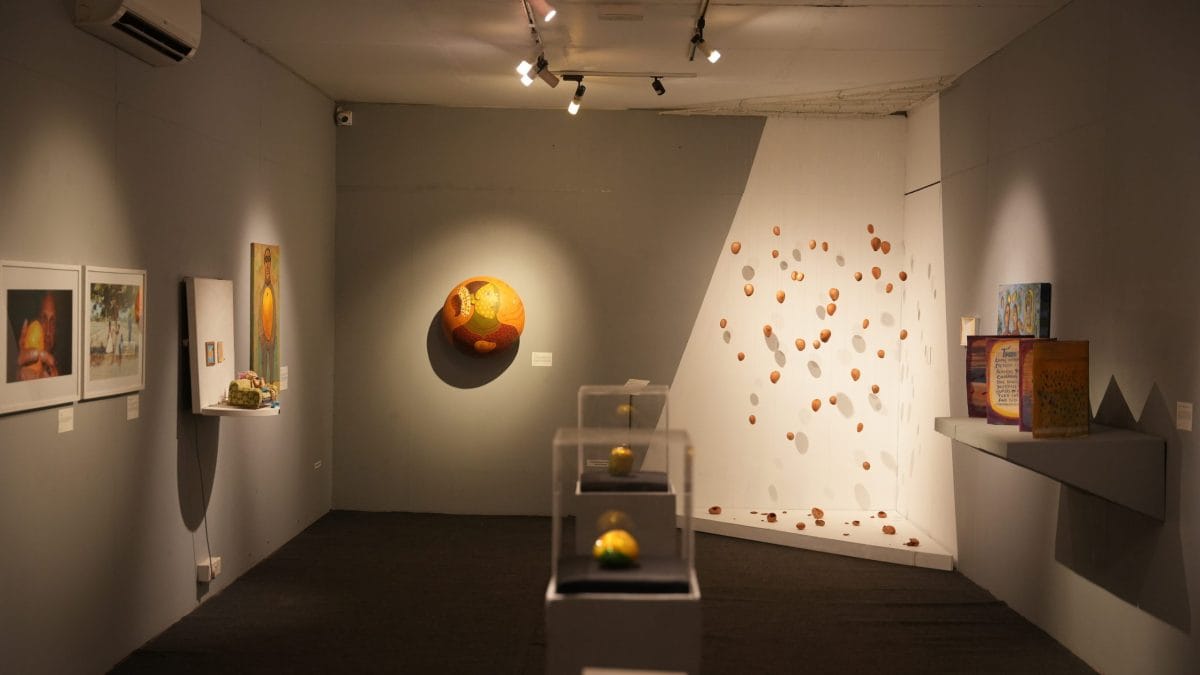
“There was a thought that the mango doesn’t sound like a serious subject, so is it worth the museum space?” she said. “But then we realised that the connection with the mango is so natural to an audience in India. We wanted to say art is accessible. Come, it’s just a story from your backyard. It’s a story about what you eat, about your grandmother and mother, about the history that you have lived.”
Visitors responded to that. The opening exhibit by Subodh Kerkar is a giant resin mango with jackfruit-textured skin — a nod to the two fruits that capture the Goan imagination throughout summer — suspended from the ceiling. A small queue of selfie-takers pretending to eat the mango had formed around the exhibit. “For the first time, every person who has walked into the show has had something to say in return,” Kerkar said.
In a corner of the gallery, a participatory wall holds visitors’ contributions — recipes, drawings, and written memories — which must be rotated every few days because the supply outstrips the available space. A child has written about the neighbourhood mango tree that she and her friends protect, but whose fruit is always stolen before it ripens. A young man has left a note about how he became a mango convert after watching his girlfriend eat one: “It was like art coming to life.”
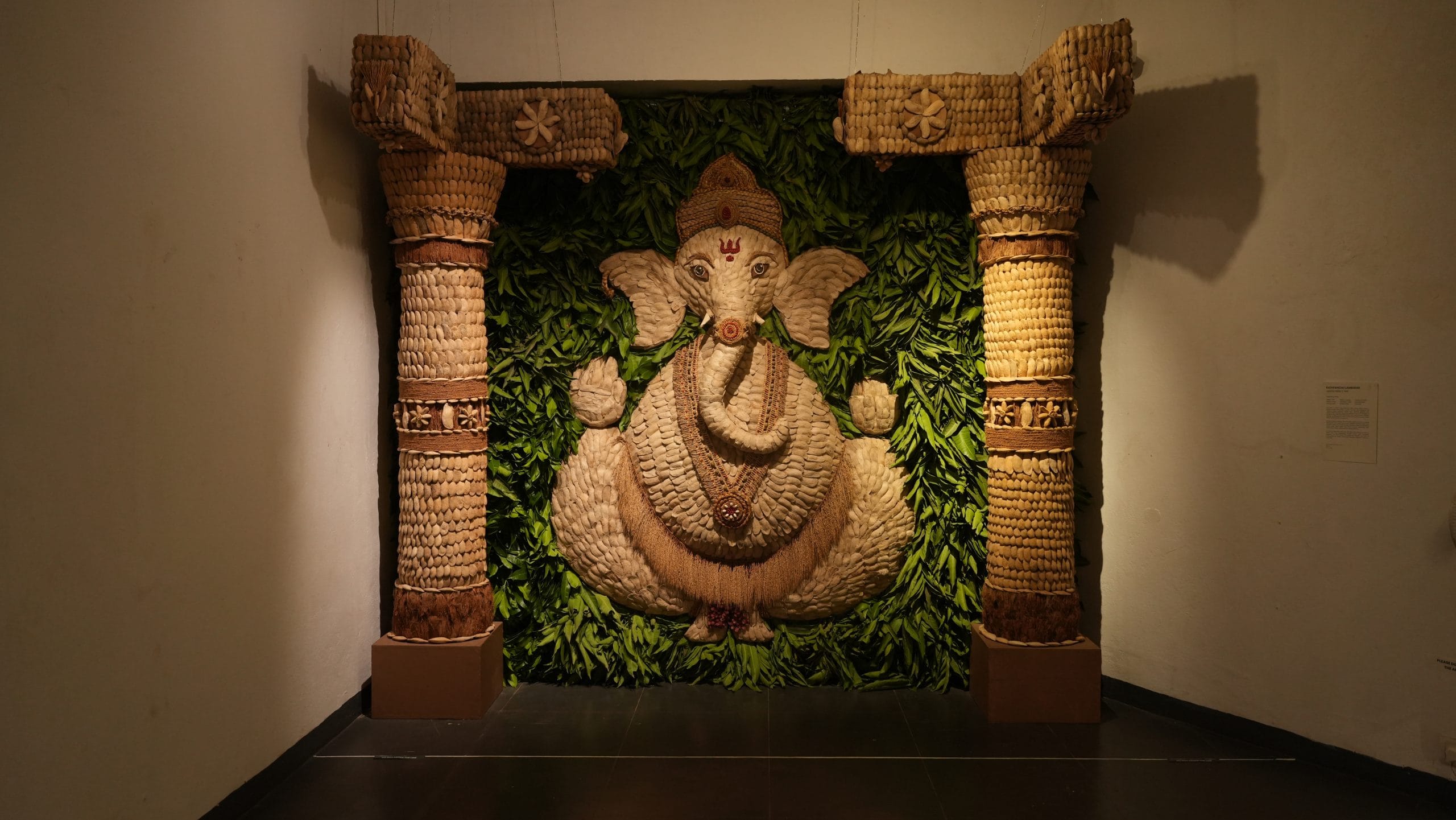
Several of the exhibits, meanwhile, blur the lines between high art and craft. Datta Naik, a matoli artist, has built a canopy for a Ganesha pandal from 1,500 dried mango seeds, with pillars made of discarded shells. A large canvas by Mithun Das is dedicated to Padma Shri Kalimullah Khan of Malihabad, who has grafted over 300 varieties onto a single tree. Akhlaq Ahmad, a former truck-signage painter, has produced a piece titled All India Permit, applying the stencilled lettering that long-haul lorries carry across state borders to the fruit itself. Ahashthya A, Sanket Mayekar and Gaurav Shet, core members of the MoG team, have projected 3D mapping onto a fibreglass mango, while recorded sounds of the ants and birds that share the tree’s ecology play alongside it; the piece argues that the mango does not belong to us alone.
Our mango obsession, Ghalib to Japan
Left to the human imagination, though, the fruit has done some heavy lifting.
“The mango controls the polarities of our cultural existence,” said Sopan Joshi in a lovely talk about his book, Mangifera Indica: A Biography of the Mango, published in 2024. He meant that the Buddha, who renounced everything (vairagya), and Kamadeva, the god of desire (anurag), sit at opposite ends of the spiritual register – and the mango appears in the iconography of both. Renunciation and longing, two of the oldest weights on the Indian mind, with the fruit parked on both shelves.
“Anurag”, predictably, has been the harder of the two to contain. Even a routine phytosanitary rejection turns into a national grievance. Last week, Japan banned the entry of kesar, Alphonso and langda from India after a consignment failed inspection. Every video about that story is filled with comments from scores of thirsting Indians demanding that the fruit be returned home and distributed among them, even as they recognise its diplomatic heft. Nepal, too, has reportedly banned the import of Indian mangoes following inspections that found pesticide residues in excess of the permissible limit. At least one report in the Nepali media says the restriction is intended to support the country’s domestic market. So Nepal too is leaving more mangoes for Indians.
In 2007, the United States lifted an 18-year FDA ban on Indian mangoes in exchange for India relaxing its import restrictions on 800cc Harley-Davidson motorcycles. A few weeks ago, Costco’s first shipment of Maharashtra kesars sold out in two hours across Washington, Las Vegas and New Jersey, with Washington’s lieutenant governor turning up at the Seattle launch to praise the fruit in person. At Indian Mango Mania 2025, hosted by the Indian embassy in Abu Dhabi last summer, mango sushi and mango chapli kebab were served. It’s a fruit so loved at home that the country has insisted the rest of the world love it back.
Whether the world loves it back is, in the end, immaterial. Our love and obsession are enough. Once again, we turn to Ghalib, whose masnavi Dar Sifat-e-Ambah is a 108-line poem in praise of the mango.
Mujh se poochho, tumhe’n khabar kya hai
Aam ke aage ney-shakar kya hai…
Ya ye hoga ke fart-e rafa’at se
Baagh-baanon ne baagh-e jannat se
Angabeen ke, ba hukm-e rabb-in-naas
Bhar ke bheje hain sar-ba-mohr gilaas
“Ask me — what would you know? A mango is far sweeter than sugarcane. Or perhaps, from the great heights above, the gardeners of heaven’s orchards have sent, by the order of the Lord, wine in sealed glasses.”
By Ghalib, if the mango is indeed wine, we are a country of drunkards.
This article is part of the Goa Life series, which explores the new and the old of Goan culture.
Karanjeet Kaur is a journalist, former editor of Arré, and a partner at TWO Design. She tweets @Kaju_Katri. Views are personal.
(Edited by Prashant Dixit)