






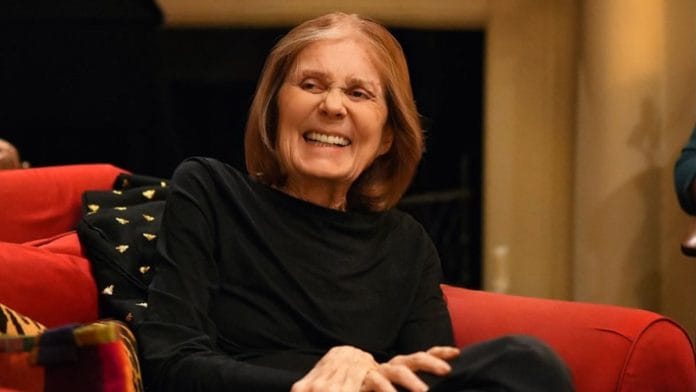

For decades, women’s magazines across the world had perfected the art of telling women how to be good mothers and wives — how to keep a husband happy, make a home beautiful, raise children, lose weight and look younger. Then, in 1971, fierce feminist Gloria Steinem helped launch Ms., and the magazine asked a far more destabilising question: What if the problem was not that women were failing at womanhood, but that the terms of womanhood themselves were rigged?
For Steinem, women’s inequality was never just private misfortune or an unfortunate fact of life. When she died Wednesday at 92 at her home in New York, she left behind something larger than a body of feminist writing or a catalogue of political causes. The poster girl of second wave feminism, Steinem embellished the movement for over half a century with its language, its magazine, its marches and, most importantly, a recognisable face.
The first wave of feminism, which gathered force in the 19th and early 20th centuries, fought primarily for women’s formal political and legal rights, most famously the right to vote. The second wave, emerging in the 1960s, pushed the argument into the terrain of work, sex, marriage, motherhood, domesticity, and reproductive freedom — issues that had long been compartmentalised as women’s problems. They became matters of public argument partly because women like Steinem insisted on dragging them out of the private sphere.
She made women feel that their lives were not small subjects. That someone was standing up for them and repeatedly questioning the supposedly natural arrangement that benefited men disproportionately.
For a young woman growing up decades later, Steinem could represent something simpler. I remember encountering her first as a name that seemed to keep appearing wherever women were arguing about the size of their lives — in books, magazine essays, conversations about careers and marriage and what women were supposed to want.
The possibility contained in the woman making those arguments stayed with me. Here was someone who had decided that questions about women’s lives were serious enough to devote an entire life to. She was curious about power, angry about injustice, ambitious about her work and completely uninterested in apologising for any of it.
For girls growing up with a thousand small instructions about being nice, desirable, sensible and accommodating, Steinem offered another language. You could be difficult. You could be angry. You could ask why. You could refuse the life that had been laid out for you and build another one.
View this post on Instagram
‘The personal is political’
Steinem became a face of feminism at a moment when feminism itself was still being treated as an affront to respectable womanhood.
In 1963, she went undercover at New York’s Playboy Club, working as a Bunny waitress and documenting the low pay, humiliating conditions and sexualised environment in which the women worked. The resulting article, “A Bunny’s Tale”, made her famous in America. It also exposed one of the traps that would follow her throughout her career: people were often more interested in Steinem’s appearance than in what she had written.
She kept writing anyway.
In 1969, at a New York abortion speak-out, she publicly discussed the abortion she had undergone in London at 22. It was an act that was both intensely personal and politically consequential: a woman was making public what women had been taught to conceal.
The great achievement of second-wave feminism was that it widened the definition of discrimination. It was no longer enough to ask whether a woman could legally enter a profession. Feminists began asking why women were paid less, why her unpaid domestic labour was invisible, why sexual violence was treated as a private tragedy, why reproductive decisions could be controlled by governments and men, and why the home itself could be a site of unequal power.
Her feminism at its strongest was an argument about power and who gets to make decisions about women and their work, their bodies, their choices.
Her most enduring idea remains “the personal is political”. It sounds almost commonplace now but it wasn’t when she helped popularise it from a Carol Hanisch essay of the same name. The phrase captured one of feminism’s most radical insights: that what happens inside a marriage, a bedroom, a workplace or a kitchen can reveal the workings of a much larger, rigged system. Then she flipped the phrase.
Steinem’s preface to Revolution from Within: A Book of Self-Esteem, she argues that it is time “turn the feminist adage around” to “the political is personal.”
Also Read: Hijab doesn’t become progressive just because a woman chose it
MeToo and Trump
Feminism has never been a finished doctrine, and Steinem herself was not immune to its arguments or corrections. The third wave of feminism, emerging in the 1990s, challenged some of the second wave’s blind spots around race, sexuality, identity and whose experiences counted as representative.
The criticism followed her, too. She was accused at various points of representing a feminism that was too white, too middle-class, too focused on women like herself. But Steinem’s politics evolved, and her willingness to listen to challenges from African-American feminists and other movements became an important part of that evolution.
Retirement did not seem to interest her.
In an interview with The Guardian a decade back she said: “I’m going to live to 100. I’m never going to retire. Would I retire from life? This is my life!”
When the fourth wave in the social-media age took many of those arguments online, Steinem turned up wherever the old questions acquired new forms.
And when the MeToo movement exploded in 2017, in an interview with Ms., Steinem argued that the cumulative effect of women coming forward was crucial: women who might not have been believed individually were now being believed collectively. But she had a warning.
“The MeToo campaign is an example of social media at its best. But also online, a hugely disproportionate number of women are harassed, threatened, photographed illegally, and trolled, sometimes even in life-threatening ways—often young women, and especially those who dare to criticize the woman-hatred in computer games or otherwise challenge other masculinity,” Steinem had said. “They are in danger.”
Donald Trump gave Steinem another version of the same fight. His election in 2016, she said, made it harder for anyone to pretend America had entered a “post-racist, post-feminist world”. She also said that the fact that the US hasn’t had a female President is a “counter to the definition of democracy.”
And then there was the extraordinary sight of Steinem, then 82, standing before hundreds of thousands of people at the Women’s March in Washington the day after Trump’s inauguration.
“Sometimes we must put our bodies where our beliefs are,” she told the crowd.
It was an apt sentence for a woman who had spent her life moving between journalism and activism, between the written word and the physical work of organising. The march was not simply a protest against one president. For Steinem, it represented a feminism that had become too large to belong to one generation.
Even before her death, Steinem remained a visible presence at rallies, campuses and political campaigns. The parted hair, the aviator glasses, the calm voice became visual shorthand for an era when saying “I am a feminist” could still be treated as a provocation.
The revolution she helped name is unfinished. But the vocabulary she gave it is now part of women’s lives across the world.
Views are personal.