






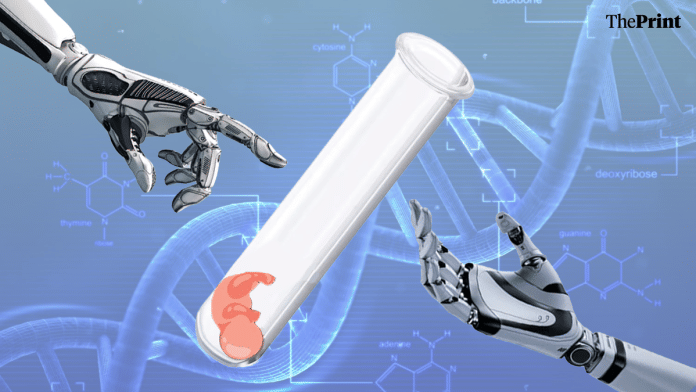


Medical science has transformed how families are created. For thousands of couples, assisted reproductive technology offers hope where nature sometimes cannot. IVF clinics now routinely create, preserve and transfer embryos, while cryopreservation allows prospective parents to postpone pregnancy for years. Yet as reproductive technology has advanced rapidly, the law has struggled to keep pace.
That gap has come into sharp focus with the recent Gurugram IVF controversy involving Rahul Rathore and Meenu Rathore. The couple alleged that DNA tests showed the twin girls born after fertility treatment were not biologically related to them. The matter is now the subject of legal proceedings. The episode is a reminder that failures in assisted reproduction can affect identity, parenthood and family itself.
The growing use of assisted reproductive technologies means Indian courts will inevitably be called upon to answer questions the law hasn’t addressed: who decides the fate of frozen embryos when intending parents separate, divorce or one of them dies?
With assisted reproductive technology becoming more common, disputes involving fertility clinics will become more frequent. Some will involve negligence; others may concern improper storage, destruction of embryos, mistaken implantation, or disputes over parentage. Each will require courts to balance medicine, ethics and law in ways that traditional legal principles were never designed to address.
The Supreme Court recently took an important step in Vijaya Kumari S. & Another v. Union of India & Others (2025), holding that couples who had frozen embryos before the Surrogacy (Regulation) Act, 2021 came into force could not be deprived of the opportunity to pursue surrogacy merely because they had subsequently crossed the statutory age limit. The judgment recognised that rights lawfully created under the earlier legal regime could not simply disappear because Parliament later introduced age-based restrictions.
Is a frozen embryo property? Is it a person? Or does it occupy a legal space of its own, beyond the reach of traditional family and property law?
That decision addressed a dispute between intending parents and the State. But what happens when the dispute is between the genetic parents themselves?
Also read: India’s dilemma with AI-driven IVF—law, data, and a regulatory vacuum
The legal status of a frozen embryo
Indian law has long recognised certain rights in favour of a child already conceived and developing within the womb. Under the Hindu Succession Act, 1956, a child en ventre sa mère is treated as already in existence for inheritance purposes, provided the child is subsequently born alive. Similarly, the Transfer of Property Act, 1882 permits property to be transferred for the benefit of an unborn person. Criminal law also recognises the protection of pregnancy by penalising acts that unlawfully cause miscarriage or prevent the birth of a viable child, subject to the Medical Termination of Pregnancy Act, 1971.
An embryo created through IVF fits neither of the traditional legal categories available to courts. It is not an unborn child developing within the womb, nor is it merely biological material capable of being bought, sold or transferred like ordinary property. It occupies a legal space somewhere between the two.
This explains why disputes concerning frozen embryos have proved so difficult across jurisdictions.
Property law offers only a partial answer. Family law offers another. Fundamental Rights relating to privacy, dignity and reproductive autonomy introduce an altogether different set of considerations. None of these legal disciplines, viewed in isolation, completely resolves the problem.
The first question, therefore, is not who should control the embryo, but what it represents in law.
Treating it as ordinary property produces troubling consequences. Property may ordinarily be sold, gifted, transferred, abandoned or inherited. Few would suggest that frozen embryos should be capable of unrestricted commercial dealing merely because they contain identifiable genetic material.
The opposite approach is equally problematic. If every embryo were treated as a legal person from the moment of its creation, decisions relating to storage, donation for approved research or even the natural expiry of cryopreservation periods would become legally impossible. Every fertility clinic would find itself preserving legal persons rather than reproductive material.
The more accurate understanding is that a frozen embryo represents biological material possessing the potential for future human life without currently enjoying independent legal personality. That intermediate status explains why legislatures across the world have generally chosen to regulate embryos through statutory safeguards rather than by recognising either unrestricted ownership or complete legal personhood.
Indian law adopts the same broad approach. Rather than attempting to define the legal status of an embryo, Parliament has concentrated on regulating the processes through which embryos may be created, stored, preserved and utilised. The law carefully prescribes who may access assisted reproductive technology, the obligations of fertility clinics and the conditions governing the storage and use of embryos. What it deliberately avoids deciding is the larger philosophical question of who ultimately “owns” an embryo once it has been created.
That unresolved question lies at the heart of every dispute that follows.
Also read: Couples who had frozen embryos before enactment of surrogacy law not bound by age bar, says SC
Consent: The foundation and the problem
Recognising the need to regulate assisted reproduction, Parliament enacted the Assisted Reproductive Technology (Regulation) Act, 2021 alongside the Surrogacy (Regulation) Act, 2021. Together, the two statutes establish a comprehensive framework governing fertility clinics, ART banks, surrogacy procedures and the use of reproductive material.
They do not conclusively determine whether one genetic parent can compel the other to proceed with implantation. Nor do they clearly address what happens if consent is withdrawn years after embryos have been cryopreserved. Questions arising from divorce, separation or the death of one genetic parent remain largely unanswered.
Instead, the statutory framework rests on a principle that lies at the heart of assisted reproduction—continuing informed consent.
Before IVF treatment begins, both intending parents are required to execute detailed consent forms dealing with the creation, preservation and proposed use of embryos. These documents are intended to ensure that both individuals understand the medical process and voluntarily agree to it.
If they jointly decide to proceed with implantation, the legal position is relatively straightforward. If they jointly decide against it, the embryos may be dealt with in accordance with the applicable statutory framework and regulatory guidelines.
The difficulty begins when consent diverges. One partner may regard the preserved embryos as the last realistic opportunity to have a genetically related child. The other may no longer wish to assume the lifelong legal, emotional and financial responsibilities of parenthood.
The law now confronts two competing claims — the right to become a parent and the right not to become one. Both derive from the same principle of personal autonomy.
The same uncertainty extends beyond separation. Consider a situation where one genetic parent dies while embryos remain in storage, or where embryos continue to be preserved for many years before either partner seeks to use them. Can reproductive choices made years earlier continue to bind individuals whose circumstances have fundamentally changed? Can parenthood be initiated after death on the basis of consent recorded during life? Does reproductive autonomy survive the death of one genetic parent? The statutes provide no definitive answers.
How other courts have answered the question
Long before Indian courts were required to grapple with these questions, courts in the United States and Europe had already confronted disputes involving frozen embryos. What emerged was not a single legal principle but three distinct approaches, each reflecting a different understanding of reproductive autonomy.
The earliest and perhaps most influential decision came from the Tennessee Supreme Court in Davis v. Davis (1992).
The dispute arose after a couple undergoing divorce disagreed over the future of their cryopreserved embryos. The court declined to treat the embryos either as ordinary property or as legal persons. Instead, it recognised that embryos occupy a special legal category because they possess the potential for human life without themselves enjoying full legal personality.
More significantly, the court held that where one genetic parent wished to use the embryos and the other did not, the right not to become a parent would ordinarily prevail. Parenthood, the court observed, should not generally be imposed upon an unwilling individual merely because embryos had earlier been created with mutual consent.
A different approach emerged in Kass v. Kass (1998) before the New York Court of Appeals.
There, the dispute centred not on competing reproductive rights but on an agreement the couple had voluntarily signed before IVF treatment began. The agreement expressly dealt with the future of their frozen embryos if the marriage subsequently ended. The court held that such agreements should ordinarily be respected. Decisions taken jointly before treatment, when both parties shared a common intention, deserved considerable legal weight. The emphasis, therefore, shifted from competing rights to contractual certainty.
The most difficult case, however, reached the European Court of Human Rights in Evans v. United Kingdom (2007).
Natalie Evans had undergone treatment for ovarian cancer that left her permanently infertile. Before the treatment, embryos had been created using her eggs and her partner’s sperm. Before implantation could take place, the relationship ended and her former partner withdrew his consent. English law required continuing consent from both genetic parents throughout the IVF process. As a result, implantation became legally impossible.
The European Court acknowledged the profound personal hardship suffered by Evans. Yet it held that her former partner’s decision not to become a parent could not simply be overridden. Reproductive autonomy, the court observed, includes not only the freedom to have children but also the freedom not to have them.
These decisions illustrate that no universal legal solution has emerged.
The Indian constitutional position
Over the past two decades, the Supreme Court has consistently recognised that decisions concerning reproduction, family life and personal relationships lie at the heart of individual liberty protected under Article 21 of the Constitution.
In Suchita Srivastava v. Chandigarh Administration (2009), the court held that decisions concerning whether and when to have children belong primarily to the individual rather than the State.
The principle was significantly broadened in Justice K.S. Puttaswamy v. Union of India (2017), where a nine-judge Bench recognised privacy as a fundamental right. The judgment identified marriage, family, procreation and other intimate personal choices as part of the decisional autonomy protected from unwarranted State interference. It firmly placed personal dignity, bodily integrity and individual choice at the heart of that protection.
More recently, in X v. Principal Secretary, Health & Family Welfare Department (2022), the Supreme Court reaffirmed that reproductive autonomy cannot be confined within traditional notions of marriage or family. Every woman, the Court held, has the right to make decisions concerning her reproductive future with dignity and autonomy.
Together, these decisions provide an important legal foundation. They do not, however, resolve the dilemma presented by frozen embryos.
The law has always adapted to scientific progress, but usually after the science has already transformed society. Assisted reproduction is no exception. Medicine can now create, preserve and transfer the possibility of parenthood with remarkable precision. The legal principles governing those possibilities remain far less certain.
The question is no longer whether science can preserve the possibility of parenthood. It is whether the law is prepared to decide who has the authority to determine its future.
Jitendra Mohananey is an advocate and former corporate finance professional. He tweets @Mohananey. Views are personal.
(Edited by Prashant Dixit)