




As one travels east after crossing Siliguri — the Chicken’s Neck corridor — in North Bengal towards the Brahmaputra in Assam, one touches the Inner Line Permit regime dating to the Bengal Eastern Frontier Regulation of 1873, which marks the frontier with Nagaland. Across this contiguous stretch of India’s eastern frontier, three state governments have faced the same dilemma: how do you answer ethnic assertion without redrawing the state map?
Each has arrived at a territorial body. The Gorkhaland Territorial Administration (GTA) came in 2011, the Bodoland Territorial Council (BTC) in 2003 (renamed the Bodoland Territorial Region after the 2020 accord), and now the Frontier Nagaland Territorial Authority (FNTA).
Siblings or distant cousins?
On paper, the three look like siblings. In law and in practice, they are distant cousins. Placing them side by side tells us a good deal about the possibilities and limits of asymmetric federalism in India.
The first and most consequential difference is where each body gets its authority. The BTC is a creature of the Sixth Schedule. Its powers are in the Constitution itself. Dispur cannot legislate them away, and altering the Council’s size or jurisdiction requires Parliament to amend the Constitution. That entrenchment is its strength. It is also its weakness. The 2020 accord’s promise to expand the Council to 60 seats has waited on a constitutional amendment that has moved at a pace that can put a snail to shame.
The GTA and the FNTA, on the other hand, are both products of tripartite agreements given effect through state legislation. This makes them structurally fragile, because a legislature that makes a law can unmake it. The state can also paralyse the authority simply by not holding elections — and in the GTA’s case, elections were postponed for half a decade.
The FNTA’s legal position is more subtle. The Bill gives it the power to make laws, rules and regulations on 46 transferred subjects, subject to a prescribed state-level process and the Governor’s assent. In fact, the delay in enactment was on account of the Solicitor General’s reservations regarding a state legislature’s competence to hand over plenary law-making power through ordinary statute. The Ministry of Home Affairs concurred with that view. The FNTA’s “legislative” power is therefore best read as delegated legislation dressed in the vocabulary of autonomy.
Also read: Frontier Nagaland Bill should have made national headlines. A new model of autonomy
Article 371A and the Sixth Schedule
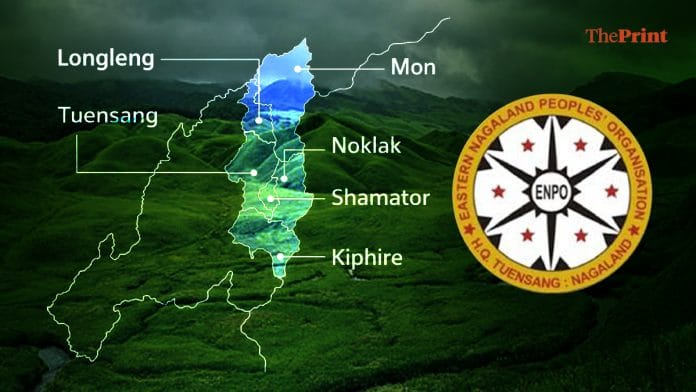
This raises an obvious question. If the Sixth Schedule gives constitutional protection, why did Eastern Nagaland Peoples’ Organisation (ENPO) reject the four Autonomous District Councils offered in 2011, along with a Rs 500 crore state package and a Rs 300 crore central one?
The answer is Article 371A. It already protects Naga religious and social practices, customary law and procedure, justice administered according to customary law, and the ownership and transfer of land and its resources. Thus, a Sixth Schedule council — say, for the Konyaks in Mon — would have allowed them to retain powers they already held, while wrapping them in a supervisory architecture answerable to the Governor. Additionally, Kohima would have found it easier to deal with four different councils than with one unified Territorial Authority.
What none of the three was given
It is equally instructive to look at what all three states withheld. None of the bodies controls the police or law and order. None has its own cadre of senior officers. None can borrow on its own account. In Nagaland, geology and mining remain exclusively with the state. That exclusion is politically loaded, given the long-running controversy over oil and minerals under Article 371A.
Also read: A win after years of demand & a poll boycott—ENPO & how it led the fight for Frontier Nagaland
The praxis of autonomy
The history of state formation offers a sobering precedent. The Gentlemen’s Agreement of 1956, which preceded the merger of Telangana with Andhra, promised a Regional Council, safeguards in employment and education, and a fair share of expenditure. Those assurances were progressively diluted. The result was the 1969 agitation and, eventually, bifurcation in 2014. The lesson is that safeguards that depend on the goodwill of a larger political majority can erode quietly, and the grievance they were meant to settle comes back.
Nagaland has its own version of this history. When the state was formed in 1963, Article 371A originally gave the Governor special responsibility for Tuensang for ten years and created a Regional Council, with a minister for Tuensang affairs. That arrangement was wound up in the 1970s. The grievance being addressed today is largely the one its withdrawal created. The FNTA, too, is to be reviewed after ten years. If progress is not substantial, ENPO will read the review clause as a door left open towards a separate state.
Also read: Centre’s ‘permanent’ solution to Gorkhaland is not so simple. Accords & discords for 38 yrs
Follow the money
In all three cases, autonomy is ultimately fiscal. All three share the same design flaw: the money passes through the state treasury.
The BTC received central packages of Rs 100 crore a year under the 2003 accord and Rs 1,500 crore under the 2020 accord. The GTA was promised Rs 200 crore a year by the Centre for three years. Beyond that, it has relied on state allocations, and disputes over recruitment and staffing have been as corrosive as those over money.
The FNTA improves on both, at least on paper. It gets a separate major sub-head in the state budget, so its allocation is visible and cannot be quietly reappropriated. Funds are to be allocated on a population-plus-area formula, which matters for a large and thinly populated region. Its accounts are subject to CAG audit.
The arithmetic of the Assembly
Political weight is the least discussed variable, and perhaps the decisive one. The Darjeeling hills send only three MLAs to a 294-member West Bengal Assembly, roughly one per cent of the House. Bodoland’s MLAs make up only a little over a tenth of Assam’s 126. Eastern Nagaland’s 20 MLAs make up a third of a 60-member House.
In this ‘third’ lies the real authority of the FNTA. No government in Kohima can easily ignore it, and it provides a protection that the Gorkhas never had. The Bill handles this with some care. The 20 MLAs sit in the Authority as ex-officio members without voting rights, which gives them a seat at the table without letting them dominate it. But it also plants the most likely rivalry: between the Chief Executive Member and the MLAs and ministers from the same districts. Both Kokrajhar and Darjeeling have seen versions of this contest.
The interface problem
The FNTA Secretariat will be headed by an IAS officer, preferably of Additional Chief Secretary rank and not below Principal Secretary. The BTC and the GTA have the same arrangement. In each case, the officer’s career incentives point to the state capital rather than to the regional body. I can vouchsafe from personal experience that when the political leadership at Nabanna is at loggerheads with the GTA, work just comes to a grinding halt.
The base is stronger for FNTA
One feature has no parallel in the other two. The FNTA is layered over existing Village Councils, Gaon Buras and tribal hohos rather than replacing them. The Bengal Eastern Frontier Regulation of 1873 and the exemption from Panchayati Raj continue. In Darjeeling, by contrast, the collapse of the three-tier panchayat system left a vacuum between the GTA and the village.
Also read: Has 6th Schedule outlived its use? Political deals do the work now, Darjeeling to Nagaland
Act East, or fence east?
The strategic case for the FNTA is easy to make. The eastern districts share around 215 km of border with Myanmar and have three notified trade points, at Longwa, Pangsha and Avakhung. Konyak kinship networks transcend the border. An empowered local authority could build the roads that turn these outposts into gateways to the Chindwin Valley.
But every other arm of policy points the other way. The Free Movement Regime was scrapped in 2024 and replaced with a pass system valid for seven days and ten kilometres. A fence costing about Rs 31,000 crore is being built along the border. The trade centres are, in practice, little more than sheds at the end of poor roads, and across the border lies a country at civil war. The FNTA can fix the Indian side of the road. It cannot fix border policy, and it cannot fix Myanmar.
The domino effect in Arunachal, Assam, Meghalaya and Manipur
Arunachal’s Tirap, Changlang and Longding were part of ENPO’s original map. They share the same tribes, the same terrain and the same grievance. Manipur’s Kuki-Zo will ask why a political settlement for eastern Nagas is not open to them. Karbi Anglong, Dima Hasao and the Garo Hills will ask for their own upgrades.
Yet the FNTA is harder to replicate than the floodgates argument suggests. It rested on unusual conditions: a single claimant organisation, a non-violent movement, no competing territorial claims, a cooperative state government, and a constitutional provision capacious enough to hold the arrangement. Manipur has none of these.
The three decisive factors
The lesson from Bodoland and Darjeeling is that the text of such arrangements rarely decides their fate. Three things do: whether funds arrive on time, whether officers answer to the regional body, and whether regional and state leaderships belong to the same political coalition. The FNTA has better fiscal visibility than either precedent, but weaker legal entrenchment than the BTC. Its future will be written in Kohima’s first budget, not in its 46 subjects, and in whether the administrative head of the Secretariat at Tuensang will retain the confidence of the CM in Kohima.
Yes, it is a challenge, but a challenge that can be overcome.
Editor’s note: This is the final part in a four-column series on political settlements in the Himalayan region of Darjeeling-Kalimpong and the eight northeastern states, now referred to as Ashtalakshmi — the eight sisters of wealth and prosperity.
Sanjeev Chopra is a Senior Fellow at the Centre for Contemporary Studies, Prime Ministers Museum and Library (PMML), New Delhi, where his Fellowship topic is Borders, Boundaries and Bluewaters of Bharat. He is also working on a biography of Padma Shri Major Bob Khathing, former Chief Secretary of Nagaland and India’s ambassador to Burma. Views are personal. He tweets @ChopraSanjeev. Views are personal.
(Edited by Prashant Dixit)