




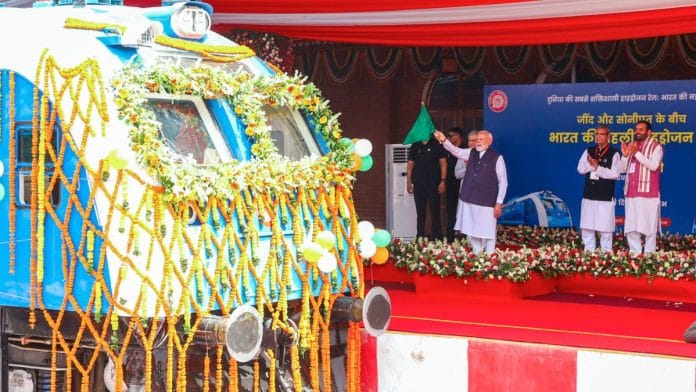

Last week another station was added in the journey for Atmanirbhar Bharat. PM Modi launched India’s first hydrogen-powered train. It was flagged off from Jind Station, Haryana. This locomotive will generate its own electricity, on board the train, using an advanced propulsion technology, with “dedicated hydrogen storage, refuelling and operational infrastructure.”
India in an elite club
Hydrogen trains are a step toward the decarbonisation of the railway systems. By flagging it off, India joins an elite club of five nations that have the engineering capability and battery cell technology to deploy such trains. Germany was the first country to introduce zero emission passenger trains powered by hydrogen way back in 2018, and was followed by Japan, China, and the US. Several other countries, including the UK and France, are testing out this technology.
Merely replacing diesel with hydrogen is not what it takes—a country needs to master several technologies simultaneously. First, the production of green hydrogen is required, which needs to be stored at very high pressures. Fuel cell technologies are still at nascent stages of development and high-power batteries are cost-prohibitive. Robust energy management systems need to be in place. Railway engineering systems need to be strong and safety certifications need to be spot on. Unlike electric trains, hydrogen trains also require an entirely new fuel ecosystem, as per the World Economic Forum.
Countries with vast rail networks, with long routes where electrification is expensive and diesel is a commonly used fuel, are prime candidates for hydrogen-powered trains. India is therefore a great testing ground for the feasibility of hydrogen-powered trains. India also has decades of experience designing locomotives, coaches, signalling and propulsion systems. Organisations like the Research Design and Standards Organisation have strong engineering capabilities, which mean that India didn’t have to start from scratch. Further, India’s coach and locomotive building capacities mean that engineers simply have to integrate the technologies and are not dependent on importing.
India also has a very strong railway engineering base. Public Sector Organisations such as BHEL, RITES, IRCON have decades of engineering expertise at their disposal.
Finally, the Indian Government is backing clean energy through policy decisions. The National Green Hydrogen Mission is expected to be key in steel, fertiliser, shipping, heavy transport industries. The idea is to reduce dependence on energy imports and become atmanirbhar in the energy sector. The recent uncertainty surrounding the war in West Asia has also led to a bigger push on energy self-reliance.
Also read: India’s first hydrogen train chugged off from Jind to Sonipat. How it works
Why does India’s achievement matter?
It’s not about becoming part of an elite club. Or being one of the first few countries to achieve this milestone. Rather it is more about demonstrating technological self-reliance. It’s about showing we can use our own resources to our own advantage.
By integrating hydrogen fuel cells, battery systems and railway engineering into a domestically developed platform, India has shown that it can participate in a frontier technology that only a few countries have developed.
This could also benefit India’s heavy industry sector, as the expertise developed here could be reused.
Also read: India can be ‘atmanirbhar’ if technology is its new religion
Net zero and hydrogen
Critics have pointed out that hydrogen is not really a net zero or a green fuel. At the point of delivery, the hydrogen train appears to be net zero, but until and unless the electricity used to generate the chemical reaction is truly green i.e. generated by solar and wind energy, the hydrogen is more ‘gray’ than ‘green’. Critics further argue that the manufacturing process used to produce hydrogen, which does not occur naturally, is largely dependent on carbon-heavy fossil fuels.
However, MIT experts have stated that the more the world starts depending on hydrogen energy, the more the process will get greener and cleaner. Emre Gencer, Principal Research Scientist at MIT, says, “If we get cheaper electrolysers, you will definitely see more green hydrogen coming online.” And cheaper energy storage would also help produce green hydrogen 24/7.
Solar and wind power are also not as “green” as critics believe. Solar panels are manufactured from the mining of rare earth materials which has its own carbon footprint. The turbines and giant fans used to garner and harvest wind energy are manufactured from lightweight high-carbon steels.
If all countries combine and share knowledge, hydrogen energy could rapidly become a clean and sustainable future of energy sufficiency. This is required to achieve self-sufficiency and meet the energy needs of 1.47 billion people.
Meenakshi Lekhi is a BJP leader and lawyer. Her X handle is @M_Lekhi. Views are personal.
(Edited by Theres Sudeep)
The Hydrogen train was the next day pulled by a diesel engine – jai ho ! if bridges can keep falling in the country, no harm when the the hydrogen engine fails – we can always improve it till it begins journey.
India will pat itself with this achievement while the world may go on to invent hydrogen powered train with operational speed of 700 km/h with 100 coaches.