





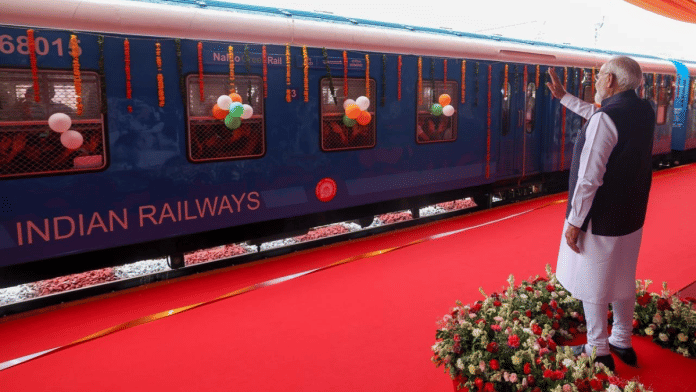


New Delhi: Prime Minister Narendra Modi flagged off India’s first hydrogen-powered train on 17 July; the journey covered 89 kms from Jind to Sonepat in Haryana. With this, India joined the small league of countries with hydrogen-operated railways, including Germany, Japan, China, the US and France.
The 10-coach passenger train runs on hydrogen fuel cell technology, a major step towards clean rail transportation, according to a press release by the government. This makes it significantly larger than most hydrogen trains globally, which are around three to four coaches long.
The train has also been designed, developed and manufactured entirely in India, designed by the Research, Designs and Standards Organisation and assembled at the Integral Coach Factory in Chennai.
Modi, while inaugurating the train, called it a successful example of the Make in India campaign. But what is hydrogen fuel-cell technology, and how was it operationalised in the Indian Railways?
What is a hydrogen train?
A hydrogen train basically runs on hydrogen fuel technology rather than diesel. This means that instead of burning fuel to generate energy and power its engine, a hydrogen train generates energy through an electrochemical reaction between hydrogen and oxygen.
This reaction happens inside a fuel cell, known as the Proton Exchange Membrane Fuel Cell. Here, hydrogen is split into protons and electrons. While the electrons convert into electricity and power the train’s engine, the protons react with oxygen, producing water vapour and heat as byproducts.
According to a government press release, the new railway is like an electric train in terms of its zero-emissions structure. It also doesn’t draw energy from overhead lines.
Aside from being cleaner and having fewer emissions than other trains, hydrogen also contains more energy than diesel. But one challenge with using hydrogen as a fuel is that it needs to be carried in high-pressure cylinders, since it is a gas. The Indian hydrogen train, therefore, carries storage cylinders with it to power the whole journey. Its fuel propulsion system can produce 1.2 MW of energy, enough to power the 10-coach train.
“For providing hydrogen for use in this train-set, a hydrogen plant has been conceived at Jind. In this plant, hydrogen is being produced using electrolysis, a process which is a key element of green hydrogen generation,” read the press release.
Alongside the hydrogen train, India also established one of the world’s largest hydrogen refuelling facilities in Jind, which can store nearly 3,000 kg of compressed hydrogen and includes hydrogen compressors, dispensing systems, technical support infrastructure and a standby compressor to ensure uninterrupted refuelling.
“Safety has been built into every layer of the project, from the design of the train and hydrogen storage cylinders to refuelling infrastructure, monitoring software and emergency response systems,” the press release added.
For future operations, the government plans to deploy a similar hydrogen fuel technology on trains on the Kalka-Shimla route, after the pilot Jind-Sonepat project is completed.
(Edited by Insha Jalil Waziri)