



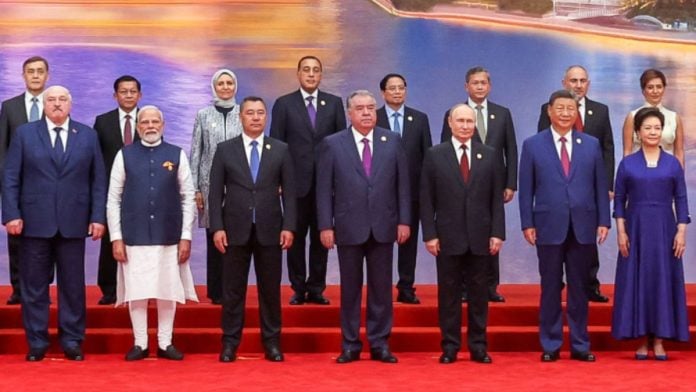
We have had a busy run-up to Diwali, and as everyone finishes gorging on their Diwali mithai, the country and the world are also seeing movements for change.
SIR anointed Leader of the Opposition Rahul Gandhi called for a rally, which became a comedy of errors. His rallies are less about political statements and, rather, are turning into a Comedy Circus, and it may now be addressed as the “Rahul Gandhi Show”.
The one at Ramlila Maidan will go down in history for producing political satire and increasing the Opposition’s comedy quotient. From pollution being blamed on vote chori, to former West Bengal chief minister Mamata Banerjee’s “Delhi Lootenge” gaffe, Congress President Mallikarjun Kharge provided another gem with his “Modi ka Baap bhi Jayega” remark, and then threatened his own audience to stay quiet.
“I’ll finish in five minutes if you stay quiet, else I’ll speak for an hour”, he had said.
No wonder, with such eminent emissaries of the Opposition parties, ABVP Ladakh swept the student polls, despite having paper ballots in action. I think of Rahul now and remember the childhood rhyme, “Cry Baby Cry, Poke your finger in your eye”.
Winds of change in oceans away
Seven seas away, some big headlines are being made. The US midterm elections were held on 3 November, throwing up some pretty significant results that will shape the balance of power in Washington during the second half of US President Donald Trump’s term.
The key contests are for all 435 seats in the House of Representatives and 35 seats in the Senate, alongside several governorships and state-level offices. These results are an important test of public confidence in the Trump administration and its policies, with implications for immigration, the economy, healthcare, foreign policy and the administration’s ability to push legislation through Congress.
The most consequential outcome is that the Democrats have made a remarkable comeback, winning control of both chambers of Congress, though the president and his power to veto still belong to the Republicans. They have secured at least 54 seats in the Senate, while two races remain unresolved.
The latest projections put their House strength between 251 and 268 seats. Democrats also made substantial gains in gubernatorial and state legislative elections, including victories in traditionally Republican strongholds such as Texas. The results point to voters’ dissatisfaction over the rising cost of living, the Iran war and the Trump administration’s governance, leaving even Vice President JD Vance blaming the Iran War for the Grand Old Party’s GOP’s midterm rout.
“Voters are pissed and planning to vote for the other guy,” Vance had said.
Democratic control of Congress from January 2027 will severely curtail Trump’s legislative agenda, increase congressional scrutiny of his administration and potentially reshape the political landscape ahead of the 2028 Presidential election.
Also read: Narendra Modi isn’t Donald Trump. India’s electoral math makes it harder to humble BJP
India-US ‘bhai bhai’
The jury is still out on the political ramifications for India. One would expect that India may get some negotiating space on trade and tariffs as Democrats increase scrutiny of Trump’s tariff policies. However, immediate relief is unlikely. On H-1 B visas and immigration policies as well, Indian professionals and students will continue to face uncertainty.
Whether defence and strategic ties and the bipartisan strategic partnership with India will endure, only time will tell. India’s defence and energy dealings with Russia, and sanctions related to our Russian oil purchase, could continue to affect India’s energy costs and economic interests. A weakened Trump administration may also bring the US-Pakistan relationship under the spotlight, although this does not necessarily translate into a more favourable policy with India.
India will engage in maintaining relationships across party lines in Washington. A Democratic-controlled Congress could bring a different emphasis, and with Rahul’s allegations and his political toolkit, the Democrats are likely to turn to some of their favourite subjects: human rights and civil liberties, etc.
It would be misleading to suggest that a Democrat controlled Washington automatically means a better relationship with India. The Joe Biden administration and sections of the Democratic Party were often critical of India’s policies.
The larger point is that both Democrats and Republicans pursue American national interests in somewhat self-centred ways. India, too, has to act in its own national interest, just like any other nation.
India and Israel’s new dimensions
Israel’s October elections have resulted in a hung Parliament. Let us see who President Isaac Herzog calls upon to form a government. For India, the immediate impact is likely to be limited because the India-Israel relationship is now institutionalised through defence, intelligence, cybersecurity, AI, agriculture and technology cooperation, rather than on the personal camaraderie of its leadership.
However, a change of leadership could alter Israel’s regional posture, particularly on Gaza, Iran and the Arab World, with implications for New Delhi’s delicate balancing act between Jerusalem, Tehran and its important partners in the Gulf.
As part of the GeoEconomic Hub initiative, I chaired the Council for International Economic Understanding’s (CIEU) roundtable where we discussed the ramifications for India of these decisive elections in the geopolitical arena. While there is huge potential with respect to India-Middle East-Europe Economic (IMEC), etc., the shadow of the latest developments persists over all such projects.
Non-alignment and the neo-non-alignment
I was invited to speak at the book launch of Professor Happymon Jacob’s India After Nonalignment. While I couldn’t make it to the event, I had received an advance copy and found it an interesting read.
Jacob is the founder and director of the Council for Strategic Defence Research (CSDS). A New Delhi-based think tank providing strategic analysis and policy recommendations for governments, institutions and businesses. In his book, Jacob argues that India’s longstanding desire to make its own decisions is not the ultimate objective.
I disagree with his analysis that India’s ambition is to become an independent centre of power that can shape international affairs on its own terms. The India pole represents the desire of every country from the Global South to have strategic autonomy, which explains India’s insistence on independent decision-making.
The idea of the India pole asks what New Delhi seeks to achieve with that independence. While I agree with Jacob about the idea of “functional multipolarity”, a country does not necessarily have to match the largest powers in every measure of strength to exercise consequential influence in particular regions or on particular issues.
Jacob also highlights how India’s relationships with the US, Russia and China illustrate the practical challenge of maintaining freedom of action while building geopolitical partnerships. He also examines India’s preference for flexibility, issue-by-issue engagement and avoiding rigid, exclusive commitments. He has also nuanced the fact that this approach is not without its share of costs, recognising that competing commitments can eventually become incompatible, forcing India to make difficult choices.
Non-alignment and multilateral engagements and/or multi-alignment are two sides of the same coin. While non-alignment defines foreign policy by what a nation avoids, multilateralism or multi-alignment focuses on identifying areas of potential cooperation and achieving them through negotiation.
Also read: The real reason BJP is quibbling over the size of INDIA bloc’s rally
Multi-alignment is the need of the day
Lines from a popular song: each friend is important. You cannot live in an isolated jungle is one thing I have learnt in my political career. Similarly, India cannot remain isolated on a geopolitical stage; rather, it must forge alliances that suit the needs of 1.4 billion people.
Modi has followed a policy wherein he stands for India first, without leaving the country alone. Today’s international environment is different from the times of non-alignment. Power is distributed across multiple centres. Economic interdependence, technological competition, energy insecurity and regional conflicts have made it difficult for any country to pursue all its interests through one relationship alone.
Under PM Modi, India seeks to operate in a more complex geospatial environment through an approach that would better be described as multi-alignment.
There is a distinct shift. Non-alignment was about not joining rival power blocs. Multi-alignment places greater emphasis on actively cultivating relationships with different powers, in different fields, while retaining the freedom to make independent decisions.
For example, India needs to deepen its strategic partnerships with the US, and simultaneously maintain longstanding defence and energy ties with Russia, engage Iran on connectivity and regional interests and deal with China wherever necessary in a positive way. These relationships are not identical, nor are they free of contradictions.
But India and Modi do not believe that every relationship must be reduced to a single test of loyalty. Sometimes, during a war-like situation, correct coordinates aren’t provided, and at other times certain codes are not made available to India for its defence decisions. Therefore, India has to choose the defence supplier that will not hesitate to share these codes.
India has had an old, traditional and trustworthy relationship with Russia. Therefore, we can’t sacrifice our own energy and defence needs to support the “No One’s War” in Ukraine. India has had to withstand immense pressure from Western partners to maintain its strategic autonomy and the right to maintain its own friendships, and was pulled to the Tethers End to take sides, which was politely rejected by India.
The same principle applies to Iran. India has important interests in regional connectivity and access to markets through Chabahar and such projects. Sanctions by the US are really between them, not our problem.
India remains an important partner for the US as a market for defence and trade of products. The relationship offers significant opportunities since both are democracies with no intention of going any other political way. But a partnership is strongest when both sides recognise the sovereignty and independence of the other.
China and India signify the phrase “it’s complicated”. But every dispute cannot be resolved through confrontation alone. Economies are interconnected, with so many components for our industries arriving from China, and thus it remains a strategic partner.
Ultimately, India’s foreign policy is inherently citizen-centric, making self-reliance the foundational strategy despite its structural challenges.
India’s decisions must be evaluated against India’s circumstances and interests rather than being determined automatically by the preference of another capital. It is easy to discuss geopolitics in terms of summits, strategic partnerships, military exercises and diplomatic declarations. But the purpose of foreign policy must extend beyond the diplomatic table and into the homes of the 1.4 billion people who look up to our leader.
Modi and the art of being aligned to India’s goals run through the spine of India’s history and culture, which provides for its civilisational heft. India has repeatedly showcased its capacity for effective multilateral engagement through landmark diplomatic achievements like securing the African Union’s permanent entry at the 2023 G20 Summit and hosting successive Voice of the Global South Summits.
This systemic leadership is further reinforced by practical global contributions, including its robust disaster relief operations, Coalition for Disaster Resilient Infrastructure (CDRI), global clean energy frameworks, Vaccine Maitri, International Solar Alliance (ISA), and high-stakes evacuation missions.
Thus, non-alignment is not a dead word, but it’s taken the form of multilateral engagements or multi-alignment in a multipolar world. India’s values and interests are not opposite, and they are aligned with its goals and interests.
Meenakshi Lekhi is a BJP leader and lawyer. Her X handle is @M_Lekhi. Views are personal.
(Edited by Saptak Datta)